Why does a futures price drift from the spot price? Mark, index and basis
Short answerA futures contract trades in its own market, so its price can differ from spot. The gap is the basis: futures minus spot price. A dated future must close it by expiry, when it settles against the index. A perpetual never expires, so funding pulls it toward the index, though on Binance a small discount still leaves longs paying the base rate. Binance uses three prices (as of 26 November 2026): the last price traded, an index price averaged across spot exchanges, and a mark price built from both, which sets liquidations. In the synthetic example below, the last price drops 1.79% under the index for seconds while the mark price dips 0.19%: a stop on the last price fires, but a 50x long survives.
Valmy noteValmy v1 trades Binance USDⓈ-M perpetuals settled in USDT, not dated futures, and its order flow places market orders. The stop orders discussed here are Binance order types a trader would place at Binance directly. Valmy backtests run on closed five-minute candles and, according to the specification as of 26 November 2026, import Binance mark prices for futures. Use this lesson to tell which of Binance's prices a stop, a liquidation or a backtest is watching.
Last price, index price and mark price#
One futures contract has three prices, and each has a job. The last price is the price of the most recent trade in the contract. The index price is an estimate of the spot price, averaged across several exchanges. The mark price is Binance's estimate of the contract's fair value, built from the index, the contract's order book and the funding rate. Binance's FAQs (updated 16 November and 26 September 2026) assign them as follows:
- Last price: realized profit and loss, because that is where trades actually happen. A stop order can also trigger on it.
- Index price: Binance says to treat it as the spot price. It feeds both the mark price and the funding rate.
- Mark price: unrealized profit and loss and liquidation. Binance says it uses the mark price to avoid unnecessary liquidations and to resist manipulation.
The split matters because the last price of a single contract can be pushed around by one large order in a thin book, while an index drawn from many spot markets is much harder to move. What does leverage change, and when is a position liquidated? shows how the mark price sets a position's liquidation point.
How Binance builds the BTCUSDT index (as of 26 November 2026)#
Binance's price index for a USDⓈ-M contract is a weighted average of the coin's spot price on several exchanges: index = sum of (weight × price) across the venues, with the weights adding up to 100%. On 26 November 2026 the BTCUSDT index page listed eight spot sources and weights:
| Exchange | Weight shown |
|---|---|
| Binance | 43.47% |
| OKX | 13.04% |
| Coinbase | 13.04% |
| KuCoin | 6.52% |
| MEXC | 6.52% |
| Bitget | 6.52% |
| Bybit | 6.52% |
| Gate.io | 4.34% |
The displayed weights add up to 99.97% because of rounding. Binance's own spot market carries the largest weight by far, so the index is not independent of Binance. The FAQ adds that Binance may include the futures contract's own last price as a constituent at its discretion, and that it can change the constituents without notice. It does not say how the weights are chosen.
Binance protects the index against a bad feed in three ways:
- Deviation cap. If one source's price is more than 3% from the median of all sources, Binance caps it at 3% above or below that median. For BTCUSDT, ETHUSDT and a few other major symbols the cap is 1%.
- Stale sources. A source that cannot be reached, or has not updated in five minutes, gets zero weight.
- Last Price Protected. If Binance cannot get stable reference prices, it temporarily bases the index on the contract's own latest trades, within limits, until conditions return to normal.
Calculating an index price from venue prices#
Suppose the eight venues quote these prices at one moment (synthetic prices, Binance's displayed weights):
| Exchange | Weight | Price (USDT) |
|---|---|---|
| Binance | 43.47% | 100,010 |
| OKX | 13.04% | 100,000 |
| Coinbase | 13.04% | 99,990 |
| KuCoin | 6.52% | 100,020 |
| MEXC | 6.52% | 100,005 |
| Bitget | 6.52% | 99,995 |
| Bybit | 6.52% | 100,015 |
| Gate.io | 4.34% | 99,980 |
Index = sum of (weight × price) ÷ 99.97% ≈ 100,004.46 USDT. A simple average of the eight prices would give 100,001.88. The weighting pulls the index toward Binance's own price.
How the deviation cap limits a bad price#
The deviation cap stops one faulty source from dragging the index far. Continuing the example, suppose Gate.io's feed prints 104,000, about 4% above its previous price. The median of the eight sources becomes 100,007.50. The BTCUSDT cap of 1% limits Gate.io's value to 1.01 × 100,007.50 = 101,007.575. The index rises by about 44.61 USDT to 100,049.07, instead of the 174.52 USDT it would have risen if the bad price had been used as is.
How Binance calculates the mark price#
Binance's FAQ gives the mark price of a USDⓈ-M perpetual as the median of three numbers, the one in the middle:
Mark price = median(Price 1, Price 2, contract price)
- Price 1 = index × (1 + last funding rate × time until next funding ÷ funding interval). It is the index plus the part of the current funding rate that has yet to be paid.
- Price 2 = index + the 30-second moving average of the basis, where the basis is sampled every second as the midpoint of the best bid and best ask minus the index. It is the index plus the contract's recent premium, smoothed.
- Contract price is the last price.
In calm markets the three are close, and the median can be the last price itself. When the last price jumps away from the other two, the median switches to one of the index-based prices. Binance adds that in extreme conditions it can set the mark price equal to Price 2, and that it can put a symbol into reduce-only mode if the mark price moves abnormally fast. For dated quarterly contracts the mark price is the index plus the same 30-second average basis, and in the last 30 minutes before delivery it becomes an average of the index.
Calculating a mark price step by step#
Take an index of 100,000.00 USDT, a last funding rate of 0.0100% on an 8-hour interval with 6 hours to go, and a 30-second average basis of +12.00 USDT.
- Price 1 = 100,000 × (1 + 0.0001 × 6 ÷ 8) = 100,007.50.
- Price 2 = 100,000 + 12.00 = 100,012.00.
- If the last trade is 100,010.00, the median of (100,007.50, 100,012.00, 100,010.00) is 100,010.00, the last price.
- If the last trade is 99,400.00, the median of (100,007.50, 100,012.00, 99,400.00) is 100,007.50. The spike is ignored.
A short spike reaches the mark price only through the 30-second average. Five seconds with a combined basis of −5,850 USDT move that average by −5,850 ÷ 30 = −195 USDT.
Why liquidation uses the mark price#
A position is liquidated when its mark price reaches its liquidation price, not when the last price does. Binance's liquidation FAQ (updated 16 November 2026) says it uses the mark price to avoid unnecessary liquidations and to combat manipulation. The concern is that one large order in a thin book could push the last price through other traders' liquidation prices and set off forced selling. The mark price is not a guarantee, though. The same FAQ warns that in a very volatile market the mark price itself can jump past a liquidation price within a second, so the position is closed at a worse level than calculated.
Worked example: a last-price spike while the mark stays near the index (synthetic data)#
In this synthetic example the contract's last price drops 1.79% below the index for a few seconds while the mark price dips only 0.19%. A stop that triggers on the last price fires and sells near the bottom, while a stop that triggers on the mark price, and a 50x long's liquidation, are never reached. The data were designed to show a spike. Assumptions:
- 120 seconds of one-second data. The index wanders between about 99,979 and 100,019 USDT. The last price normally sits a few USDT above the index.
- In seconds 60 to 64, a burst of selling into a thin book pushes the last price 700, 1,450, 1,800, 1,300 and 600 USDT below the index before it returns.
- The best bid and ask midpoint equals the last price. The last funding rate is 0.0100%, with about 3 hours to the next 8-hourly settlement.
- The mark price is computed each second with Binance's formula.
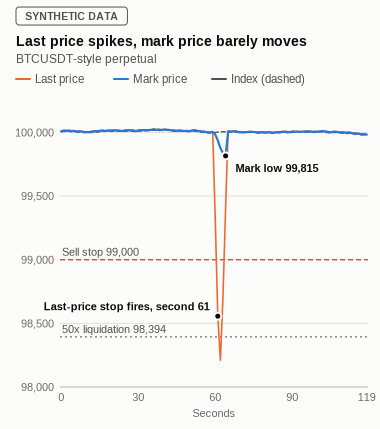
What happens, second by second:
- Seconds 60 to 64. The last price falls to 98,210.30 at second 62. It is now the lowest of the three inputs, Price 1 is the highest, and the median is Price 2, whose 30-second average absorbs only part of the spike. The mark price bottoms at about 99,815 at second 64.
- Second 65 onward. The last price is back near 100,010. Price 2 is still depressed, because the spike stays in its 30-second window, so it is now the lowest input and the median becomes Price 1. The mark price returns to the index at once and ends the window at about 99,983.
What a CONTRACT_PRICE stop and a MARK_PRICE stop would do#
A trader is long 0.05 BTC from 100,000 USDT with a sell stop-market order at 99,000. On Binance USDⓈ-M, the trigger price type workingType is either CONTRACT_PRICE, the last price and the default, or MARK_PRICE, as What is a stop order, and why can it fill worse than its trigger price? explains.
- CONTRACT_PRICE. The last price prints 98,556.21 at second 61, below 99,000, so the stop fires. Suppose its market order fills at the next trade, 98,210.30. The loss is 0.05 × (100,000 − 98,210.30) ≈ 89.49 USDT. By second 65 the price is back above 100,000, and the trader is out of the position.
- MARK_PRICE. The mark price never goes below about 99,815, so the stop never fires. The position is still open at second 119.
- Price protection. Binance's optional
priceProtectsetting lets a stop-market order trigger only when the mark and last prices are within a threshold, 3% for BTCUSDT on 26 November 2026. At second 61 they were about 1.4% apart, so price protection would not have stopped this trigger. - Liquidation. A 50x long of the same size from 100,000 has a liquidation price of about 98,393.57 USDT. The last price went below it, but the mark price did not, so the position would not have been liquidated.
The comparison can come out the other way. When a fall is real, the index falls too and the mark price follows within seconds. A mark-price stop then fires a little later than a last-price stop, and its market order still trades in the contract's own book, which may have fallen further. A last-price stop reacts faster to a real drop but also fires on spikes like this one. Neither choice is better in every case.
Basis: futures minus spot#
Basis is the futures price minus the spot price, usually the index. As a percentage, basis ÷ spot. A positive basis means the future trades at a premium, a negative one at a discount. What drives it depends on the contract:
- A dated future settles against the index at expiry, so its basis must shrink to about zero by then. Before then it is roughly the price of holding the position to expiry, compared across contracts by annualizing it: percentage basis × 365 ÷ days to expiry.
- A perpetual has no expiry, so funding takes the place of convergence. On Binance, funding stays at the 0.0100% base rate, paid by longs, while the average premium is between −0.04% and +0.06%: at −0.020%, longs still pay +0.010%, and shorts pay longs only below −0.05%. That average is not the basis you see at one moment. It comes from a premium index, which compares the prices a sizable order would get in the perpetual's book with the index, weighted over the whole funding interval, as What is a perpetual future, and what does funding do? explains.
Calculating an annualized basis for a quarterly contract#
On 26 November 2026 Binance listed a BTCUSDT quarterly contract delivering on 25 December 2026 at 08:00 UTC, 29 days after 26 November at 08:00 UTC. Suppose the index is 100,000 USDT and the quarterly trades at 100,850 (synthetic prices).
- Basis = 100,850 − 100,000 = 850 USDT, or 0.85%.
- Annualized = 0.85% × 365 ÷ 29 ≈ 10.70% a year.
For comparison, a perpetual long that paid the base funding rate of 0.0100% at every 8-hour settlement would pay 0.0100% × 3 × 365 = 10.95% of its notional a year. That is an illustration, not a quote: the quarterly's 10.70% is locked in by a trade held to delivery, while funding is recalculated every period and can rise, fall or turn negative. Both are a price for holding leveraged exposure over time, paid in one case through the basis and in the other through funding.
Cash-and-carry in one paragraph#
A cash-and-carry trade tries to earn the basis without betting on direction: buy 1 BTC on the spot market at 100,000 and short 1 BTC of the quarterly at 100,850. At delivery the quarterly settles at an index-based price. If the coin is sold at that same price, the result is 850 USDT whatever happens in between: at 90,000, the spot coin loses 10,000 and the short gains 10,850; at 120,000, the coin gains 20,000 and the short loses 19,150. Binance's base taker fees for the three trades (spot purchase at 0.100%, futures short at 0.0500%, spot sale at about 100,000) would take about 250 USDT of that. The risks are practical: if the price reaches 120,000 before delivery, the short leg shows a 19,150 USDT loss that must be covered by futures margin, even though the spot coin has gained as much, and an under-margined short can be liquidated before the trade completes. The coin also sits on an exchange, with the custody risks in What do I own when I hold crypto on an exchange?. A working paper from the Bank for International Settlements (Schmeling, Schrimpf and Todorov, 2023) found that in their data this crypto carry averaged above 10% a year for bitcoin and ether, reached up to 60% a year, and varied strongly over time. The authors link it to small investors chasing leveraged exposure in booms and to scarce arbitrage capital, note that the trade suffers margin spikes and liquidations in drawdowns, and report that high carry has predicted crashes. Valmy v1 offers perpetuals only, so the dated leg is outside its scope.
What could change the conclusion about mark, index and basis?#
The mark price shields positions from most single-contract spikes, but its protection depends on its inputs, and the basis can behave very differently from one period to the next.
The index is only as good as its sources. Binance's own spot market carries about 43% of the BTCUSDT index weight. A problem shared by several venues, or on Binance Spot itself, would reach the index and the mark price.
Protections change the formula in a crisis. In an outage the index can fall back on the contract's own trades under Last Price Protected, and in extreme conditions Binance can set the mark price equal to Price 2, change index constituents or switch a symbol to reduce-only.
The mark price can still gap. Binance's liquidation FAQ warns that the mark price can jump past a liquidation price within a second in a volatile market.
Basis regimes shift. The BIS paper reports long periods of high carry and sudden collapses. A dated future's basis can also turn negative, and then buying spot and shorting the future locks in a loss instead of a gain. On a perpetual, a small negative basis is not enough to reverse funding: on Binance, longs keep paying until the average premium falls below −0.05%.
Rules are as of 26 November 2026. Index constituents, weights, deviation caps and contract listings are Binance settings that change.
Candles hide seconds. A backtest on five-minute candles sees a spike like the one above only as a long lower wick, without knowing whether the last price or the mark price touched a level first. Valmy's specification describes intrabar liquidation ordering in backtests as approximate for this reason.
Check your understanding: a mark price and an annualized basis#
Question. For a perpetual, the index is 80,000 USDT, the last funding rate is +0.0200% on an 8-hour interval with 2 hours to go, the 30-second average basis is −16 USDT, and the last trade printed 79,200.
- What are Price 1, Price 2 and the mark price?
- A trader has a sell stop at 79,500. Does it trigger with
CONTRACT_PRICE? WithMARK_PRICE? - A quarterly contract on the same coin trades at 81,000 with 73 days to delivery. What is the basis as a percentage, and annualized?
Show the answers
Answer.
- Price 1 = 80,000 × (1 + 0.0002 × 2 ÷ 8) = 80,004.00. Price 2 = 80,000 − 16 = 79,984.00. The median of (80,004.00, 79,984.00, 79,200.00) is 79,984.00, so the mark price is 79,984.00.
- With
CONTRACT_PRICEit triggers, because 79,200 is at or below 79,500. WithMARK_PRICEit does not, because 79,984 is above 79,500. - Basis = 81,000 − 80,000 = 1,000 USDT, or 1.25%. Annualized: 1.25% × 365 ÷ 73 = 6.25% a year.
Related lessons#
- Before this lesson: What is a perpetual future, and what does funding do? explains funding and the premium index.
- See also: What does leverage change, and when is a position liquidated? and What is a stop order, and why can it fill worse than its trigger price?.
- See also: What are perpetuals and other derivatives that track stocks? and How much do fees and slippage change a backtest?.