What do I own when I buy a share through a broker?
Short answerWhen you buy a US-listed share through a broker, you usually become its beneficial owner, not its registered owner. The gains, losses, dividends and votes are yours, but the company's register normally shows Cede & Co., the nominee of the Depository Trust Company (DTC), and your name appears only in your broker's records. Buy 25 shares and the register usually does not change at all: the trade settles in DTC's books and your broker's, and your account shows 25 more shares. Your broker's agreement can change some details, for example for fractional shares or shares lent from a margin account.
If a broker fails with customer assets missing, SIPC covers up to $500,000 per customer, including up to $250,000 in cash. It never covers a fall in market value. Knowing where your name is recorded tells you what to check before you count on a dividend, a vote or a transfer to another broker.
Scope note: Valmy v1 trades crypto on Binance Spot and USDⓈ-M futures and offers no shares, tokenized stocks or stock derivatives. This lesson explains how US shares are held, as of 26 November 2026, so you can read a broker statement and account agreement knowing what they record.
How US shares are held: registered owners and beneficial owners#
A registered owner (also called the record owner) is the name on the company's register, which the company's transfer agent keeps. A beneficial owner is the person who gets the economic result of the share. When you hold through a broker in street name, these are different parties: you are the beneficial owner, and the registered owner is usually Cede & Co., the nominee of the Depository Trust Company (DTC). The clearest way to see the difference is to follow one share from your broker statement to the register.
Tracing one share from your statement to the register#
Suppose your broker statement lists 1 share of Example Foods Inc., an invented company, held in street name. Here is where that share is recorded, starting with the document you see and ending with the company's register, which shows Cede & Co. rather than you:
- Your broker statement. The line on your statement is your broker's own record, and it is the only record in the chain with your name next to the share. A broker holding shares for you in street name sends a statement at least every quarter.
- Your broker's position at DTC. Your broker does not hold a share labeled with your name. It holds one combined position in Example Foods at DTC for all its customers, and your share is one unit of that total. Brokers and banks with accounts at DTC are called participants.
- DTC's books. DTC, the country's main central securities depository, keeps a total for each participant. It is regulated by the SEC as a registered clearing agency. Its books show your broker's total, not you.
- The company's register. The transfer agent's register records all of DTC's shares under one name, Cede & Co. The 2023 SEC and FINRA bulletin on holding securities calls it "DTC's nominee". Your name is not on the register.
Each record covers only the level directly beneath it, so your claim runs to your broker, not to the company. Trades between brokers settle in these same books, without touching the register. Since 28 May 2024, most US securities trades settle one business day after the trade date, known as T+1.
Three ways to hold a US share#
The 2023 SEC and FINRA bulletin on holding securities describes three forms of holding a US share. They differ in whose name is on the company's register and where your record is kept:
| Form | Name on the register | Where your holding is recorded |
|---|---|---|
| Street name | An intermediary, usually Cede & Co. | Your broker's books |
| Direct registration (DRS) | Yours | The transfer agent's books, electronically |
| Physical certificate | Yours | A paper certificate you keep |
The first two are book-entry forms: electronic records with no paper certificate. At many brokers, street name is what you get unless you ask for something else. Certificates are fading: some companies no longer issue them, and some brokers will not take them in.
Following one holding from the company to your account (synthetic data)#
This invented example follows 25.4 shares of Example Foods Inc. from the company to your brokerage account, one layer at a time. Each layer's total must equal the position recorded for it in the layer above.
| Layer | Who keeps the record | What it shows |
|---|---|---|
| 1. Issuer | Example Foods Inc. | 200,000,000 shares issued |
| 2. Register | The transfer agent | Cede & Co. 190,000,000 shares (95%); holders in their own name 10,000,000 |
| 3. DTC | DTC | Broker A 12,000,000; other participants 178,000,000 |
| 4. Broker A | Broker A | You 25.4; other customers 11,999,974.6 |
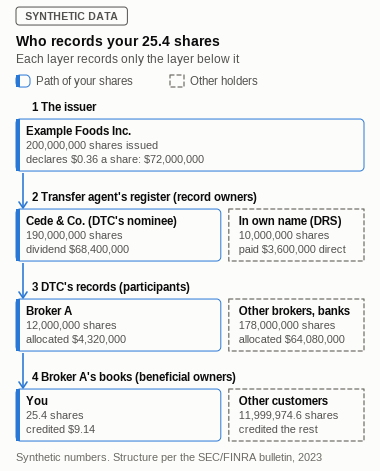
The ties. 190,000,000 + 10,000,000 = 200,000,000 at the register. 12,000,000 + 178,000,000 = 190,000,000 at DTC, which matches Cede & Co.'s registered position. 25.4 + 11,999,974.6 = 12,000,000 at Broker A, which matches Broker A's position at DTC. If any layer failed to tie, some holder would be recorded with shares that do not exist one level up. Rules on how brokers hold customer securities, covered below, are designed to prevent that.
What you own, legally. Your claim runs against your broker, which holds a position at DTC. DTC's nominee is the shareholder of record. The economic result is the same as owning the shares directly: if Example Foods rises 10%, your 25.4 shares rise 10%. The difference lies in how dividends, votes and protections reach you.
How a dividend reaches a street-name holder#
A cash dividend is paid to whoever is on the register on the record date. For street-name shares, that is Cede & Co. DTC allocates the payment to its participants, and each broker credits its customers. The credit does not always land on the payment date: the SEC and FINRA bulletin notes that some brokers batch these payments on a weekly to monthly cycle, so a street-name holder can be paid a little later than a registered holder.
To be entitled to a dividend, you must have bought before the ex-dividend date. Investor.gov explains that with one-day settlement, the ex-dividend date is usually the record date itself, or the business day before it when the record date is not a business day. A purchase on or after the ex-dividend date does not receive that dividend. The seller keeps it. Large dividends (25% or more of the share price) and stock dividends follow different rules.
Dividend arithmetic through the chain (synthetic data)#
Example Foods declares $0.36 a share. Working down the chain:
- Issuer to register. 200,000,000 × $0.36 = $72,000,000 in total. Cede & Co. is owed 190,000,000 × $0.36 = $68,400,000. The holders in their own name are paid $3,600,000 directly by the company or its transfer agent.
- DTC to brokers. Broker A is allocated 12,000,000 × $0.36 = $4,320,000. Other participants receive $64,080,000. Together that is $68,400,000, which matches Cede & Co.'s payment.
- Broker A to you. 25.4 × $0.36 = $9.144. Assume Broker A rounds to the nearest cent, so it credits $9.14.
The dividend on a fractional share#
A fractional share is less than one whole share. Of your 25.4 shares, the 25 whole shares earn 25 × $0.36 = $9.00 and the 0.4 fraction earns 0.4 × $0.36 = $0.144. The SEC's fractional-share bulletin says fractional holders generally receive dividends in proportion to the fraction they own. It also tells investors to check their own broker's policy. BNY Pershing's fractional-share disclosure (October 2024) is one example of a broker's terms. It says dividends are passed on in proportion to the investor's interest, and amounts smaller than a cent are not distributed.
Voting shares you hold through a broker#
As a street-name holder you vote by instructing your broker, not by voting directly at the company. Under the SEC's guidance on the mechanics of voting, the company or your broker sends you the proxy materials, and you return a voting instruction form instead of a proxy card. If you want to attend the meeting, your broker generally has a process for that.
If you give no instructions, exchange rules allow a broker to vote your shares only on matters treated as "routine". Since the SEC approved a change to NYSE Rule 452 on 1 July 2009, brokers may not vote uninstructed shares in director elections held on or after 1 January 2010, except at registered investment companies such as mutual funds. So if you stay silent on a director election, your shares are not voted.
Two situations can leave you with no vote at all:
- Fractional shares. The SEC bulletin warns that you may not have voting rights on a fraction, depending on your broker. BNY Pershing's disclosure, for example, says investors cannot vote proxies for fractional positions.
- Lent shares. If your shares are on loan on the record date, you do not vote them (see the lending section below).
Fractional shares are a record kept by your broker#
A fractional share exists only in your broker's books, which is why you generally cannot move it to another broker. BNY Pershing's disclosure (October 2024) describes how one broker handles fractions:
- The whole-share part of an order goes to the market. The broker fills the fractional part itself, as principal, meaning it trades from its own account. It keeps custody of the whole share in which you hold a fraction.
- Any part of that share not allocated to one customer may be allocated to other customers or kept by the broker.
The SEC bulletin and FINRA (June 2025) describe the practical consequences:
- You generally cannot transfer a fraction to another broker. If you move your account, you may have to sell the fraction. Pershing notes that the standard US account-transfer system does not transfer fractions.
- Order types can be limited. Some brokers accept only market orders for fractions or limit after-hours trading in them.
- Liquidity is not guaranteed. A broker may not promise to keep buying back fractions, even when whole shares trade easily.
What a margin account lets your broker do with your shares#
A margin account lets you borrow from your broker against the securities you hold. It also usually gives the broker permission to lend those securities to others, typically to short sellers. Under FINRA Rule 4330(a), a broker needs your written authorization before lending your margin securities. A margin agreement can serve as that authorization if it clearly says so.
Some brokers also run fully paid lending programs, which borrow shares you have paid for in full. Under FINRA Rule 4330(b), the broker must first judge the program appropriate for you and give you written disclosures. FINRA Regulatory Notice 14-05 (February 2014) says those disclosures must cover several risks:
- the loss of voting rights on loaned shares
- possible tax effects of cash paid in place of dividends while the shares are on loan
- that SIPC protection may not cover the loan itself
- that the collateral you receive may be your main recourse if the broker fails to return the shares
Example: dividends on lent shares (synthetic data)#
Lent shares are often used to settle a short sale, so on the record date another investor holds them. Suppose 10 of your 25.4 Example Foods shares are on loan over the record date. For those shares you receive a payment in lieu of dividends, funded by the borrower: 10 × $0.36 = $3.60. The 15.4 shares not on loan earn the dividend itself, 15.4 × $0.36 = $5.544. Together the two add to the same $9.144 as before. The cash total does not change, but the payment in lieu may be taxed differently from a dividend, and the 10 lent shares carry no vote. Only shares your broker holds can be lent like this: the SEC and FINRA bulletin notes that shares you keep as a paper certificate are out of its reach.
Direct registration: putting your name on the register#
Under direct registration (DRS), your own name goes on the company's register for your shares, in place of Cede & Co.'s. Suppose you move 25 of your Example Foods shares from Broker A into DRS. Cede & Co.'s registered position falls by 25 shares, a new entry for 25 shares in your name appears on the register, and Broker A's position at DTC and its record of your holding each fall by 25. The shares are never recorded in both places at once.
From then on, dividends, annual reports and proxy materials for those 25 shares come straight from the company or its transfer agent. The SEC and FINRA bulletin describes what you give up in return:
- Selling through a broker takes an extra step. You first ask the broker to "pull" the shares from the transfer agent back into street name.
- Margin and broker order types stop applying to those shares. Borrowing against them or using a limit order at your broker means moving them back first.
- It is not always on offer. Some companies do not offer direct registration, and some brokers cannot move shares into it.
- Fees can apply. Ask both the broker and the transfer agent before moving shares either way.
Having your name on the register can matter during a broker failure or a dispute. The cost is the convenience of a brokerage account.
What protects you if the broker fails, and what does not#
Two layers of rules protect customers' shares at a US broker: the broker must keep them apart from its own assets, and SIPC covers missing customer assets up to $500,000 per customer, including up to $250,000 in cash, if a member broker fails. Neither protects you from a fall in market value.
The first layer is segregation. FINRA's 2024 oversight report summarizes the SEC's Customer Protection Rule (Exchange Act Rule 15c3-3): a broker that holds customer accounts must keep customers' fully paid and excess margin securities in its possession or at a good control location. It must also hold a cash reserve at least equal to the net cash it owes customers. Excess margin securities are the part of the securities in a margin account that goes beyond what the rules let the broker use as collateral for your loan.
The second layer is SIPC, the Securities Investor Protection Corporation. Its protection, within the limits above, covers the broker's custody function only. SIPC does not protect against:
- a fall in the value of your securities, for any reason
- worthless securities you were sold
- bad investment advice
- commodity futures, foreign exchange trades, and crypto assets that are not registered securities
Example: a market loss vs a missing share (synthetic data)#
Your 25.4 shares are worth 25.4 × $40 = $1,016. If the price falls to $30, the position is worth $762. The $254 drop is a market loss, and nobody reimburses it. If Broker A then failed and your 25.4 shares were missing from its records, the aim of the SIPC process is to restore the missing shares or their value, within the $500,000 limit. It would not restore the earlier $40 price.
What could change the conclusion about what you own?#
Your broker's agreement decides several details. Fractional shares, dividend timing, voting on fractions, securities lending and transfer fees all differ between brokers. The bulletins cited here keep telling investors to check with their own firm.
The chain outside the United States is different. Depositories, nominee names and investor-protection schemes differ by country. A non-US broker may hold US shares through further intermediaries before DTC. This lesson describes the US chain only.
Digital records do not change the structure by themselves. DTC's tokenization service went live on 28 October 2026 for eligible users. The SEC staff letter that allowed the pilot (11 December 2025) limits it to DTC participants and says the securities stay registered in Cede & Co.'s name. A tokenized record of a street-name position is still a street-name position. The next lesson explains how tokenized stocks sold to the public differ.
Corporate events can change your position without a trade. Stock splits, mergers and spin-offs change the number or type of shares you hold, and each broker's terms say how it handles any fractions they create. See How does dilution happen, and how do I spot it in a filing? for how new shares affect each holder.
Check your understanding: dividends, votes and protection#
Question. You hold 40.75 shares of a company in a margin account at Broker B. The company pays $0.52 a share. On the record date, Broker B has lent 15 of your shares to another firm, as your margin agreement allows.
- How much cash do you receive in total, and how much of it is a payment in lieu of dividends?
- Can you vote on a director election with all 40.75 shares?
- The share price later falls from $60 to $45, and then Broker B fails with your shares missing. What does SIPC protection cover, and what does it not?
Show the answers
Answer.
- The total is 40.75 × $0.52 = $21.19. The 15 lent shares produce a payment in lieu of 15 × $0.52 = $7.80. The other 25.75 shares earn the dividend itself, 25.75 × $0.52 = $13.39. The two parts add to $21.19. The payment in lieu may be taxed differently, so check your broker's statement and tax documents.
- Probably not. The 15 shares on loan are held by someone else on the record date, so you cannot vote them. Whether you can vote the 0.75 fraction depends on your broker's program, and some brokers do not allow it. Your broker cannot vote any of your shares in a director election without your instructions.
- Your position fell from 40.75 × $60 = $2,445 to 40.75 × $45 = $1,833.75. That $611.25 market loss is not covered. If your shares are missing when Broker B fails, the SIPC process aims to restore them or their value, within the $500,000 limit per customer. The 15 lent shares are a separate question. Your claim on them depends on the margin agreement and the collateral arrangements, so read those documents before lending is ever an issue.
Related lessons#
- Before this lesson: none. This lesson starts the instruments and venues track.
- Next: What is a tokenized stock, and what does the holder actually own?, which compares tokens with the street-name share described here.
- Next: When can I trade, and what happens to prices outside market hours?
- See also: What do I own when I hold crypto on an exchange?, the same question for a crypto exchange account, and Where do I find a company's numbers?