When can I trade, and what happens to prices outside market hours?
Short answerUS shares trade on weekdays that are not market holidays, 09:30 to 16:00 Eastern time in the core session and 04:00 to 20:00 with early and late sessions, plus overnight on alternative trading systems from Sunday to Thursday nights (as of 26 November 2026). No venue trades them on Saturday. Products linked to shares keep their own venue's hours: ten xStocks tokens on Kraken Pro and stock perpetuals on crypto venues trade on Saturday. Their prices then come only from their own traders. Say a stock closes Friday at $100, its token trades at $96 on Sunday and the stock opens Monday at $98: arbitrage usually pulls the token toward $98, but redemption limits, financing costs and thin trading can leave a gap.
Outside the core session fewer people trade, so spreads widen, prices jump more, and the next open can gap away from the last close. Exchange night sessions are planned from 6 December 2026. Crypto trades 24/7 and has no close at all. Before you hold a position over a night or a weekend, check which venue's price it will be valued at: on a thin market, that price can fill your order or trigger your liquidation.
Scope note: Valmy v1 trades crypto on Binance Spot and USDⓈ-M futures and offers no shares, tokenized stocks or stock derivatives. This lesson describes other venues' hours as of 26 November 2026; Valmy's crypto markets are the 24/7 case.
US stock market sessions (as of 26 November 2026)#
The core session, also called regular trading hours, runs from 09:30 to 16:00 Eastern time (ET) on NYSE and Nasdaq. FINRA's investor guidance says the 16:00 prices are treated as the official closing prices, whatever happens in extended hours. The sessions around it differ by venue:
| Session | Hours (ET) | Where, per the venues' own pages |
|---|---|---|
| Early (pre-market) | 04:00–09:30 | NYSE Arca and Nasdaq. NYSE American, National and Texas start at 07:00. The main NYSE market accepts orders from 06:30 but holds them for its opening auction. |
| Core | 09:30–16:00 | All US exchanges |
| Late (after-hours) | 16:00–20:00 | NYSE Arca, NYSE American, National, Texas and Nasdaq |
| Overnight | 20:00–04:00, Sunday to Thursday nights | Alternative trading systems such as Blue Ocean. Exchange sessions from 21:00 are planned from 6 December 2026. |
An alternative trading system (ATS) is a trading venue regulated as a broker rather than an exchange. Brokers decide which of these sessions their customers can use, and some offer only part of them.
Market holidays, weekends and early closes#
Stock exchanges close at weekends and on market holidays. Today, 26 November 2026, is Thanksgiving, and the US stock market is closed. NYSE's published calendar lists these full-day holidays:
| Holiday | 2026 | 2027 |
|---|---|---|
| New Year's Day | Thu 1 Jan | Fri 1 Jan |
| Martin Luther King Jr. Day | Mon 19 Jan | Mon 18 Jan |
| Washington's Birthday | Mon 16 Feb | Mon 15 Feb |
| Good Friday | Fri 3 Apr | Fri 26 Mar |
| Memorial Day | Mon 25 May | Mon 31 May |
| Juneteenth | Fri 19 Jun | Fri 18 Jun (observed) |
| Independence Day | Fri 3 Jul (observed) | Mon 5 Jul (observed) |
| Labor Day | Mon 7 Sep | Mon 6 Sep |
| Thanksgiving | Thu 26 Nov | Thu 25 Nov |
| Christmas | Fri 25 Dec | Fri 24 Dec (observed) |
On early-close days the core session ends at 13:00. NYSE's late sessions on its other markets end at 17:00 on those days. The early closes are Friday 27 November 2026, Thursday 24 December 2026 and Friday 26 November 2027. A holiday that falls on a Friday or a Monday turns a two-day weekend into three days without trading in the stock.
Why spreads widen and liquidity thins outside regular hours#
Outside the core session, fewer buyers and sellers are active, so the gap between the best bid and the best offer (the spread) widens and a single order can move the price further. FINRA Rule 2265 requires brokers to give customers a risk disclosure before they trade in extended hours. It covers six risks:
- Lower liquidity. Your order may be filled only in part, or not at all.
- Higher volatility. Prices can swing more than during the day.
- Changing prices. The price may differ from the close or from the next morning's open.
- Unlinked markets. Prices on one extended-hours venue may not match another's.
- News announcements. Companies often release news after the close, and its effect can be exaggerated while few people trade.
- Wider spreads. The cost of crossing the spread is higher.
FINRA's investor page (31 July 2024) adds that the national best bid and offer, the consolidated best quotes across venues, is published only during regular hours, so in extended hours you may see one venue's prices only. The consolidated data feeds plan to extend their hours from 6 December 2026. The SEC's older guidance on after-hours trading makes similar points. It adds that a limit order may not be filled if the market moves away from it, and that you may be trading against professionals with more information. What makes a market liquid, and why does it matter for my order? explains why a thin order book costs more to trade.
Overnight trading: what runs now and what is planned#
As of 26 November 2026, overnight trading in US stocks runs on alternative trading systems. Exchange night sessions are approved or filed. Nasdaq and 24X plan to start theirs on 6 December 2026, provided the consolidated data feeds are ready.
- Blue Ocean ATS says its clients trade listed US stocks from 20:00 to 04:00 ET, Sunday to Thursday nights. A Reuters report, which Blue Ocean reposts on its website, says a surge in orders during a global selloff forced it to shut its system shortly after 03:00 ET on 5 August 2024. The report says it raised its capacity on 19 August 2024. The episode shows that a newer venue can stop trading in the middle of a volatile night.
- Nasdaq. The SEC approved Nasdaq's 23-hour weekday schedule on 10 April 2026. It adds a night session from 21:00 to 04:00, Sunday to Thursday, after a one-hour pause at 20:00. Nasdaq's trader alert of 17 August 2026 says the night session begins on 6 December 2026. Under the approval, it cannot start until the consolidated data feeds can carry it.
- 24X National Exchange. The SEC approved 24X as an exchange on 27 November 2024, and it began trading in October 2025, from 04:00 to 20:00. Its overnight session from 21:00 to 04:00 targets 6 December 2026, pending approval.
- NYSE Arca. The SEC approved a 22-hour weekday schedule in February 2025. In May 2026 NYSE filed a 23-hour schedule instead, with an overnight session from 21:00. Its website gives a targeted launch in 2026.
- Behind the scenes. The plan that runs the consolidated data feed for Nasdaq-listed stocks expects to extend its hours from 21:00 on Sunday to 20:00 on Friday, starting 6 December 2026. DTCC's clearing house (NSCC) began clearing around the clock on weekdays on 29 June 2026.
Planned dates can slip. Until a session is live, the overnight hours above apply only to the ATSs.
When each instrument trades: one week at a glance#
Trading hours are set by each venue, not by the type of product. The figure lines up a typical week without holidays, in Eastern time, from each venue's published schedule, and separates three things: the shares themselves, products linked to them, and crypto. The shares trade from Sunday evening, on an overnight ATS, to Friday evening, and never on Saturday. Linked products follow their venue: Robinhood's EU stock tokens and Kalshi's perpetuals stop at weekends, while ten xStocks on Kraken Pro and stock perpetuals on crypto venues trade on Saturday, when no venue trades the shares. What is a tokenized stock, and what does the holder actually own? and What are perpetuals and other derivatives that track stocks? describe these products.
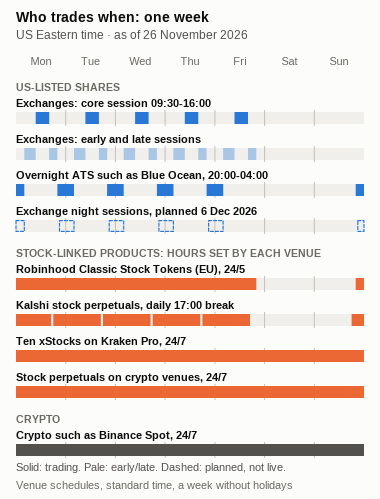
- Robinhood's Classic Stock Tokens (EU) trade from Monday 02:00 to Saturday 02:00 Central European Time. In late November, with both regions on standard time, that is Sunday 20:00 to Friday 20:00 ET. They are closed on US market holidays.
- xStocks on Kraken. As of 26 November 2026, Kraken lists ten US-listed xStocks that trade 24/7 on Kraken Pro: TSLAx, QQQx, SPYx, NVDAx, CRCLx, AAPLx, HOODx, MSTRx, GLDx and GOOGLx. Its other US-listed xStocks trade 24/5 and not at weekends, and UK and EU-listed ones also close on exchange holidays. Withdrawn to a self-custody wallet, xStocks can also trade onchain at any hour.
- Perpetuals on crypto venues such as Binance and trade.xyz trade 24/7.
- Kalshi's perpetual security futures, regulated in the US, trade from Sunday 18:00 to Friday 17:00 ET with a daily one-hour break, and not at weekends.
- Crypto itself, such as Binance Spot, trades 24/7.
How tokens and stock perpetuals are priced while the stock market is closed#
While the shares trade, a token or a perpetual is kept close to them by arbitrage, funding or an index that follows the stock. When no venue trades the shares, at weekends for example, that anchor weakens, and the product's price comes from whoever trades it on its own venue. Kraken, for example, says spreads on xStocks are wider outside market hours and that market makers then quote from other sources, such as ATS prices and index futures. How each product is held near the share differs:
- Backed certificates (xStocks). The issuer can buy or sell the underlying shares only in exchange hours, and its prospectus warns that it may limit issuance and redemption to once a trading day, at the closing price. Creating or redeeming tokens therefore cannot pull the token's price back to the share's value at weekends.
- Perpetuals that follow their own market. Binance (since 16 May 2026) and trade.xyz switch the index to an average of their own prices when the stock market is closed. The perpetual can then react to news. Binance's FAQ says the index switches back to the stock's price within a minute of the reopen.
- Venues that stop the clock. Kalshi's contracts do not trade at weekends and compute no funding premium while the stock market is closed.
Why a weekend premium or discount can outlast the reopen#
When the shares reopen, arbitrage usually pulls a token or a perpetual back toward the share price: if a token trades below the share, a trader can buy the token and sell the share, and the reverse when it trades above. Nothing guarantees the gap closes at once or completely. On Binance and trade.xyz a perpetual's index or oracle switches back to the share price at the reopen, but the perpetual's own traded price is pulled toward it only by funding and traders. A token's price is pulled only as far as arbitrage is worth the trouble. Four things can keep a premium or discount open after the reopen:
- Creation and redemption limits. Under the xStocks issuer's base prospectus (8 May 2026), only qualified professional investors subscribe for new tokens directly with the issuer; others buy through an authorized participant. Redeeming means passing its know-your-customer and anti-money-laundering checks, which it can refuse, or selling to an authorized participant. Redemption happens on business days, is paid up to five business days after the issuer receives the tokens, and may be priced at the day's close. Minimum amounts, if any, are set in each product's final terms. A holder who cannot redeem can only sell to another trader.
- Financing costs. Closing a gap means holding the cheap side against a sale or short of the expensive side, for example tokens bought against shares sold short, until the prices meet or the tokens are redeemed. That ties up capital or margin, and on a perpetual funding adds to or subtracts from the cost.
- Thin liquidity. If few traders are active on the token's venue, buying or selling enough to close a gap moves the price against the arbitrageur.
- Trading frictions. Each leg pays spreads and fees, and the xStocks issuer may charge up to 5% on issuance and redemption. A gap smaller than those costs is not worth closing.
Leveraged positions are valued at whatever the venue's rules say once trading resumes. A gap that persists after the reopen is a real price for anyone who trades or is liquidated at it.
How the opening price is set, and why prices gap#
US exchanges open each stock with an opening auction: orders collected before 09:30 are matched at a single price. NYSE Arca's rules define the auction price as the one at which the most shares can trade, within price limits called collars. Nasdaq's Opening Cross runs at 09:30, and Nasdaq publishes order-imbalance information from 09:25. The auction gathers everything that happened since the last close: overnight news, other markets and weekend trading in tokens and perpetuals.
A gap is the difference between one session's close and the next session's open. It is larger when more news arrives while the market is shut, which is why Monday opens and openings after earnings releases can jump. Gaps matter for stop orders. A stop does nothing until the price its broker watches reaches the stop price. The SEC's investor bulletin on stop orders notes that some brokers trigger on last-sale prices and others on quotes. Suppose a stock closes on Friday at $100.00 and you hold a sell stop at $97.00. If it opens on Monday at $98.00 and the price your broker watches stays above $97.00, the stop is never triggered, even though the stock is 2% below Friday's close. If it opens at $96.00 and that price meets your broker's trigger standard, the stop becomes a market order and sells at the bids available when it executes: often near $96.00, but lower if bids are thin, or higher if buyers come back first. Either way, the stop price does not set the fill. See What is a stop order, and why can it fill worse than its trigger price?
Crypto trades 24/7, so it has no closing price#
Crypto markets such as Binance Spot run continuously, so they have no opening auction and no official close. A "daily close" on a crypto chart is a convention: the last price before the candle's chosen cutoff, often 00:00 UTC. Liquidity still varies by hour and day, but weekend moves happen in real time rather than as a gap on Monday. Indicators that reset each session, such as VWAP, need a chosen anchor time in crypto. See What is VWAP, and why does it reset? For how volatility is measured across sessions and gaps, see How much does this market usually move?
Worked example: who gains and who loses from a weekend gap (synthetic data)#
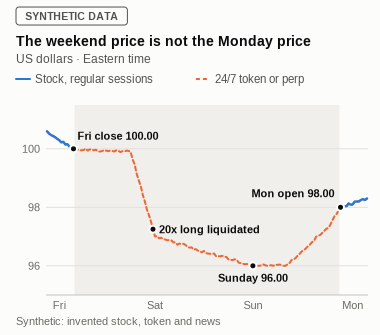
This invented example follows one weekend for several people holding different instruments on the same stock. It was designed to show a weekend price that overshoots. Assumptions:
- A stock closes on Friday at $100.00.
- A token or perpetual on it trades 24/7 on a crypto venue. After invented news on Saturday, it falls and spends Sunday at $96.00.
- On Monday the stock opens at $98.00. To keep the arithmetic simple, assume the 24/7 price closes the whole gap at the open; the previous section explains why a real one might not.
- Ignore fees, funding and spreads unless stated.
The moves#
The weekend price was 96.00 ÷ 100.00 − 1 = −4.0% below Friday's close. The stock opened 98.00 ÷ 100.00 − 1 = −2.0% below it.
Who gained and who lost by Monday's open#
These results use the example's assumption that the 24/7 price meets the stock's $98.00 opening price.
- A shareholder with 100 shares could do nothing at the weekend and lost 100 × $2.00 = $200 at the open.
- A token holder who sold 100 tokens at $96.00 on Sunday received $9,600. The same tokens were worth $9,800 at the open, so selling early cost $200 more than holding.
- The buyer of those tokens gained 98.00 ÷ 96.00 − 1 = 2.08% by the open.
- A trader long 50 perpetual contracts at 20x, opened at $100.00, had a $5,000 position and $250 of margin. Assume a maintenance margin of 2.5%. The position is liquidated when the remaining margin, 250 − 50 × (100 − P), falls to 2.5% of 50 × P, the position's value at price P. That happens at P = 4,750 ÷ 48.75 = $97.44, so it was liquidated on Saturday for a loss of about $128 before fees. Had it survived to the open, the loss would have been $100. At $96.00 the loss would have been 80% of the margin. See What does leverage change, and when is a position liquidated?
- A shareholder with a stop order to sell at $99.00 saw the stock open at $98.00, below the stop. Assume the opening price meets the broker's trigger standard and the resulting market order fills at $98.00; it could fill lower if bids were thin, or higher if buyers came back first. At $98.00 that is $1.00 a share below the stop, $100 on 100 shares. A stop at $97.00 would not have been triggered at all unless the price the broker watches reached $97.00 after the open.
- A trader short 50 perpetual contracts from $100.00 gained 50 × $2.00 = $100 at the open, ignoring funding. They could also have taken a larger profit on Sunday, at $96.00.
Reading it. The weekend price was one forecast, made by the people trading on the venue. Here it overshot. The token holder who sold on Sunday and the long liquidated on Saturday ended worse off than if they had waited for the open, while the buyer on the other side of the Sunday sale gained 2.08%. In a different weekend the stock might have opened at $95.00, and the early seller would have done better. The point is not that weekend prices are wrong. It is that they are set by a smaller group of traders, without the stock market's opening auction, and that leverage can turn a temporary price into a realized loss. The example also assumed the token closed the gap at the open. Had it still traded at, say, $97.50 when the stock opened at $98.00, the Sunday buyer's gain and the early seller's shortfall would both be smaller, and a token holder could get the share's price only by redeeming, with the limits above, or by waiting for the gap to close.
What could change the conclusion about trading hours?#
Schedules are changing. Several exchanges plan night sessions from 6 December 2026, and the dates depend on data-feed readiness and regulatory filings. Once those sessions are live, weekday gaps may shrink, but at weekends and on holidays the shares still trade nowhere, and only some stock-linked products keep trading.
Your broker decides your hours. Even when a venue is open, your broker may not route orders to it, may accept only limit orders, or may exclude fractional shares from extended hours.
Time zones shift. The US and Europe change clocks on different dates. For a few weeks each March and around the end of October, Central European Time is five hours ahead of Eastern time instead of six, so a schedule set in Europe moves by an hour.
Liquidity varies within sessions too. Even in the core session, a thinly traded stock can have a wide spread, so the session alone does not tell you the cost of trading.
Weekend prices on 24/7 venues depend on their rules. Index design, mark-price caps and funding decide how a perpetual behaves while the stock is shut. Check the specific contract before holding a leveraged position over a weekend.
The reopen need not close the gap. Arbitrage usually narrows a premium or discount once the shares trade again, but redemption limits, financing costs, thin liquidity and fees can keep it open after the shares reopen. Compare the token's or the perpetual's price with the share's after the open, not just before it.
Check your understanding: a weekend rally#
Question. A stock closes on Friday at $50.00. Over the weekend its 24/7 token, and a 24/7 perpetual on it, rise to $52.50 after news. On Monday the stock opens at $51.00. For parts 2 and 3, assume the token and the perpetual trade at the stock's opening price.
- By what percentage did the weekend price and the Monday open differ from Friday's close?
- You bought 40 tokens at $52.50 on Sunday. What is your gain or loss at the open?
- A trader shorted 40 perpetual contracts at $50.00 on Friday with 10x leverage ($200 of margin) and a 2.5% maintenance margin. At what price is the short liquidated, and does that happen at the weekend? What is the result at the open?
- Which price will most US data sources show as Friday's close if the stock traded at $49.70 at 19:00 in the late session?
- Drop the assumption: at the open the token still trades 1% above the stock. What is your result on the 40 tokens now, and what could keep that premium open?
Show the answers
Answer.
- The weekend price was 52.50 ÷ 50.00 − 1 = +5.0%. The open was 51.00 ÷ 50.00 − 1 = +2.0%.
- 40 × (51.00 − 52.50) = −$60 at the open. The Sunday price overshot the open.
- The short is liquidated when 200 + 40 × (50 − P) falls to 0.025 × 40 × P, which gives P = 2,200 ÷ 41 = $53.66. The weekend high of $52.50 stays below that, so the short survives. At the open it has lost 40 × $1.00 = $40 before funding.
- $50.00, the 16:00 closing price. FINRA's investor guidance says the regular-session close is the official one, whatever happens in extended hours.
- The token trades at 51.00 × 1.01 = $51.51, so the result is 40 × (51.51 − 52.50) = −$39.60 instead of −$60. A premium like this can last if arbitrageurs who buy shares and sell tokens must finance the shares until new tokens are issued, if only qualified professional investors and authorized participants can have new tokens issued, or if the token's order book is too thin to sell into without pushing the price down. Fees on each leg, including an issuance surcharge of up to 5%, can also make a 1% gap not worth closing.
Related lessons#
- Before this lesson: What do I own when I buy a share through a broker? and What is a tokenized stock, and what does the holder actually own?
- Next: What are perpetuals and other derivatives that track stocks?, for how funding behaves when the stock market is shut.
- See also: What is a stop order, and why can it fill worse than its trigger price? and What makes a market liquid, and why does it matter for my order?