What is a stop order, and why can it fill worse than its trigger price?
Short answerA stop order waits until the market trades at or through a price you choose, the stop price or trigger, and then sends an order for you. A stop-market order sends a market order, which trades at the best prices available when it executes, so it can fill worse than the trigger. A stop-limit order sends a limit order: it never fills worse than its limit, but it may not fill at all. If a market opens below a sell stop after a closure, the stop triggers at the open and sells at the bids available then: often near the opening price, but it can be lower, or even a little higher if bids recover before the order executes.
Fast markets, thin order books and many stops gathered at one level also push fills past the trigger. Size a position from the stop price, but expect the actual loss to be larger when the market jumps or the book is thin.
Valmy noteAs of 26 November 2026, Valmy's v1 order flow places market orders, so the stop orders described here are Binance order types a trader would place at Binance directly. A Valmy v1 strategy can express an exit rule, but the rule is evaluated on closed five-minute candles and acts through a market order after the candle closes. That behaves like a stop-market order that can only trigger at candle closes. Use this lesson to judge how a stop placed at Binance could fill and how much slippage to allow for a closed-candle exit.
How stop orders work: trigger versus fill#
A stop order has two prices that are easy to confuse: the price that wakes it up and the price it actually trades at. The trigger (stop price) is a condition. Once the market reaches it, the stop order releases a new order. The fill price is the price, or the average of several prices, at which that new order trades. Only the fill decides your result.
The U.S. Securities and Exchange Commission's investor bulletin on stop orders describes the basic layout:
- A sell stop sits below the current price. Traders use it to limit a loss, or protect a gain, on something they own.
- A buy stop sits above the current price. Traders use it to limit a loss on a short position, and some use it to enter when price breaks out upward (When does a breakout fail? discusses why breakout levels attract such orders).
What counts as "reaching" the trigger depends on the venue. The SEC bulletin notes that some brokers trigger on the last trade price and others on quotes. Binance's Spot documentation describes its stops as triggering when the market price hits the stop price. Its USDⓈ-M futures let the trader choose the contract's last price or its mark price, as explained below.
Stop-market versus stop-limit#
The two kinds of stop differ only in what they send once triggered.
| Stop-market | Stop-limit | |
|---|---|---|
| What the trigger sends | A market order | A limit order at a price you set |
| Fill price | Whatever the book offers, possibly far beyond the trigger | The limit price or better |
| Main risk | A fill much worse than planned | No fill, or a partial fill, while price keeps moving |
A market order trades immediately against the best available prices, and if one price level runs out it moves to the next (What actually happens when I place a buy order?). A limit order trades only at its price or better. A stop-limit order therefore needs two prices. For a sell, the limit is usually set a little below the trigger to leave room for small slippage.
Why a stop can fill worse than its trigger#
A trigger only tells you that a trade happened at or through your price; it does not reserve a buyer there. A triggered sell stop's market order sells into the bids, the buy orders resting in the book, highest first. The SEC and FINRA both warn that a stop price is not a guaranteed execution price: the fill depends on the bids available when the order executes. Several situations push it past the trigger:
- Gaps when a market reopens. A stop cannot trigger while trading is closed. If a stock opens well below a sell stop after an overnight or weekend close, the stop triggers at the open and sells at the bids available when it executes: often near the opening price, but lower if bids are thin, or a little higher if buyers return first. The stop price no longer sets the fill, because the market went straight past it (When can I trade, and what happens to prices outside market hours?). Major crypto pairs trade around the clock, but a fast enough move can skip levels in the same way.
- Fast markets. FINRA's guidance points out that in a rapidly moving market a triggered stop can execute at a price significantly different from the stop price, because prices keep changing between the trigger and the fill.
- Thin order books. When few bids sit just below the trigger, a market sell walks down through several levels. What makes a market liquid, and why does it matter for my order? covers book depth.
- Many stops at one level. Stops tend to gather at obvious prices, such as round numbers or just beyond a recent low. When price reaches them, they all send market orders at once, which pushes price further and can trigger the next group. Osler (2002) studied currency markets and found that exchange rates moved unusually fast after reaching levels where stop-loss orders were known to cluster, an effect she called price cascades. The effect was statistically significant over hours but not over days.
- Short-lived spikes. A brief drop can trigger a stop and then reverse. Both the SEC and FINRA warn that the order can execute at a poor price even if the market recovers shortly after.
Worked example: a sell stop at 95 in a normal and a thin book (synthetic data)#
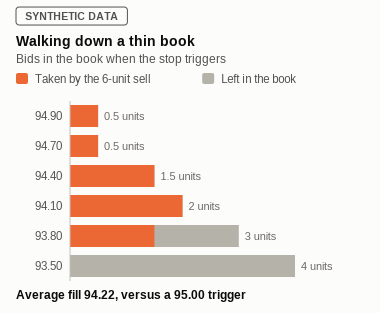
This example uses an invented token quoted in USDT. A trader holds 6 units bought at 100.00 and places a sell stop at 95.00. The planned loss is 6 × (100.00 − 95.00) = 30.00 USDT. Below are two invented order books as they might look at the moment the stop triggers.
| Normal book: bid price | Units | Thin book: bid price | Units | |
|---|---|---|---|---|
| 94.98 | 2 | 94.90 | 0.5 | |
| 94.95 | 3 | 94.70 | 0.5 | |
| 94.90 | 4 | 94.40 | 1.5 | |
| 94.85 | 5 | 94.10 | 2 | |
| 93.80 | 3 | |||
| 93.50 | 4 |
The thin book is what a book can look like after other stops at 95 have already sold into the best bids, or when buyers step back during a fast fall.
Calculating the average fill in a normal book#
The 6-unit market sell takes 2 units at 94.98, 3 at 94.95 and 1 at 94.90. Proceeds = 189.96 + 284.85 + 94.90 = 569.71 USDT, an average of about 94.95. The loss is 600.00 − 569.71 = 30.29 USDT, close to the 30.00 plan.
Calculating the average fill in a thin book#
The same sell takes 0.5 units at 94.90, 0.5 at 94.70, 1.5 at 94.40, 2 at 94.10 and 1.5 of the 3 units at 93.80. Proceeds = 47.45 + 47.35 + 141.60 + 188.20 + 140.70 = 565.30 USDT, an average of about 94.22.
- Slippage against the trigger: 95.00 − 94.22 = 0.78 per unit, about 0.82%.
- Loss: 600.00 − 565.30 = 34.70 USDT, 15.7% more than the planned 30.00.
What the stop-limit order would have done#
Suppose instead the trader used a stop-limit order with the trigger at 95.00 and a limit at 94.50. In the thin book the limit order sells only what is bid at 94.50 or higher: 0.5 units at 94.90 and 0.5 at 94.70, an average of 94.80. The other 5 units rest in the book as a sell order at 94.50.
In this synthetic path, price never trades back up to 94.50. It bounces to 94.20 and then slides to 91.80 two minutes after the trigger. The trader has realized a loss of 1 × (100.00 − 94.80) = 5.20 USDT and still holds 5 units, now showing a loss of 5 × (100.00 − 91.80) = 41.00 USDT. The total, 46.20 USDT, is already larger than the stop-market loss of 34.70, and the position remains open.
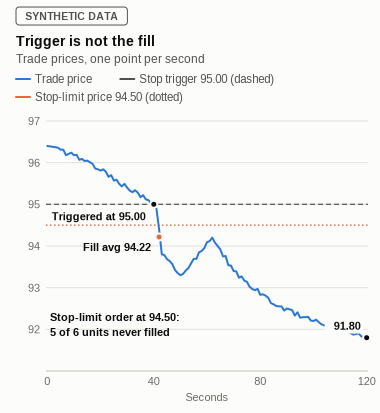
The comparison can also come out the other way. If the drop had been a brief spike that recovered above 94.50 within seconds, the stop-limit order would have sold its remaining units at 94.50 or better, while the stop-market order would have sold at the bottom. Neither order type is better in every case. A stop-market order chooses certainty of exit over price, and a stop-limit order chooses price over certainty of exit.
A gap at a market open (synthetic)#
After a gap, a triggered sell stop sells at the bids available when its market order executes; the stop price no longer sets the fill. Picture 6 shares, not a crypto pair, bought at 100.00 USD, closing on Friday at 96.50 with a sell stop at 95.00. Bad news arrives over the weekend and the first trade on Monday is at 91.00. The stop triggers at the open and becomes a market order. The fill is often near 91.00, but it is lower if the opening bids are thin, or a little higher if buyers step in before the order executes. At a fill of 91.00 the loss is 9.00 USD per share instead of the planned 5.00, or 54.00 USD instead of 30.00. Valmy v1 does not offer shares; the mechanism applies to any market that closes.
Stop orders on Binance Spot and USDⓈ-M futures (as of 26 November 2026)#
Binance offers both kinds of stop on Spot and on USDⓈ-M futures, with different names and trigger choices. On Spot, the stop-market order is called STOP_LOSS and the stop-limit order STOP_LOSS_LIMIT. On USDⓈ-M futures they are STOP_MARKET and STOP, and the trader can choose whether the last traded price or the mark price triggers them. The details below come from Binance's official API documentation and support pages, checked on 26 November 2026. The app interface may label the same orders differently.
Binance Spot: STOP_LOSS and STOP_LOSS_LIMIT#
- STOP_LOSS is a stop-market order: once the market price hits its
stopPrice, Binance places a market order. - STOP_LOSS_LIMIT is a stop-limit order: once the market price hits its
stopPrice, Binance places a limit order at the order'sprice. - A sell stop must be placed below the current market price and a buy stop above it.
- Binance's market-order FAQ says that if the book does not have enough liquidity, a market order fills as far as it can and the rest expires. Because a triggered STOP_LOSS places a market order, the same can happen to it in an extreme case.
- A trailing version, set with
trailingDelta, moves the trigger as price moves in the trader's favor. Where would a trailing stop sit? covers trailing stops.
Binance USDⓈ-M futures: STOP_MARKET, STOP and the trigger price type#
- Since 9 December 2025, Binance places USDⓈ-M conditional orders through its algo order service. The API endpoint for new orders of these types is the "New Algo Order" endpoint with
algoTypeset toCONDITIONAL. - STOP_MARKET sends a market order when triggered and STOP sends a limit order. A sell stop triggers when the chosen price is at or below the trigger price, and a buy stop when it is at or above.
- The trigger price type,
workingType, is eitherCONTRACT_PRICE, the contract's last traded price and the default, orMARK_PRICE, the mark price that Binance also uses for liquidation (What does leverage change, and when is a position liquidated?). A last-price trigger reacts to every trade on the contract, including brief spikes. The mark price draws on spot prices from several exchanges and on funding data, and Binance uses it to avoid unnecessary liquidations, so a mark-price trigger can fire later, or not at all, when only the contract's own trades spike. - Price protection (
priceProtect) on STOP_MARKET orders makes the order trigger only if the gap between the mark price and the last price is within the symbol's threshold. On 26 November 2026 Binance's public exchange information listed that threshold for BTCUSDT as 0.03, or 3%. - A stop meant only to exit can be sent as reduce-only, or with
closePosition, so that it cannot open or enlarge a position. - Binance's change log notes that after the move to the algo service there is no margin check before a conditional order triggers.
What could change the conclusion about stop orders?#
How much worse than its trigger a stop fills depends on conditions at the moment it fires, and several factors can shift the picture.
Where the stop sits. A stop at an obvious level, such as a round number or just below a well-watched low, shares that level with many other stops. That raises the chance of a cascade like the one Osler described. A stop placed farther away is less crowded but risks more per unit, which means a smaller position for the same risk budget (How much should I risk on one trade?).
How deep the book is. In the normal book above, the whole slippage was 0.29 USDT on a 30 USDT plan. In the thin book it was 4.70. The same order type can behave very differently in a deep market and a thin one, and in the same market at a calm and a hectic moment.
Which price triggers the order. Last price, quotes and mark price can disagree, especially during spikes. A trader who sets a stop on the last price and is liquidated on the mark price can see the two happen in an unexpected order.
Rules differ by venue. FINRA notes that some stock exchanges stopped accepting stop orders because of their risks, although brokers may still offer them. Crypto exchanges define their own trigger rules, protections and order names, and they change them, as Binance's December 2025 move to an algo service shows.
Closed-candle exits act later. An exit rule evaluated on a closed candle, as in a Valmy v1 strategy, only acts after the candle closes beyond the level and fills on a later bar. In a fast move the close itself can be far past the level, so the slippage allowance for such exits needs to be larger than for a resting exchange stop.
Check your understanding: a stop through a thin book#
Question. A trader holds 10 units bought at 50.00 USDT and has a sell stop at 47.00. When it triggers, the book shows bids of 3 units at 46.95, 4 units at 46.80 and 5 units at 46.50.
- If the order is a stop-market order, what is the average fill and the loss? How does it compare with the planned loss?
- If it is a stop-limit order with a limit of 46.85, how many units sell, and what happens to the rest?
Show the answers
Answer.
- The market sell takes 3 units at 46.95, 4 at 46.80 and the remaining 3 at 46.50. Proceeds = 140.85 + 187.20 + 139.50 = 467.55 USDT, an average of 46.755. The loss is 500.00 − 467.55 = 32.45 USDT, against a planned 10 × 3.00 = 30.00 USDT.
- Only the 3 units bid at 46.95 are at or above the 46.85 limit, so 3 units sell. The other 7 units rest as a sell order at 46.85. They fill only if buyers come back at that price. If price keeps falling, the trader still holds 7 units with a growing loss, and has to decide whether to sell at market or wait.
Related lessons#
- Before this lesson: What actually happens when I place a buy order? explains market and limit orders and the order book.
- Before this lesson: Why did I pay more than the price on screen? explains spreads and slippage.
- Next: Where would a trailing stop sit? shows indicator-based ways to place and move a stop.
- See also: What makes a market liquid, and why does it matter for my order?, How much should I risk on one trade?, What does leverage change, and when is a position liquidated?, When does a breakout fail? and When can I trade, and what happens to prices outside market hours?.