What does leverage change, and when is a position liquidated?
Short answerLeverage changes how much collateral, called margin, you post for a futures position, and so how far price can move against you before the exchange closes it by force. It does not change the profit or loss per price move: a 0.05 BTC position gains or loses 50 USDT per 1,000 USDT move at 2x or 50x. On Binance USDⓈ-M futures with isolated margin, a position is liquidated when the mark price reaches its liquidation price: for a small BTC long, about 9.6% below entry at 10x and 1.6% at 50x (as of 26 November 2026). Before entering, check that the liquidation price sits well beyond your stop, or a dip can close a trade that was right about direction.
Valmy noteValmy v1 supports Binance USDⓈ-M futures limited to USDT-settled perpetuals, one-way positions and isolated margin, with the exchange's automatic margin top-up turned off and leverage capped. The numeric cap was still an open decision on 26 November 2026, so this lesson does not state one. Use the lesson to see where a position would be liquidated at the leverage you choose; it does not recommend a leverage level.
How margin, leverage and liquidation fit together#
A leveraged futures position is backed by margin worth only a fraction of the position's value. Binance liquidates a position when its collateral (the margin plus realized and unrealized profit or loss) falls below the maintenance margin, the minimum the position must keep, and it measures that with the mark price. In short: initial margin = position value ÷ leverage, and maintenance margin = position value × maintenance margin rate − maintenance amount. The terms in more detail:
- Position value (notional) = quantity × price. 0.05 BTC at 100,000 USDT is 5,000 USDT.
- Initial margin is the collateral posted to open the position. Binance's Leverage & Margin page gives the formula above. At 10x, the 5,000 USDT position needs 500 USDT.
- Isolated margin means only the margin assigned to this one position can be lost on it. The rest of the futures wallet is not drawn in.
- The maintenance margin rate and maintenance amount come from a tier table, shown in the next section.
- The mark price is Binance's estimate of the contract's fair price, built from funding data and spot prices on several exchanges. Binance computes liquidation prices and unrealized profit or loss from the mark price, not from the last traded price. Why does a futures price drift from the spot price? covers how the two can differ.
A USDⓈ-M perpetual future is a contract that tracks a coin's price, settles in USDT and has no expiry date. What is a perpetual future, and what does funding do? explains it in full.
Why leverage does not change profit per price move#
Profit or loss on a futures position is quantity × price change. Leverage does not appear in that product. A 0.05 BTC long loses 50 USDT when the mark price falls 1,000 USDT, at any leverage. What leverage changes is the size of that 50 USDT relative to the margin: 1% of 5,000 USDT at 1x, 10% of 500 USDT at 10x, 50% of 100 USDT at 50x.
Leverage changes profit per move only through the quantity a trader chooses. With a fixed 500 USDT of margin, 2x buys 0.01 BTC (10 USDT per 1,000 USDT move) and 20x buys 0.1 BTC (100 USDT per move). That is why the size should come from the stop distance and a risk budget, as in How much should I risk on one trade?, and leverage only decides how much collateral backs that size.
Binance's maintenance margin tiers for BTCUSDT#
Binance sets the maintenance margin rate by tier: the larger the position value, the higher the rate and the lower the maximum leverage allowed. On 26 November 2026, Binance's Leverage & Margin page showed 12 tiers for the BTCUSDT perpetual, last updated on 19 August 2025. The first four:
| Tier | Position value (USDT) | Max leverage | Maintenance margin rate | Maintenance amount (USDT) |
|---|---|---|---|---|
| 1 | 0 to 300,000 | 150x | 0.40% | 0 |
| 2 | 300,000 to 800,000 | 100x | 0.50% | 300 |
| 3 | 800,000 to 3,000,000 | 75x | 0.65% | 1,500 |
| 4 | 3,000,000 to 12,000,000 | 50x | 1.00% | 12,000 |
Higher tiers continue up to tier 12, at 1x and a 50% rate. The page warns that Binance may adjust maximum leverage, brackets and rates during extreme price moves. Binance's API change log for 9 October 2026 also notes that the maximum leverage is set per symbol rather than by a fixed documented ceiling. A trader should read the current table before relying on any of these numbers.
The liquidation price formula Binance publishes#
Binance publishes one formula for the liquidation price of a USDⓈ-M position and says how to apply it to isolated margin: use the position's isolated wallet balance, and set the maintenance margin and unrealized profit of other positions to zero. For a one-way position, with WB the isolated balance, Q the quantity, EP the entry price, MMR the maintenance margin rate and cum the maintenance amount of the position's tier, it reduces to:
- Long: liquidation price = (Q × EP − WB − cum) ÷ (Q × (1 − MMR)).
- Short: liquidation price = (Q × EP + WB + cum) ÷ (Q × (1 + MMR)).
At that price the margin left equals the maintenance margin. Binance's FAQ adds a tier check: if the position value at the computed price falls in a different tier, recompute with that tier's rate and amount. The calculation for this lesson reproduces both liquidation prices in Binance's own published example (26,316.89 for BTCUSDT and 1,153.26 for ETHUSDT), so the reduced formula matches Binance's.
Calculating the liquidation price for a 10x long#
A long of 0.05 BTC at 100,000 USDT, isolated, at 10x (synthetic numbers). The position value is 5,000 USDT, in tier 1, so MMR = 0.40% and cum = 0. The isolated balance is the 500 USDT initial margin, ignoring fees and funding.
- Liquidation price = (0.05 × 100,000 − 500 − 0) ÷ (0.05 × (1 − 0.004)) = 4,500 ÷ 0.0498 ≈ 90,361.45 USDT.
- Distance from entry: 1 − 90,361.45 ÷ 100,000 ≈ 9.64%.
- Loss at that price: 0.05 × (100,000 − 90,361.45) ≈ 481.93 USDT, leaving 18.07 USDT, which is exactly the maintenance margin (0.05 × 90,361.45 × 0.40%).
A handy approximation for a long in tier 1 is a fall of about 1 ÷ leverage − MMR. At 10x that is 10% − 0.4% = 9.6%.
Worked example: one BTCUSDT long at six leverage levels (modeled)#
Holding the position fixed and changing only the leverage shows exactly what leverage does. The same 0.05 BTC long at 100,000 USDT, isolated, tier 1, modeled with Binance's formula and ignoring fees and funding:
| Leverage | Initial margin | Liquidation price | Fall that liquidates | P&L for a 1,000 USDT fall | Same, as % of margin |
|---|---|---|---|---|---|
| 1x | 5,000 USDT | none above zero | 100% | −50 USDT | −1% |
| 2x | 2,500 USDT | 50,200.80 | 49.80% | −50 USDT | −2% |
| 5x | 1,000 USDT | 80,321.29 | 19.68% | −50 USDT | −5% |
| 10x | 500 USDT | 90,361.45 | 9.64% | −50 USDT | −10% |
| 20x | 250 USDT | 95,381.53 | 4.62% | −50 USDT | −20% |
| 50x | 100 USDT | 98,393.57 | 1.61% | −50 USDT | −50% |
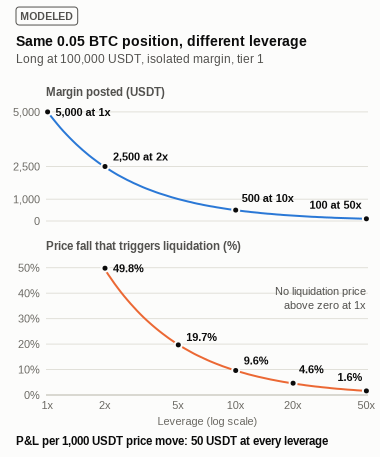
The P&L column is the same in every row. The last two columns are what change: the margin shrinks, so each move is a bigger share of it, and the liquidation price climbs toward the entry.
Worked example: a dip that liquidates the higher-leverage positions (synthetic data)#
A position can be liquidated even when the trader is right about the direction, because liquidation depends on the path, not on where price ends up. Figure 2 uses a synthetic hourly mark price that starts at 100,000 USDT, dips to 89,800 at hour 30 and recovers to 102,000 by hour 72. Three traders hold the same 0.05 BTC long at 5x, 10x and 20x.
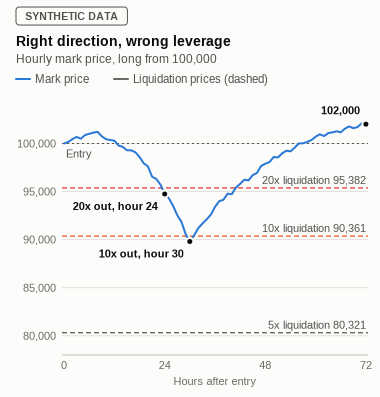
- 20x is liquidated at hour 24, when the mark price first falls below about 95,382 USDT.
- 10x is liquidated at hour 30, at the low of the dip, below about 90,361 USDT.
- 5x never comes near its liquidation price of about 80,321 USDT. At hour 72 it shows a gain of 0.05 × 2,000 = 100 USDT, which is 10% of its 1,000 USDT margin.
What a liquidated position loses#
At the 10x liquidation price the position has already lost about 481.93 of its 500 USDT. Binance's liquidation FAQ says a liquidation clearance fee is then charged from the remaining collateral, and that smaller positions are more likely to be fully liquidated because their maintenance margin can be smaller than that fee. A trader using isolated margin should therefore expect to lose roughly the whole isolated margin when liquidated, not just the distance to the liquidation price.
A larger position sits in a higher tier#
The maintenance margin depends on position size, not on leverage. A 10 BTC long at 100,000 USDT is worth 1,000,000 USDT, which falls in tier 3 (0.65% rate, 1,500 USDT maintenance amount, 75x maximum leverage). Its maintenance margin at entry is 1,000,000 × 0.65% − 1,500 = 5,000 USDT. At 10x the liquidation price is (1,000,000 − 100,000 − 1,500) ÷ (10 × 0.9935) ≈ 90,437.85 USDT, a fall of 9.56% instead of 9.64% for the small position. The difference is small here, but it grows in higher tiers.
What could change the conclusion about leverage and liquidation?#
The formula gives a clean liquidation price. Real positions can be closed earlier, later or at a worse price for several reasons.
Mark price is not the price you trade at. Liquidation follows the mark price, while a stop order can be set to trigger on the last traded price. On Binance's USDⓈ-M conditional orders, the trigger price type defaults to the contract (last) price unless the trader chooses the mark price. A stop on the last price and a liquidation on the mark price can therefore fire in a different order than their levels suggest. What is a stop order, and why can it fill worse than its trigger price? covers the trigger choices.
Fast markets. Binance's FAQ notes that in volatile markets the mark price can jump past the computed liquidation price within a second, so the position is closed at a worse mark price. If the remaining collateral cannot cover the loss, the position becomes bankrupt, and Binance's insurance fund and, as a last resort, auto-deleveraging of other traders absorb the rest.
Anything that changes the isolated balance moves the liquidation price. This lesson ignores trading fees and funding payments. Adding margin to an isolated position lowers a long's liquidation price, and a smaller balance raises it.
Rules change. Tiers, rates and maximum leverage are exchange settings that Binance can adjust, as its Leverage & Margin page warns.
Backtests cannot see inside a candle. A backtest on five-minute candles knows each candle's high and low but not the order in which they happened. Valmy's specification describes its simulated isolated liquidation as approximate for this reason.
Leverage is not a risk setting. The loss from a stop-out is quantity × distance, whatever the leverage. The practical question is whether the liquidation price sits safely beyond the stop, with room for slippage, so that the stop gets the chance to work. One way to use leverage is as the lowest setting that keeps the liquidation price well past the stop, with the margin left over held as a buffer.
Check your understanding: does the stop fire before liquidation?#
Question. A trader opens a long of 0.02 BTC at 80,000 USDT on a BTCUSDT perpetual, isolated margin, tier 1 (maintenance margin rate 0.40%, maintenance amount 0). They choose 40x leverage and plan a stop at 77,500 USDT. Ignore fees and funding.
- How much margin do they post?
- What is the liquidation price?
- Will the stop get a chance to work?
- What is the highest whole-number leverage that keeps the liquidation price at least 1% below the stop?
Show the answers
Answer.
- Position value = 0.02 × 80,000 = 1,600 USDT. Margin = 1,600 ÷ 40 = 40 USDT.
- Liquidation price = (1,600 − 40) ÷ (0.02 × 0.996) ≈ 78,313.25 USDT.
- No. The liquidation price is above the stop, so a fall toward 77,500 liquidates the position first, at about 78,313. The planned loss at the stop, 0.02 × 2,500 = 50 USDT, is more than the 40 USDT margin, which is another way to see the problem.
- The target is 77,500 × 0.99 = 76,725 USDT or lower. At 22x the margin is about 72.73 USDT and the liquidation price is about 76,670.32, which passes. At 23x it is about 76,829.06, which fails. So 22x is the highest whole number. The loss if the stop is hit is still 50 USDT at any of these leverage levels.
Related lessons#
- Before this lesson: How much should I risk on one trade? sets the position size that leverage then finances.
- Next: What is a perpetual future, and what does funding do? explains the contract and its funding payments.
- Next: Why does a futures price drift from the spot price? covers mark, index and last prices.
- See also: What is a stop order, and why can it fill worse than its trigger price? and How deep can a drawdown get, and how long does recovery take?.