What is a perpetual future, and what does funding do?
Short answerA perpetual future is a futures contract with no expiry date. To keep its price near the spot index, exchanges use funding, regular payments between longs and shorts. On Binance USDⓈ-M futures, each payment is the position's value at the mark price times the funding rate, and a positive rate means longs pay shorts. On BTCUSDT, which settled every 8 hours on 26 November 2026, the rate stays at the 0.0100% base rate while the average premium over the index is between −0.04% and +0.06%. At −0.020%, funding is −0.020% + 0.030% = +0.010%, and longs still pay; shorts pay only below −0.05%. Most perpetuals settled every 4 hours that day, where the same premium gives +0.005% per settlement.
The base rate is an illustration, not a quoted price. Paid at every settlement, 0.0100% every 8 hours would add up to about 10.95% of the position value a year, but the rate is recalculated each period and can rise, fall or turn negative. Funding is charged on the full position value, not on the margin, so before you hold a leveraged perpetual for weeks, estimate its funding alongside the trading fees.
Valmy noteValmy v1 supports Binance USDⓈ-M perpetuals settled in USDT, with one-way positions, isolated margin and capped leverage. As of 26 November 2026, Valmy's specification says backtests import Binance funding at the times it was actually charged and report it as a separate cost, and paper and live accounts apply funding to open positions. The rules below are Binance's; use them to estimate what a position would pay or receive.
How a perpetual future works#
A futures contract is an agreement to buy or sell an asset later at a price fixed now. A dated future has an expiry date, when it settles against the underlying price. A perpetual future has no expiry. Binance's funding FAQ puts it this way: perpetual contracts have no expiry date or settlement obligation, so a position stays open until the trader closes it or it is liquidated. Holding one does not mean owning the coin. It means holding a contract whose profit or loss follows the coin's price.
The terms used in this lesson:
- USDⓈ-M (USDT-margined) contracts such as BTCUSDT are quoted in USDT, take margin in USDT and pay profit and loss in USDT. Profit or loss = quantity × price change.
- Long profits when the price rises. Short profits when it falls.
- Notional (position value) = quantity × mark price. A 0.05 BTC position at 100,000 USDT has a notional of 5,000 USDT.
- Margin is the collateral behind the position, as What does leverage change, and when is a position liquidated? explains. At 10x, 5,000 USDT of notional needs 500 USDT of margin.
- The mark price is Binance's estimate of the contract's fair price. It is used for unrealized profit and loss, liquidation and the funding amount. Why does a futures price drift from the spot price? explains how it is built.
Binance also lists dated quarterly contracts. On 26 November 2026, its USDⓈ-M exchange information showed BTCUSDT and ETHUSDT contracts delivering on 25 December 2026 and 26 March 2027. Valmy v1 trades only the perpetuals.
Why a perpetual needs funding#
A dated future is pulled toward the spot price because it settles against it at expiry. A perpetual has no such date, so funding takes over that job, with a tilt toward longs paying. When the perpetual's average premium over the spot index rises above +0.06%, funding climbs above the 0.0100% base rate: holding a long costs more, and a trader who shorts the perpetual and buys the coin on the spot market collects more. That selling pressure pushes the perpetual back down. A small discount does not reverse the payments. On an 8-hour Binance contract with the standard interest rate, such as BTCUSDT, an average premium of −0.020% still gives funding of +0.010%, and longs pay; a 4-hour contract would charge half that per settlement, +0.005%. Funding drops below the base rate only when the average premium is below −0.04%. It turns negative, so that shorts pay longs and a trader who buys the perpetual against a spot sale collects, only below −0.05%.
Two details separate what you see on screen from what is charged. The premium index compares the prices a sizable order would get in the perpetual's order book with the index, not the last trade. Funding then uses a time-weighted average of it over the whole interval. A contract that trades below the index for part of an interval can still settle with a positive average premium, and even a negative average, as long as it stays above −0.05%, leaves longs paying.
Research supports this picture with caveats. Ackerer, Hugonnier and Jermann (Mathematical Finance, 2026) derive no-arbitrage prices for perpetual futures and show that funding is what ties the price to spot: in their model the futures price equals the risk-neutral expected spot price at a random future date, and particular funding rules make the futures and spot prices coincide. In a working paper, He, Manela, Ross and von Wachter report that crypto perpetuals have deviated from such prices by more than comparable contracts in traditional currency markets, that the deviations move together across coins, and that they have shrunk over time.
What funding does: who pays whom#
Funding is a payment between traders holding long positions and traders holding short positions at each funding time. Binance's funding FAQ (updated 6 March 2026) sets out the rules:
- When the funding rate is positive, longs pay shorts. When it is negative, shorts pay longs.
- Binance charges no fee on funding. The payment passes directly between the two sides.
- Funding amount = notional at the mark price × funding rate.
- Only positions open at the funding time pay or receive. A position closed before then pays nothing. The FAQ notes that the actual transfer can be up to 15 seconds off the scheduled time.
- Funding is taken from the available balance in the futures account. If that balance is too small, it comes out of the position's margin, which can move the liquidation price.
A long of 0.05 BTC with a mark price of 100,000 USDT at a funding rate of 0.0100% pays 5,000 × 0.0001 = 0.50 USDT at that settlement, and a short of the same size receives 0.50 USDT.
Binance's USDⓈ-M funding formula (as of 26 November 2026)#
Binance computes each funding rate from an average premium index, which measures how far the perpetual's order book sits above or below the spot index, plus an interest component, then limits the result with a cap and a floor. For an 8-hour contract:
Funding rate = average premium + clamp(0.0100% − average premium, −0.05%, +0.05%)
In words: when the 8-hour average premium is between −0.04% and +0.06%, the funding rate equals the 0.0100% interest rate. Above that band, the rate is the premium minus 0.05%. Below it, the premium plus 0.05%, which stays positive down to −0.05% and turns negative only below that. So the sign of the funding rate does not follow the sign of the premium: with an average premium between −0.05% and 0%, the contract trades at a discount and longs still pay. For an interval of N hours, the FAQ divides the result by 8 ÷ N, which leaves these thresholds unchanged but scales the rate: at an average premium of −0.020%, a 4-hour contract pays +0.010% ÷ 2 = +0.005% per settlement, the same 0.03% a day over six settlements. On a contract whose interest rate is 0%, the formula gives zero funding anywhere between −0.05% and +0.05%, so the same −0.020% premium pays nothing. The pieces:
- Premium index = [max(0, impact bid − index) − max(0, index − impact ask)] ÷ index, computed every 5 seconds. The index is a weighted average of spot prices on several exchanges.
- Impact bid and ask are the average prices a market order of a set size would get on each side of the perpetual's book. The size, the impact margin notional, is 200 USDT divided by the initial margin rate at the contract's maximum leverage. BTCUSDT's maximum leverage was 150x on 26 November 2026, an initial margin rate of 1/150, so the impact size works out to 30,000 USDT.
- Average premium: over an 8-hour period Binance uses all 5,760 samples, weighted 1, 2, 3 and so on, so later samples count more. For 1-hour contracts the samples are weighted equally.
- Interest rate: 0.03% a day, or 0.0100% per 8 hours, by default. Binance's public data showed 0.0100% for BTCUSDT on 26 November 2026. Three trading perpetuals showed 0% that day: ETHBTC, BNBUSDT and BNBUSDC.
- Cap and floor: for 34 listed major contracts, including BTCUSDT and ETHUSDT, ±0.75 times the maintenance margin rate at maximum leverage. For BTCUSDT that is 0.75 × 0.40% = ±0.30%, the value Binance's funding-information data listed on 26 November 2026. For most remaining USDⓈ-M perpetuals the setting was ±2%, but it is contract-specific: the index perpetuals BTCDOMUSDT and ALLUSDT had ±3%, while the pre-market PREDICTUSDT had ±0.005% on 26 November 2026. Binance can adjust the limits. Before estimating funding, find the exact symbol in its current funding-information response and check
adjustedFundingRateCap,adjustedFundingRateFloorandfundingIntervalHours; confirm the contract type and trading status in exchange information. Do not infer one instrument's limits from another's.
Funding intervals. The default is every 8 hours, at 00:00, 08:00 and 16:00 UTC, but intervals differ by contract and can change:
- Since 2 May 2025, when a settlement reaches the cap or floor, the contract switches to 1-hour funding from the next period.
- Since 2 January 2026, a 1-hour contract returns to 4-hour funding after 16 settlements in a row with a rate no larger than 0.025% either way.
- On 26 November 2026, Binance's exchange information listed 567 USDⓈ-M perpetuals with trading status, and its funding-information endpoint gave an interval for every one of them: 431 settled every 4 hours, 131 every 8 hours, including BTCUSDT and ETHUSDT, and 5 every hour. So the 8-hour default described in the FAQ was the exception that day, not the rule. The endpoint's 833 rows also include contracts that were not trading, and counts can move within a day as contracts switch intervals, so check the interval of the specific contract before you estimate its funding.
Calculating funding rates from an average premium#
With the 0.0100% interest rate and the ±0.05% clamp:
| Average premium | 0.0100% − premium | After the clamp | Funding rate |
|---|---|---|---|
| 0.0300% | −0.0200% | −0.0200% | 0.0100% |
| 0.0429% (Binance's own example) | −0.0329% | −0.0329% | 0.0100% |
| 0.0800% | −0.0700% | −0.0500% | 0.0300% |
| 0.1500% | −0.1400% | −0.0500% | 0.1000% |
| −0.0200% | 0.0300% | 0.0300% | 0.0100% |
| −0.0450% | 0.0550% | 0.0500% | 0.0050% |
| −0.0500% | 0.0600% | 0.0500% | 0.0000% |
| −0.0700% | 0.0800% | 0.0500% | −0.0200% |
| 0.4000% | −0.3900% | −0.0500% | 0.3500%, capped at 0.3000% for BTCUSDT |
All four negative premiums describe a contract trading below the index on average. At −0.0200% and −0.0450% longs still pay, at −0.0500% nobody pays, and only at −0.0700% do shorts pay longs.
On a 4-hour contract, an average premium of 0.0800% gives (0.0800% − 0.0500%) ÷ 2 = 0.0150% per settlement, with twice as many settlements a day.
Worked example: funding on a BTCUSDT long over one week (synthetic data)#
Funding paid over a week depends on how the premium moves, so this example first shows constant rates and then a synthetic week. Assumptions throughout: a long of 0.05 BTC on an 8-hour contract with BTCUSDT's parameters, the mark price held at 100,000 USDT at every funding time so the notional stays 5,000 USDT, 10x isolated margin of 500 USDT, and no trading fees. A week has 21 settlements and a year 1,095.
Funding at constant rates#
At a constant rate, funding paid = notional × rate × number of settlements. For this 5,000 USDT long, a base rate of 0.0100% held at every settlement would cost 0.50 USDT per settlement, 10.50 USDT a week and 547.50 USDT a year. The table applies the same arithmetic to other rates. The weekly and yearly columns show what a rate would cost if it never changed, not what a position will pay:
| Funding rate per 8 h | Per settlement | Per week | Per year | Share of notional per year | Share of 500 USDT margin per year |
|---|---|---|---|---|---|
| 0.0100% | 0.50 USDT | 10.50 USDT | 547.50 USDT | 10.95% | 109.5% |
| 0.0300% | 1.50 USDT | 31.50 USDT | 1,642.50 USDT | 32.85% | 328.5% |
| 0.1000% | 5.00 USDT | 105.00 USDT | 5,475.00 USDT | 109.5% | 1,095% |
| −0.0100% | −0.50 USDT | −10.50 USDT | −547.50 USDT | −10.95% | −109.5% |
The yearly figures are simple totals, without compounding, and real rates do not stay constant. The last column is the point to notice: because funding is charged on the notional, a 10x position paying the base rate at every settlement for a year would pay more than its whole margin. A negative rate means the long receives.
A synthetic week of premium and funding#
Over a synthetic week with a rally and a selloff, the 5,000 USDT long pays 30.88 USDT of funding, almost three times the 10.50 USDT it would pay at the base rate. Figure 1 uses a synthetic premium index sampled hourly (Binance samples every 5 seconds) and averaged with Binance's 1, 2, 3 weighting over each 8-hour period. The path was designed to show a calm start, an overheated rally and a selloff.
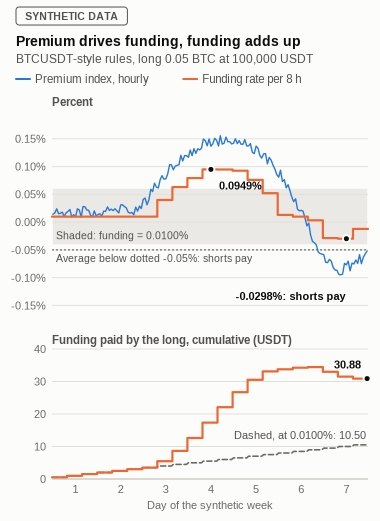
- Days 1 to 3. The premium stays between about 0.01% and 0.03% for two days, then starts to climb. The 8-hour averages stay inside the band until midway through day 3, so the first seven settlements are all 0.0100%, 0.50 USDT each.
- Days 3 to 5. The premium keeps climbing, to a peak of about 0.16% on day 4. Funding follows it, up to 0.0949% per settlement. Days 4 and 5 alone cost the long 24.47 USDT.
- Day 6. The premium falls back and drops below zero from hour 135, late on day 6. The settlement that includes hour 135 still averages above zero, because the time-weighted average looks at all eight hours. The last settlement of day 6 averages −0.0468%: every hourly sample in its window was negative, and the last three were below −0.05%. Its rate is still +0.0032%, so longs pay a little while the contract trades at a discount.
- Day 7. All three averages are below −0.05%, so funding turns negative (as low as −0.0298%), and the long receives 3.54 USDT over three settlements.
Over the week the long pays 30.88 USDT net, about 0.62% of its notional and 6.2% of its 500 USDT margin. At a constant 0.0100% it would have paid 10.50 USDT, so the rally almost tripled the cost.
How funding can move an isolated liquidation price#
If the futures account has no other available balance, funding comes out of the position's margin, and less margin moves an isolated long's liquidation price closer. Using the reduced form of Binance's formula from the leverage lesson, liquidation price = (quantity × entry − margin) ÷ (quantity × (1 − maintenance margin rate)), with BTCUSDT's 0.40% tier 1 rate:
- With 500 USDT of margin: (5,000 − 500) ÷ (0.05 × 0.996) ≈ 90,361.45 USDT.
- After the week's 30.88 USDT of funding: (5,000 − 469.12) ÷ 0.0498 ≈ 90,981.53 USDT, 620.08 USDT higher.
Each 1 USDT of funding taken from this position's margin raises its liquidation price by about 20.08 USDT.
Funding compared with trading fees#
For a position held more than a day or two, funding can cost more than the trading fees. At Binance's base USDⓈ-M taker rate of 0.0500% (as of 26 November 2026), opening and closing the 5,000 USDT position costs 2 × 5,000 × 0.0005 = 5.00 USDT. One week with every settlement at the base funding rate would cost 10.50 USDT, about 2.1 times that round trip, and the synthetic week cost 30.88 USDT. Both are charged on the notional, so both rise with leverage. How much do trading fees cost me over a year? covers the fee side.
Funding can also be income. A short receives positive funding, and a long receives negative funding. For a strategy that holds positions across many funding times, the funding total can be a meaningful part of the result, and its sign depends on which side the strategy tends to hold while the premium is high.
Valmy note: as of 26 November 2026, Valmy's specification has backtests import funding events with their timestamps and rates, apply them to positions open at those times, and report costs split into fees, a slippage estimate and funding. A strategy evaluated on closed five-minute candles pays or receives funding like any other position that is open at a funding time. How much do fees and slippage change a backtest? shows how such costs change a test result.
What could change the conclusion about funding?#
Funding is simple to compute once the rate is known, but the rate, the interval and the rules can all move.
Rates change and switch sign. The synthetic week was designed to show a rally and a selloff. Real rates may sit at the base rate or swing sharply. A long that receives funding in a selloff can pay much more in the next rally. The sign follows the average premium with an offset, not the price you see: a contract can trade below the index for hours while longs keep paying, until the average falls below −0.05%.
The interval can shorten. If a settlement reaches the cap or floor, Binance moves the contract to hourly funding. The FAQ's example for BTCUSDT keeps the ±0.3% limit on each hourly settlement, so in an extreme market the cost can build up to eight times faster than on the 8-hour schedule. Binance says it does not announce these switches.
Parameters can change. Binance reserves the right to change the interest rate, the caps and floors, and the intervals. All values here are as of 26 November 2026.
The displayed rate is an estimate. Before a settlement, the rate Binance shows is computed from the most recent 8 hours of premium data, so it can change until the settlement time.
Notional moves with the mark price. This lesson held the mark price at 100,000 USDT. A position whose mark price rises pays more funding at the same rate.
Spot is an alternative with different risks. Holding the coin on Binance Spot involves no funding and no liquidation, but no leverage either, and the holding is a claim on the exchange, as What do I own when I hold crypto on an exchange? explains.
Check your understanding: funding on a short position#
Question. A trader is short 0.03 BTC on an 8-hour BTCUSDT perpetual and holds the position through three settlements. The mark prices at those times are 90,000, 91,000 and 89,500 USDT, and the funding rates are +0.0200%, −0.0100% and +0.0500%.
- How much funding does the short pay or receive in total?
- What 8-hour average premium produces a funding rate of +0.0500%?
- What would the same average premium produce on a 4-hour contract, and how does the daily cost compare?
- If the rate stayed at 0.0500% per 8 hours for a year, what would a long pay, as a simple percentage of its notional?
- At a fourth settlement, the 8-hour average premium is −0.0300%, so the contract traded below the index on average, and the mark price is still 89,500 USDT. Does the short pay or receive funding, and how much?
Show the answers
Answer.
- Settlement 1: notional 0.03 × 90,000 = 2,700 USDT; the rate is positive, so the short receives 2,700 × 0.0002 = 0.54 USDT. Settlement 2: 2,730 USDT at a negative rate, so the short pays 2,730 × 0.0001 = 0.273 USDT. Settlement 3: 2,685 USDT, the short receives 2,685 × 0.0005 = 1.3425 USDT. Net: 0.54 − 0.273 + 1.3425 = 1.6095 USDT received.
- 0.0500% is above the band, where the rate equals the premium minus 0.05%. So the average premium is 0.1000%.
- (0.1000% − 0.0500%) ÷ 2 = 0.0250% per settlement. There are six 4-hour settlements a day, so 6 × 0.0250% = 0.15% a day, the same as 3 × 0.0500% on the 8-hour contract.
- 0.0500% × 1,095 = 54.75% of notional a year, as a what-if: real rates change every period, so this is not a forecast.
- The clamp term is 0.0100% − (−0.0300%) = 0.0400%, inside ±0.05%, so the rate is −0.0300% + 0.0400% = +0.0100%. The rate is positive, so longs pay shorts despite the discount: the short receives 2,685 × 0.0001 = 0.2685 USDT. Shorts would pay only if the average premium fell below −0.05%.
Related lessons#
- Before this lesson: What does leverage change, and when is a position liquidated? explains margin, the mark price and liquidation.
- Next: Why does a futures price drift from the spot price? covers the index, the mark price and basis.
- See also: How much do trading fees cost me over a year? and How much do fees and slippage change a backtest?.
- See also: What are perpetuals and other derivatives that track stocks? applies the same contract design to other underlyings.