How much do trading fees cost me over a year?
Short answerA year of trading fees costs roughly number of trades × size of each trade × fee rate, and every round trip (a buy and a sell) pays twice. At Binance's base Spot rate of 0.100% per trade (as of 26 November 2026), two round trips a week with 1,000 USDT positions cost about 208 USDT a year, 20.8% of a 1,000 USDT account. The base USDⓈ-M futures taker rate of 0.0500% halves that, but leverage raises the notional the fee is charged on. Before running a strategy, check that its average gain per round trip (the compounded average, if each trade reinvests the balance) beats twice the fee rate plus the spread and slippage: on Spot, more than 0.20% plus execution costs.
Scope note: Fee rates in this lesson are Binance's published Regular User (base tier) rates, checked on 26 November 2026. Exchanges change their rates and run promotions, so check the current fee page before relying on them. This lesson covers the exchange's trading fees only.
How exchange trading fees are charged#
Exchanges charge a trading fee, also called a commission, as a percentage of the value of each trade. The value of a trade is its notional: quantity × price. A 1,000 USDT purchase at a 0.100% fee costs 1.00 USDT in fees, whatever the coin.
Three details decide what you actually pay:
- Maker or taker. An order that rests in the book and is filled later is a maker. An order that trades immediately is a taker. Exchanges can charge the two differently. Market orders are always takers. See What actually happens when I place a buy order?.
- Which asset pays. On Binance Spot, the fee is taken from the asset you receive, unless you pay it in BNB at a discount. A buy of 1 BTC at 0.100% credits 0.999 BTC. If your BNB balance can't cover the discounted fee, the full fee comes out of the received asset instead.
- Futures fees are charged on notional, not on margin. Binance's futures FAQ gives the commission as notional value × fee rate. With 2× leverage, 1,000 USDT of margin controls 2,000 USDT of notional, so each trade's fee is twice as large.
Binance's base-tier fee rates as of 26 November 2026#
Binance groups users into tiers. The base tier, called Regular User, covers every account that doesn't qualify for a VIP tier. VIP 1 requires at least 1,000,000 USD of 30-day Spot volume (5,000,000 USD for futures) together with a balance of at least 5 BNB, and higher tiers need more of both. VIP tiers pay lower rates.
| Product (Regular User tier) | Maker | Taker | With the BNB discount |
|---|---|---|---|
| Spot | 0.100% | 0.100% | 0.075% maker and taker (25% off) |
| USDⓈ-M futures, USDT-margined | 0.0200% | 0.0500% | 0.0180% maker, 0.0450% taker (10% off) |
Two notes from the same pages. Spot pairs quoted in USDC showed a slightly lower taker rate of 0.095%. The futures page also listed promotional rates for some perpetuals margined in other stablecoins. Valmy v1 trades Binance Spot and USDT-settled perpetuals, so the standard rates in the table are the ones used below.
The annual fee formula: trades × notional × rate#
For a strategy that trades the same size each time:
Annual fee cost = trades per year × notional per trade × fee rate
A round trip is one buy and one sell, so it counts as two trades. A strategy with N round trips a year makes 2N trades.
Worked example: two round trips a week with 1,000 USDT (hypothetical)#
Suppose a trader opens and closes a 1,000 USDT position twice a week. That is 104 round trips, or 208 trades, a year. For simplicity, assume each trade is worth 1,000 USDT. The table applies the base-tier rates:
| Fee schedule | Rate per trade | Annual fees (USDT) | Share of a 1,000 USDT account |
|---|---|---|---|
| Spot | 0.100% | 208.00 | 20.8% |
| Spot, fee paid in BNB | 0.075% | 156.00 | 15.6% |
| USDⓈ-M futures, taker | 0.0500% | 104.00 | 10.4% |
| USDⓈ-M futures, taker, BNB | 0.0450% | 93.60 | 9.36% |
| USDⓈ-M futures, maker | 0.0200% | 41.60 | 4.16% |
| USDⓈ-M futures, maker, BNB | 0.0180% | 37.44 | 3.744% |
For Spot: 208 × 1,000 × 0.001 = 208.00 USDT. The trader pays this whether the trades win or lose.
Leverage multiplies the fee on futures#
Fees on futures follow the notional, so leverage scales them up. If the same trader uses 1,000 USDT of margin at 2× leverage, each position is worth 2,000 USDT. One round trip at the taker rate then costs 2 × 2,000 × 0.0005 = 2.00 USDT, and 104 round trips cost 208.00 USDT a year: 20.8% of the margin, the same as Spot without leverage. Leverage also scales gains and losses, as What does leverage change, and when is a position liquidated? explains.
Fee drag when you reinvest everything: (1 − f)^(2N)#
When a trader puts the whole balance into every trade, each fee is taken from a balance already reduced by earlier fees. With a fee rate f per trade, one round trip leaves (1 − f)² of the capital, before any gain or loss. After N round trips:
Capital kept = (1 − f)^(2N), so capital lost to fees = 1 − (1 − f)^(2N)
This is exactly how Spot fees work when you buy with all your USDT and sell everything: the buy credits (1 − f) of the coins, and the sale credits (1 − f) of the proceeds.
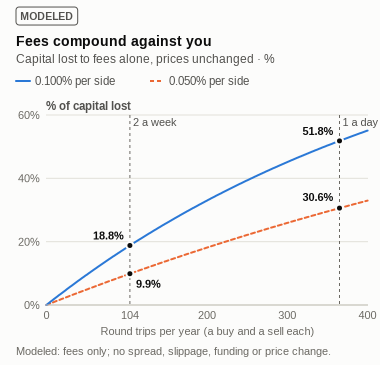
For 104 round trips at 0.100%: 0.999^208 ≈ 0.8121, so fees alone take about 18.8% of the capital in a year if prices don't move. That is a little less than the simple total of 208 × 0.100% = 20.8%, because later fees are charged on a smaller balance. The difference grows with the number of trades:
- 104 round trips (two a week): 18.8% at 0.100% per side, 9.9% at 0.050%.
- 365 round trips (one a day): 51.8% at 0.100%, 30.6% at 0.050%.
- 1,825 round trips (five a day): about 97% at 0.100%. A strategy on five-minute candles can trade that often if its rules allow.
Fees against a strategy's average gain per trade#
The useful comparison is fee cost per round trip against the strategy's average gross gain per round trip, the gain before costs. A round trip at fee rate f costs about 2f of the position, so a strategy that trades the same fixed amount each time needs an average gross gain above 2f just to break even on fees. If each trade instead reinvests the whole balance, the test is the compounded gain per trade, which is lower than the simple average when results vary; How much do fees and slippage change a backtest? shows a case where the simple average clears the cost and the account still loses. For fixed-size trades, the thresholds are:
- Spot at 0.100%: above 0.20% per round trip.
- USDⓈ-M futures taker at 0.0500%: above 0.10%.
- USDⓈ-M futures maker at 0.0200%: above 0.04%.
Worked example: a 0.30% average gain per round trip (hypothetical)#
Take the trader from the first example, with 104 round trips of 1,000 USDT a year. Suppose the strategy's average gross gain is 0.30% per round trip, or 3.00 USDT, which adds up to 312.00 USDT a year before costs. For simplicity, both sides of each trade are charged on 1,000 USDT.
| Fee schedule | Fee per round trip (USDT) | Net per round trip (USDT) | Net per year (USDT) |
|---|---|---|---|
| Spot, 0.100% | 2.00 | 1.00 | 104.00 |
| Spot with BNB, 0.075% | 1.50 | 1.50 | 156.00 |
| USDⓈ-M futures taker, 0.0500% | 1.00 | 2.00 | 208.00 |
| USDⓈ-M futures maker, 0.0200% | 0.40 | 2.60 | 270.40 |
On Spot, fees take two thirds of the gross gain. The edge that looked like 312 USDT a year is 104 USDT after fees. Now add the spread and slippage from Why did I pay more than the price on screen?. If they cost a hypothetical 0.05% per side, the round trip costs 0.20% in fees plus 0.10% in execution, and the 0.30% average gain shrinks to exactly zero.
The futures rows look cheaper, but they leave out funding payments, and leverage raises the notional that the fees are charged on.
Other costs on top of fees: spread, slippage and funding#
Trading fees are the cost you can read from a fee page. Two other costs are less visible:
- Spread and slippage. Every market order pays part of the spread, and larger orders walk the book. These costs come on top of the fee and are not shown on any fee page. See What makes a market liquid, and why does it matter for my order?.
- Funding on perpetual futures. Holders of perpetual futures exchange funding payments at set times. Binance's funding FAQ says that when the funding rate is positive, longs pay shorts, and when it is negative, shorts pay longs. Binance takes no fee on these payments. The FAQ gives every 8 hours (at 00:00, 08:00 and 16:00 UTC) as the default, but intervals vary by contract: on 26 November 2026, 431 of Binance's 567 trading USDⓈ-M perpetuals settled every 4 hours, while BTCUSDT settled every 8. Only positions open at that moment pay or receive. The payment is the position's notional value × the funding rate.
For scale, with a hypothetical funding rate of +0.01% per 8-hour period, a 2,000 USDT long held for three days (nine periods) would pay 2,000 × 0.0001 × 9 = 1.80 USDT, about as much as one taker round trip at that size. Real funding rates change over time and can be negative, so a position can also receive funding. How funding works is covered in What is a perpetual future, and what does funding do?.
Valmy note: as of 26 November 2026, Valmy's specification reports backtest costs split into fees, a slippage estimate and funding, so each of these costs can be seen separately. How much do fees and slippage change a backtest? shows how much they change a test result.
What could change the conclusion about fee costs#
The arithmetic is simple, but the inputs can shift:
- Rates change. Exchanges revise fee schedules, add promotions on particular pairs and change BNB discounts. The rates here are as of 26 November 2026.
- Your tier can change. Higher 30-day volume and a BNB balance can move an account to a VIP tier with lower rates. A trader who qualifies pays less than the table shows.
- The BNB discount has strings attached. It requires holding BNB, whose price moves. If the BNB balance runs short, Binance takes the full fee from the received asset instead.
- Choosing maker fees isn't free. A resting limit order pays the lower maker rate on futures, but it may fill late, only partly or not at all. The saving is real only if the strategy still gets the trades it needs.
- Fixed size and full reinvestment give different numbers. The simple formula fits a trader who trades the same amount each time. The compounding formula fits one who trades the whole balance. Most real accounts sit somewhere between.
- Average gains vary; fees don't. A 0.30% average gain may come from a few large wins and many small losses. Fees are charged on every trade, winners and losers alike.
Check your understanding: fees on a leveraged futures strategy#
Question. A trader runs a USDⓈ-M futures strategy with 500 USDT of margin at 2× leverage, so each position is worth 1,000 USDT. It opens and closes a position three times a week with market orders, at the base taker rate of 0.0500% and without the BNB discount. Its hypothetical average gross gain is 0.15% of notional per round trip.
- What are the fees per round trip and per year, and what share of the margin is that?
- What share of the gross gain do the fees take, and what is the net result per year?
- What changes if both sides could be filled as maker orders at 0.0200%?
Show the answers
Answer.
- Each round trip pays 2 × 1,000 × 0.0005 = 1.00 USDT. Three a week is 156 round trips a year, so fees are 156.00 USDT, or 31.2% of the 500 USDT margin.
- The gross gain is 0.15% × 1,000 = 1.50 USDT per round trip. Fees take 1.00 of it, about two thirds. The net is 0.50 USDT per round trip, or 78.00 USDT a year, before spread, slippage and funding.
- Maker fees would be 2 × 1,000 × 0.0002 = 0.40 USDT per round trip, or 62.40 USDT a year. The net would rise to 1.10 USDT per round trip, or 171.60 USDT a year. That assumes every limit order still fills, which is not guaranteed.
Related lessons#
- Before this lesson: What actually happens when I place a buy order?
- Next: How much do fees and slippage change a backtest?
- See also: Why did I pay more than the price on screen?
- See also: What is a perpetual future, and what does funding do?
- See also: What makes a market liquid, and why does it matter for my order?