What do I own when I hold crypto on an exchange?
Short answerWhen you hold crypto on a centralized exchange such as Binance, you usually do not hold coins at a blockchain address you control. You hold a claim on the exchange: an entry in its internal ledger, backed by coins it pools for all its customers in shared wallets. That claim is only as safe as the exchange's terms, the law it answers to and the accuracy of its records. FTX showed what happens when the records are wrong: after it failed in November 2022, its customers waited years and were repaid a dollar amount, not their coins.
Knowing this, you can decide how much to leave on an exchange and judge what its proof of reserves does and does not tell you.
In Valmy’s private paper beta, the balance is virtual. You can follow this lesson without an exchange account, API key or deposit. The Binance and Base sections explain who would control real assets under two different live-account designs. The exchange terms and reserve figures are dated examples, with FTX as a historical case.
Exchange balance versus a wallet you control#
The difference between an exchange balance and coins in your own wallet is who holds the private key, the secret that authorizes moving coins from a blockchain address. The U.S. Securities and Exchange Commission's investor bulletin on crypto custody (12 December 2025) separates two arrangements:
- Self-custody: you hold the private keys. Nobody else can move the coins, and nobody else can rescue them if the keys are lost.
- Third-party custody: an exchange or custodian holds the keys. You hold an account, and the custodian decides how and where the coins are stored. The bulletin's warning about this arrangement is the subject of this lesson: if the custodian is hacked or fails, its customers can be cut off from their coins.
An exchange keeps an internal ledger, its own database of what each customer holds. Three everyday actions show how the ledger and the blockchain relate:
- Deposit. You send coins on the blockchain to an address the exchange controls. Once the transfer is confirmed, the exchange credits your account in its ledger. From then on, the coins are in the exchange's hands and the ledger entry is yours.
- Trade. When you buy BTC with USDT on Binance Spot, no coins move on the blockchain. Binance's Terms of Use say its custodian settles trades by updating its internal ledger, debiting one account and crediting another. What actually happens when I place a buy order? explains the matching step that comes before.
- Withdrawal. You instruct the exchange to send coins to an external address. Binance's terms say it then deducts your balance and starts an on-chain transfer. The same clause lets it decline a withdrawal that rules or the agreement prevent, and suspend withdrawals while it resolves an incident on the platform.
A withdrawal is the only step that turns the claim back into coins you control.
Where a deposit sits: ledger entries and omnibus wallets#
Your exchange balance is a row in the exchange's ledger, and the coins behind all customers' rows are usually pooled in omnibus wallets: blockchain addresses that hold many customers' coins together, sometimes alongside the exchange's own. Custodians can use hot wallets, connected to the internet so withdrawals can be processed quickly, and cold wallets, kept offline for safety. The SEC bulletin notes that a custodian may use either or both, and Binance's Proof of Reserves page mentions both.
Because the coins are pooled, nobody can point to "your" coins on the blockchain. What you own is a quantity: 0.5 BTC of the exchange's BTC holdings, not particular coins. The system works as long as the total in the wallets is at least the total the ledger owes customers.
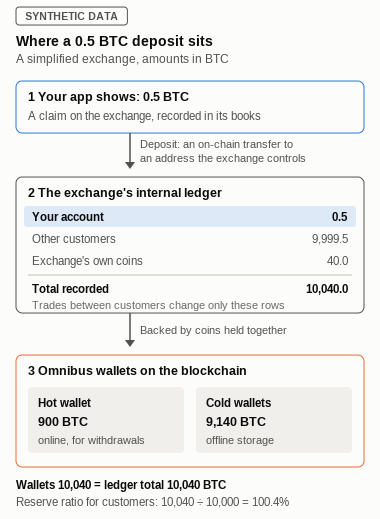
In this simplified exchange, customers are owed 10,000 BTC, the exchange owns 40 BTC itself, and the wallets hold 10,040 BTC, so reserves cover customer balances at 10,040 ÷ 10,000 = 100.4%. Binance's terms say its custodian reconciles the balances recorded in customer accounts against the omnibus wallets at least every week.
What Binance's Terms of Use say about ownership (as of 26 November 2026)#
Binance's global Terms of Use, effective 27 October 2026, say that the coins recorded in your account are held for you on trust by a Binance custodian, recorded separately from its own assets in its ledger, and may be pooled on-chain in omnibus wallets. Your right is described as a beneficial interest in a quantity and type of coin, not in the specific coins you deposited. The agreement is with three Binance companies in the Abu Dhabi Global Market (ADGM), each regulated there by the Financial Services Regulatory Authority: Nest Exchange Limited runs the exchange, Nest Clearing and Custody Limited (NCCL) provides clearing and custody, and Nest Trading Limited acts as broker-dealer. Local terms can add to these in some countries, so a user should read the terms that apply to their own account.
The custody clauses, paraphrased:
- Custodian. Opening an account appoints NCCL as custodian of the digital assets, securities and currency in it.
- Ledger segregation. NCCL keeps separate ledger records of its own assets and of the assets it holds for each client.
- Fungible entitlement. Each client has an individual entitlement to the amount of each asset recorded in their account. Coins of the same type are interchangeable.
- Omnibus wallets. Client coins may sit in shared wallets with NCCL's own coins and other clients' coins. Each person owns a proportion of a wallet's contents equal to their ledger amount, and the pooling does not end the trust.
- No lending without consent. NCCL will not lend, pledge or otherwise use client assets, except where the client opts into product terms that permit it, or where the agreement or the clearing rules allow it in order to clear and settle trades.
- Insolvency. Assets held on trust are not NCCL's property and benefit from ADGM protections if NCCL becomes insolvent. The terms add that if the costs of distributing trust assets must be paid from those assets, NCCL's own share is used first and any remainder is charged to clients pro rata.
- Binance's own rights over your assets. You grant NCCL a security interest and lien over the assets in your account to secure what you owe Binance, and Binance can set off amounts you owe it against amounts it owes you.
- Cash. Currency is held as client money in pooled accounts at financial institutions and is not available to NCCL's creditors. The terms exclude cash held in a separately labeled fiat wallet from that protection.
What "on trust" and a beneficial interest mean in plain terms#
A trust is a legal arrangement in which one party, the trustee, holds property for the benefit of others, the beneficiaries. If an exchange's custodian holds client coins on trust and the records are accurate, those coins are meant to stay outside the custodian's own estate if it fails, so its general creditors cannot take them. A beneficial interest is the beneficiary's right to that property.
Two limits follow. First, a trust protects coins that exist and are correctly recorded. It cannot recover coins that were never there or were taken. Second, the protection works through the rules of the place that governs the trust, here ADGM, and through an insolvency process that can take time and charge costs. The terms describe what Binance promises. The next sections show how a customer can check part of that promise, and what happened when another exchange's promises were false.
Proof of reserves: what Binance publishes#
Proof of reserves is an exchange's evidence that, at a given moment, it held at least as many coins of each asset as its customers' balances. Binance's Proof of Reserves page shows, for each asset in a snapshot, customers' net account balances, the balance of its wallets on the blockchain, split into an exchange balance and a third-party custody balance, and the reserve ratio of wallets to customer balances. It publishes the wallet addresses, a Merkle root and a zk-SNARK proof. On 26 November 2026 the latest snapshot shown was dated 12 November 2026 at 00:00 UTC.
Calculating Binance's BTC reserve ratio (real data, snapshot of 12 November 2026)#
Binance's figures for BTC in that snapshot:
| Item | BTC |
|---|---|
| Customers' net account balances | 687,912.027 |
| Exchange balance | 677,744.009 |
| Third-party custody | 10,539.645 |
| On-chain wallet balance (sum of the two lines above) | 688,283.654 |
- Reserve ratio = 688,283.654 ÷ 687,912.027 ≈ 1.0005, shown as 100.05%.
- Excess over customer balances = 688,283.654 − 687,912.027 = 371.627 BTC.
- Third-party custody = 10,539.645 ÷ 688,283.654 ≈ 1.53% of the BTC reserve.
The page adds that the excess in these addresses does not indicate how much of its own assets Binance holds. A ratio just above 100% says the wallets covered customer BTC balances at midnight UTC on 12 November 2026, with little to spare.
How the Merkle-tree check works#
A Merkle tree lets each customer check that their own balance was counted in the total without seeing anyone else's. Every account becomes a leaf: a hash, a short fingerprint computed from the account ID and its balances. Pairs of hashes are hashed together, and the pairs of those, until one Merkle root remains, which the exchange publishes. Changing any balance changes the root.
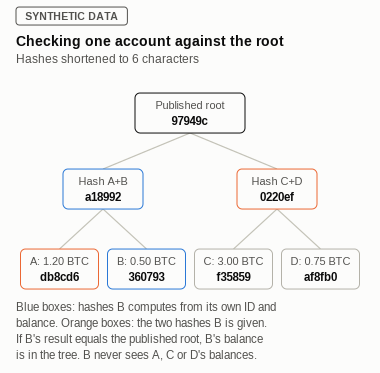
On Binance, a logged-in user finds their record ID and leaf under the wallet's verification page and can check it with Binance's verification method. Binance describes its zk-SNARK proof as showing that each included account's balances are counted in the customer total it reports and that no account's net balance is below zero. The second condition matters because a fake account with a negative balance could otherwise shrink the total.
What proof of reserves cannot show#
A reserve snapshot compares coins at one moment against customer balances. It does not show the exchange's other debts, whether some coins were borrowed just for the snapshot, what happened to the coins afterwards, or whether the exchange's controls are sound. Staff of the Public Company Accounting Oversight Board (PCAOB), the U.S. auditing regulator, issued an investor advisory on 8 March 2023 warning that proof-of-reserve reports prepared by outside firms are not audits and give investors no meaningful assurance. The limits it lists apply just as much to a proof an exchange publishes itself:
- One point in time. The 12 November 2026 snapshot was 14 days old when this lesson was checked. Coins can be moved, lent or lost after a snapshot.
- Other liabilities are missing. The ratio compares wallets with customer balances only. Loans the exchange owes to lenders, or other claims on the same coins, are not in it.
- Borrowed reserves are invisible. Coins borrowed for the snapshot would raise the ratio while creating a debt the report does not show.
- No view of controls or governance. A correct snapshot says nothing about how the exchange is run between snapshots.
- The exchange chooses what to publish. The Binance page read on 26 November 2026 describes self-verification through a Merkle tree and zk-SNARK proof. It did not name an outside auditor.
The Merkle check also has a blind spot of its own: it proves your balance was included, but it cannot prove the exchange's ledger was right about what you were owed.
What happened to FTX customers#
FTX shows what a claim on an exchange can become when the records do not match the coins. FTX filed for Chapter 11 bankruptcy in November 2022. Its customers did not get their coins back. They received payments based on the U.S. dollar value of their claims at the bankruptcy filing, in installments starting in 2025. The key events, from U.S. government and bankruptcy-estate sources:
- The shortfall. The FTX Debtors later said that at the time of the filing, FTX.com held only 0.1% of the bitcoin and 1.2% of the ether that customers believed it held.
- 13 December 2022. The SEC charged founder Samuel Bankman-Fried, alleging that customer funds had been diverted to Alameda Research, his trading firm, which received what amounted to an open credit line funded by FTX customers.
- 2 November 2023 and 28 March 2024. A jury convicted Bankman-Fried on seven counts, and he was sentenced to 25 years in prison. The U.S. Attorney's Office for the Southern District of New York said he had told customers their deposits were held in custody and kept separate from company assets, while in fact channeling billions of dollars of deposits to Alameda.
- 19 December 2023. A settlement between the FTX Debtors and FTX Digital Markets, the Bahamian affiliate in liquidation, set FTX.com customer claims in U.S. dollars as of the bankruptcy filing dates, with no extra payment for later price changes.
- 7 October 2024. The bankruptcy court in Delaware confirmed the plan. The Debtors expected 98% of creditors by number to receive about 119% of their allowed claims.
- 31 July 2026. The fifth distribution, announced for that date, was to bring FTX.com customer claims to 105% of their allowed amount in total, and small "convenience" claims of 50,000 USD or less to 120%.
Worked example: a dollar claim versus the coins (hypothetical prices)#
The headline percentages are of a dollar claim fixed in November 2022. Suppose a customer's FTX.com account showed 100 units of a coin, call it XYZ, worth 50 USD each on the filing date, and that XYZ was worth 150 USD by mid-2026. These prices are hypothetical.
- Claim = 100 × 50 = 5,000 USD.
- Paid in total after the 31 July 2026 distribution = 105% × 5,000 = 5,250 USD.
- Value of 100 XYZ held in self-custody at the later price = 100 × 150 = 15,000 USD.
- The customer recovered 5,250 ÷ 15,000 = 35% of what the coins would have been worth.
Had XYZ fallen after the filing instead, the dollar claim would have been worth more than the coins. Either way, the customer held a claim for money in a court process, not the coins, and waited years to be paid, subject to identity checks and paperwork.
Self-custody: control with its own risks#
Holding coins in your own wallet takes the exchange's failure out of the picture for those coins, but every job the custodian did becomes yours. The SEC's custody bulletin sets out the risks. In practice they come down to four:
- No reset button. Nobody can reissue a private key. If you lose both the key and its backup, the coins it controls are out of reach for good.
- The backup is the wallet. A seed phrase, the list of words that can restore a wallet, lets anyone who sees it take the coins.
- Hot and cold wallets fail differently. A hot wallet on a phone or computer can be hacked, or its owner tricked into signing a transfer by a phishing page. A cold wallet kept offline avoids online attacks but can be misplaced, broken or stolen.
- Effort and fees. You set up and look after the wallet yourself, and every move on the blockchain costs a network fee.
There is also a practical trade-off: coins in self-custody cannot be traded on the exchange until they are deposited again. A trader who wants to limit exposure to one exchange can keep only trading balances there and hold the rest in self-custody, accepting the key-management risks above in exchange.
What custody would mean for a live Valmy account#
Start with the asset and ask who holds its private key. In the Binance model, the exchange holds the coins and Valmy’s credential authorizes trades within the account. In the Base model, Valmy holds the key to a dedicated trading address. The private beta uses a third case: the balance and fills are entries in a simulator, with no coins in custody.
Binance exchange connection#
A paper account needs no exchange key or deposit. For a future live Binance connection, the design leaves funds and collateral at the exchange. An API credential would give Valmy limited permission to act on that account.
- Trading permissions. The credential would permit reading the account and trading the selected product from Valmy’s fixed server address. Valmy would reject permissions for withdrawals, transfers or unrelated products. A trade-only credential can still cause losses through unwanted trades.
- Encrypted storage. The live design encrypts the exchange credential and limits decryption to the trade executor through a separate key-management service.
- Disconnecting. Disconnecting would stop new Valmy actions and erase its stored credential. The account holder could revoke the original credential at Binance. Existing positions would remain open.
The dedicated Base wallet#
In the Base design, Valmy generates a fresh address and holds its private key. A separate wallet could fund that address without sharing its own key. This makes Valmy a custodian of assets at the dedicated address. Local tests used disposable assets. Public-network deployment and custody of real funds require a separate release.
Three points in the design set it apart from the Binance connection:
- You could export the key. After re-entering their password, plus a one-time code if they have one set up, the owner could export the wallet's private key and then control the address without Valmy.
- Exporting shares control; it does not end Valmy's. An export gives the owner a copy of the key without deleting Valmy's, and the specification says Valmy cannot then prove the owner's control is exclusive. To end shared control, the owner would have to move the assets to an address whose key nobody else holds.
- Your funding wallet stays outside Valmy's reach. Valmy never asks for the key to the wallet you send deposits from and has no authority over it.
What could change the conclusion about exchange custody?#
The conclusion that an exchange balance is a claim, protected only as well as the terms, the law and the records allow, holds broadly. Its details can shift:
Which company and which terms. The protections above come from Binance's global terms under ADGM rules. Local terms can apply in some countries, and terms change. Other exchanges' terms can differ, including on whether customer coins remain the customer's property.
Which product. Spot balances, savings or staking products, margin loans and futures collateral can sit under different product terms. Binance's terms allow client assets to be lent or used where a client opts into product terms that permit it. A futures position is a contract, not a coin, as What is a perpetual future, and what does funding do? explains.
Stablecoins add a second claim. A USDT balance on an exchange is a claim on the exchange for a token that is itself a claim on its issuer.
Law in practice. How a trust over pooled wallets performs in a real insolvency depends on courts and on records being accurate. FTX's customers had been told their deposits were kept separate, and that statement was false.
Snapshots age. A reserve ratio is as old as its snapshot. A trader who relies on it should check the date.
Check your understanding: what a reserve ratio leaves out#
Question. An exchange publishes a snapshot for ETH. Customers' net balances total 20,000 ETH. Its wallets on the blockchain hold 19,600 ETH, and a third-party custodian holds another 600 ETH for it.
- What is the reserve ratio, and how large is the excess?
- Suppose 1,000 ETH in those wallets had been borrowed from a lender the day before, and the loan is not in the report. What share of everything the exchange owes in ETH do the reserves cover?
- A customer with 2 ETH finds her leaf in the Merkle tree. What has she proved, and what has she not?
Show the answers
Answer.
- Reserves = 19,600 + 600 = 20,200 ETH. Ratio = 20,200 ÷ 20,000 = 101.0%. The excess is 200 ETH.
- The exchange owes 20,000 ETH to customers and 1,000 ETH to the lender, 21,000 ETH in all. Coverage = 20,200 ÷ 21,000 ≈ 96.19%, a shortfall of 800 ETH. The published ratio of 101.0% would not reveal this.
- She has proved that an account recorded with her balance was included in the customer total at the snapshot. She has not proved that the exchange still holds the coins, that it owes nothing else in ETH, or that it will process her withdrawal.
Related lessons#
- Before this lesson: What actually happens when I place a buy order? explains the order book and how a fill changes your balance.
- Next: What is a perpetual future, and what does funding do? covers what you hold in a futures position.
- See also: What is a tokenized stock, and what does the holder actually own? asks the same ownership question for a different product.
- See also: What does a token holder actually own? looks at the rights attached to the token itself.