What does a token holder actually own?
Short answerA token holder owns a balance recorded by a smart contract, plus whatever rights that contract and the documents around it grant. Unlike a shareholder, a token holder usually has no legal claim on a business's profits or assets. Governance tokens such as ARB and UNI give votes, but no right to be paid. UNI's protocol fees are used to burn UNI rather than being paid out. A stablecoin such as USDC gives a redemption claim against its issuer, but only to holders who meet the issuer's terms, and it pays no interest. These rights depend on code, foundations and terms that can change, sometimes without each holder's consent.
A token's price can be quoted like a share price while the holder's position is very different. Before treating a token like equity, check what it entitles you to (votes, payouts, a claim on assets) and who can change that.
Scope note: Valmy v1 trades on Binance Spot and USDⓈ-M futures, and its launch market list is still an open decision. This lesson uses ARB, UNI and USDC because their issuers publish the relevant terms. It does not mean any of them is available in Valmy. Nothing here is legal advice.
What a share gives its owner#
A share of common stock is a legal ownership stake in a company, and company law gives its owner specific rights. The US Securities and Exchange Commission's investor education site, Investor.gov, describes three that matter here (as of 26 November 2026):
- Votes. Common stock entitles its owner to vote at shareholder meetings, for example to elect the board of directors.
- Dividends. Shareholders receive a part of the company's earnings when the company decides to distribute them. A company does not have to pay dividends.
- A residual claim on assets. If a bankrupt company's assets are sold, bondholders are paid first, then preferred shareholders, and common shareholders receive whatever is left, which may be nothing.
These rights come from law and from the company's own governing documents, and changing them usually requires a shareholder vote or a court. Lesson What do I own when I buy a share through a broker? explains how the share is held for you.
What a token holder has instead#
A token is an entry in a smart contract that records how many units each address holds. Owning the token means you control an address with that balance. Any further right exists only if something grants it:
- The token contract can give rights in code, for example votes counted by a governance contract or the ability to redeem for another asset.
- Off-chain documents such as terms of use, a foundation's bylaws or a DAO's constitution can describe what holders may do and what others owe them.
- Protocol decisions by governance can direct fees, treasury funds or new tokens toward holders, or away from them.
In most cases, none of these makes the holder a shareholder or creditor of the team that built the protocol. A DAO (decentralized autonomous organization) is a group of token holders who vote onchain. A DAO often works alongside a foundation, a legal entity that signs contracts, pays contributors and holds assets on the DAO's behalf. Lesson Who gets paid when people use a protocol? follows the money from users to these parties.
Three tokens compared, as of 26 November 2026#
Three widely used tokens show the main patterns: governance only (ARB), governance plus an indirect claim on fees (UNI), and a redemption claim on an issuer (USDC). Each description comes from the issuer's or project's own documentation, checked on 26 November 2026.
ARB: votes, and no share of network fees#
ARB holders can vote on Arbitrum DAO proposals, including upgrades to the Arbitrum One and Nova chains and how DAO treasury funds are used. Votes are weighted by tokens held, and holders can delegate their votes. The Arbitrum Foundation's documentation describes no dividend, fee share or claim on the Foundation's assets. On Arbitrum One, the fee that reimburses the cost of posting data to Ethereum goes to the Arbitrum Foundation, and the rest of the transaction fees go to the DAO treasury. The DAO can change these recipients through a constitutional proposal. Lesson What changes when tokens unlock? covers ARB's supply and its onchain minting record.
UNI: votes, and fees that burn UNI#
UNI holders govern the Uniswap protocol. Uniswap's documentation lists what governance controls: spending the treasury, setting and switching on the protocol fee, and minting up to 2% more UNI a year. To vote, a holder first assigns their voting power to an address, their own or a delegate's.
Since December 2025, protocol fees collected from Uniswap v2 and v3 pools go into a collection contract on each network. Anyone can take the collected tokens by burning a set amount of UNI in exchange. The documentation states plainly that holders have "no individual or pro-rata claim on protocol revenue". Any benefit reaches holders indirectly: burned UNI can never be used again, so each remaining token is a larger share of the UNI that can still move.
USDC: a redemption claim, not a share of the issuer#
Circle's USDC Terms, which apply to holders outside the European Economic Area, name Circle Internet Financial, LLC as the issuer. Circle commits to redeem 1 USDC for 1 US dollar, subject to its terms, applicable law and any fees (USDC Terms, last updated 15 October 2026). Three limits matter:
- Only Circle Mint customers can redeem with Circle. A holder without a Circle Mint account cannot redeem directly until they open one, and must otherwise sell on a market.
- No interest. Circle may earn interest on the reserves, but the terms say holders are not entitled to any of it.
- Addresses can be blocked. Circle reserves the right to block USDC addresses and, for addresses it holds in custody, to freeze the associated USDC. Its terms also say USDC held in a Circle Mint account is not covered by deposit insurance.
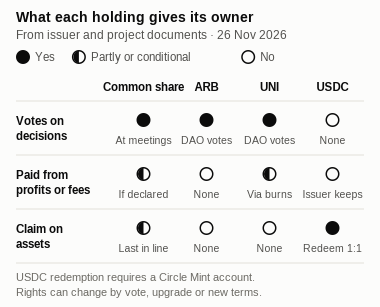
The pattern in Figure 1: none of the three tokens combines votes, payouts and a claim on assets the way a common share does. Each gives one or two of these, and each right depends on documents or code that can change.
Worked example: what 10,000 UNI can and cannot do#
This example uses values read from the Uniswap contracts on Ethereum mainnet at block 26,498,507 (26 November 2026, 09:34 UTC) through the public endpoint ethereum-rpc.publicnode.com (real data). In short, a holder of 10,000 UNI can vote or delegate, but holds 0.025% of the votes needed for a quorum, receives no payments, and has no claim on assets.
Voting. A proposal passes only if at least 40,000,000 UNI vote for it, the quorum (4% of the 1 billion supply). Submitting a proposal requires 1,000,000 UNI of voting power, the proposal threshold. A 10,000 UNI holder therefore has 0.025% of a quorum and 1% of the threshold. They can vote, or delegate to someone who votes, but cannot pass or even propose anything alone. Voting lasts 40,320 blocks, about 5.6 days at 12 seconds per block, and approved actions wait 2 days in a timelock before they can be executed.
Payments. The holder receives nothing directly from the protocol fee. As of the same block, 114,643,581 UNI (11.46% of the 1 billion total) sat at the address 0x000000000000000000000000000000000000dEaD, which is used for burning because no one is known to control it. That left about 885.4 million UNI that can still move. A 10,000 UNI holder owns 0.00100% of the total supply and 0.00113% of the UNI outside the burn address, a 12.9% larger slice than if nothing had been burned. Their token count and cash are unchanged. Whether the larger slice is worth more depends entirely on what the market pays for UNI.
Claims. If Uniswap's legal entities were wound up, nothing in the documentation reviewed gives UNI holders a claim on their assets.
Who stands behind a token: foundations, DAOs and legal wrappers#
Many token projects separate the onchain DAO from one or more legal entities, often in jurisdictions chosen for how they treat such structures. Holding the token rarely makes you an owner of those entities. The documents for the three examples, as of 26 November 2026, say:
- Arbitrum. The Arbitrum Foundation is a Cayman Islands foundation company. Its documentation says it serves and is governed by the Arbitrum DAO, which can elect and remove its directors through a DAO vote.
- Uniswap. A governance proposal executed on 12 September 2025 established Uniswap governance as DUNI, a Wyoming Decentralized Unincorporated Nonprofit Association (DUNA). Uniswap's documentation says any UNI holder who takes part in governance is a member, and that the structure gives participants limited liability and lets governance sign contracts and handle tax and regulatory duties. Uniswap Labs, which builds products around the protocol, and the Uniswap Foundation are separate organizations.
- USDC. Circle Internet Financial, LLC is the issuer, and the holder's right is the contractual redemption right in its terms.
None of the documents reviewed describes ARB or UNI holders as shareholders of these entities. Membership of an association, a vote in a DAO and a contractual claim are different legal positions, and their effect depends on local law. Anyone relying on such a right should take legal advice for their own situation.
How a holder's rights can change#
Token rights are only as fixed as the processes that can change them. Three routes appear in the examples:
- Governance votes. The Arbitrum DAO can redirect fees by constitutional proposal. Uniswap governance sets protocol fee levels and can mint up to 2% more UNI a year. A holder who does not vote is bound by the result.
- Contract upgrades. The ARB token contract is an upgradeable proxy. The Arbitrum DAO Constitution lets the 12-member Security Council, with 9 of 12 approvals, make any software upgrade with no delay in a true emergency.
- New terms. Circle can amend its USDC Terms, which were last updated on 15 October 2026, and can block addresses under its blocklisting policy.
Lesson How do I check a token's documentation against its contracts? shows how to see who controls upgrades and minting onchain.
What could change the conclusion about a token's rights?#
Law and regulation can add rights. Stablecoin laws, securities rulings or consumer-protection rules can give holders claims that the token's own terms do not. They can also restrict who may hold or redeem.
Where you hold the token matters. Tokens held on an exchange are usually recorded in the exchange's name, so you may not be able to vote or redeem directly. Lesson What do I own when I hold crypto on an exchange? explains the difference.
The same name can mean a different contract. UNI exists as bridged versions on several networks, and USDC is issued on many chains. A bridged token's rights depend on the bridge as well as the original issuer.
Documentation can lag the code. Documents describe intent, and contracts enforce rules. When they disagree, the contract decides what happens.
Governance power can be concentrated. When a few large holders or delegates control most of the voting power, a small holder's right to vote may never change an outcome. In the worked example above, a 10,000 UNI holder would need 3,999 other holders of the same size voting the same way to reach quorum alone.
Check your understanding: dividend or buyback-and-burn?#
Question. A company has 500 million shares and pays out $10 million of profit as a dividend. A token has 500 million tokens, trades at $5.00, and its protocol uses $10 million of fees to buy tokens on the market and burn them. You hold 50,000 shares of the company, or 50,000 tokens.
- How much cash does the shareholder receive?
- How many tokens are burned, and how does the token holder's share of supply change?
- What is the token holder's gain if the price stays at $5.00? What if the market keeps the token's total value unchanged after the burn?
- What is the key difference in rights?
Show the answers
Answer.
- $10 million ÷ 500 million = $0.02 per share. 50,000 shares receive $1,000 in cash.
- $10 million ÷ $5.00 = 2 million tokens burned, leaving 498 million. Your share rises from 0.0100% to 0.01004%, about 0.40% more.
- At an unchanged $5.00, your holding is still worth $250,000: no gain, no cash. If the market values the 498 million remaining tokens at the same $2.5 billion as before, the price becomes about $5.0201 and your gain is about $1,004, close to the dividend.
- The shareholder's $1,000 is cash in hand once declared. The token holder's $1,004 depends on how the market prices the token, and the holder has no legal claim to the fees. Governance could also stop the burn by vote.
Related lessons#
- Before this lesson: Who gets paid when people use a protocol?
- Next: How do I check a token's documentation against its contracts?
- See also: What changes when tokens unlock?, for ARB's supply; What do I own when I buy a share through a broker?; What is a tokenized stock, and what does the holder actually own?; and What do I own when I hold crypto on an exchange?