How do I check a token's documentation against its contracts?
Short answerTo check a token's documentation, find the official contract address, confirm on a block explorer that its source code is verified, find out whether it is an upgradeable proxy and who controls it, read the values that enforce the documented claims (total supply, minter or owner, mint caps, timelock delays), and record the block number of every read. Documentation states intentions; the contract enforces the rules, so where they disagree, the contract decides. A check of UNI on 26 November 2026 matched five documented claims and found two differences, including "burned" tokens that still count in the contract's total supply.
These reads tell you whether a supply cap, a vesting promise or an "immutable" label is enforced by code, and who could change that code, instead of taking the documentation's word for it.
Scope note: Valmy v1 trades on Binance Spot and USDⓈ-M futures, and its launch market list is still an open decision. This lesson uses UNI and ARB because their projects publish contract addresses and rules that can be checked. It does not mean either token is available in Valmy.
Why a token's documentation and its contracts can disagree#
Documentation and contracts are written at different times, by different people, for different readers, so they drift apart. A launch post describes a plan. A documentation site is edited later and may simplify. The contract is deployed once, but if it is upgradeable, its code can be replaced afterwards. A reader who trusts only the documents can miss three kinds of gap:
- Wording gaps. The documentation uses a word, such as "burn" or "capped", that the contract implements differently from what a reader expects.
- Timing gaps. Dates or parameters in the contract differ from those announced.
- Control gaps. The documentation says a rule is fixed, but someone holds the power to change the code or the parameters.
Lesson What changes when tokens unlock? combined a contract read, ARB's nextMint value, with the token's full event history to show that no ARB has been minted since the initial 10 billion. The read alone could not show that, because ARB's code can be replaced and an earlier version could have changed the stored value. This lesson turns such reads into a complete method.
Seven steps to check a token's documentation against its contracts#
The method below works for most tokens on Ethereum-compatible chains. Each step produces a record that someone else can repeat.
- Find the official address. Take the contract address from the project's own documentation, and confirm it on a second official page, such as a governance or developer page. Search results and token lists can point to look-alike tokens with the same ticker. The same token often has separate addresses on different chains.
- Confirm it on a block explorer. Check that the address holds contract code on the chain you expect, and that the name, symbol and decimals match.
- Check that the source code is verified. A block explorer such as Etherscan, or the open verification service Sourcify, compiles the published source and compares it with the deployed code. An "exact match" means the source you read is the code that runs. Verified does not mean audited or safe.
- Find out whether it is a proxy, and who controls it. A proxy is a contract that holds balances but runs code from a separate implementation contract. A proxy is not necessarily upgradeable. Inspect the verified proxy and implementation source for an upgrade mechanism and its authorization, then trace who controls that authority. To list the implementations it has run, use its
Upgradedevents only after checking its proxy pattern and verified source: the EIP-1967 standard recommends these events but does not enforce them, and beacon proxies record code changes elsewhere (see below). - Read the values that enforce each claim. Typical values are
totalSupply(), the owner or admin, any minter role, mint caps and intervals, pause controls and timelock delays. - Compare claim by claim. For each documented promise, find the line of code or stored value that enforces it, and note where none exists.
- Record what you read. Note the chain, contract address, function, block number, block time and endpoint. Repeat important reads on a second endpoint, and repeat the check later, because upgradeable contracts and governance votes change the answer.
How to read a contract value yourself#
Anyone can read a contract's public values through a JSON-RPC endpoint, a server that answers questions about a blockchain. The eth_call method runs a read-only function at a chosen block. The function is named by its selector: the first 4 bytes of the Keccak-256 hash of its signature. For mintingAllowedAfter() the selector is 0x30b36cef. This request reads that value from the UNI contract at block 26,498,507 (hexadecimal 0x19455cb):
curl -s -X POST https://ethereum-rpc.publicnode.com \
  -H "Content-Type: application/json" \
  --data '{"jsonrpc":"2.0","id":1,"method":"eth_call","params":[{"to":"0x1f9840a85d5aF5bf1D1762F925BDADdC4201F984","data":"0x30b36cef"},"0x19455cb"]}'
The answer ends in 65920080, which is 1,704,067,200 in decimal, a Unix time of 1 January 2024 at 00:00 UTC. Block explorers offer the same reads through a "Read Contract" tab. Using a fixed block number, instead of "latest", makes the read repeatable. Public endpoints may only serve recent blocks, so record the block when you read it.
How to tell whether a token is upgradeable#
Many modern proxies follow EIP-1967, a standard with fixed storage positions, called slots, for the implementation address and an optional admin address. Using these slots does not by itself make a proxy upgradeable. A third slot holds the address of a beacon, used instead of the implementation slot by beacon proxies. The slots are derived from hashes, so they never collide with the token's own data:
- Implementation slot:
0x360894a13ba1a3210667c828492db98dca3e2076cc3735a920a3ca505d382bbc - Admin slot:
0xb53127684a568b3173ae13b9f8a6016e243e63b6e8ee1178d6a717850b5d6103 - Beacon slot:
0xa3f0ad74e5423aebfd80d3ef4346578335a9a72aeaee59ff6cb3582b35133d50
The eth_getStorageAt method reads a slot directly. If the implementation slot holds an address, it identifies the code the proxy currently delegates to; it does not prove that anyone can replace it. OpenZeppelin's plain ERC1967Proxy has no upgrade mechanism by itself. For a transparent proxy, verify its upgrade interface and admin authority, then follow the admin or ProxyAdmin to its controller. For a UUPS proxy, inspect the upgrade functions and authorization in the implementation, such as _authorizeUpgrade, rather than assuming an admin slot controls it. If it is empty, read the beacon slot: a beacon proxy points to a separate beacon contract, and the standard says to call that beacon's implementation() function to find the code. One beacon can serve many proxies; inspect its verified source to establish whether it can be upgraded and who authorizes that change, which would affect every proxy using it. If all three slots read zero and the verified source contains no proxy logic, the contract is not an EIP-1967 proxy. Older proxies use other slot layouts, so a zero result is not proof on its own: confirm with the verified source.
How to trace a proxy's past implementations#
A slot read shows only the current implementation. For the past ones you need the proxy's event history, which is only as complete as the code that writes it, so an empty or short history alone does not show that a contract was never upgraded. EIP-1967 says a change to the implementation slot SHOULD be announced with an Upgraded event, and a change of beacon with a BeaconUpgraded event. In standards language, "SHOULD" is a recommendation, not a requirement the chain enforces. Before treating a proxy's Upgraded events as its full history, check two things:
- The pattern. For a beacon proxy, the code changes inside the beacon, and the proxy itself logs no event for that change. Trace the beacon's own history, and the proxy's
BeaconUpgradedevents for any switch to a different beacon. - The source. In the verified source of the proxy and of each implementation it has run, every function that can change the slot should also emit the event.
If either check fails, or the source is not verified, describe the limit instead of drawing a conclusion about the token's upgrade history.
Worked example: UNI's documentation against its contract#
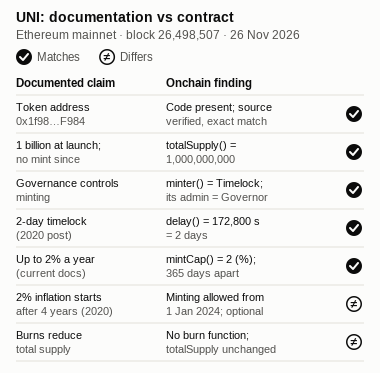
Of seven documented claims about UNI, five match its contract and two differ: minting has been allowed since 1 January 2024, earlier than the launch post said, and "burned" UNI still counts in the contract's total supply (real data). All reads below were made on Ethereum mainnet at block 26,498,507 (26 November 2026, 09:34 UTC) through ethereum-rpc.publicnode.com, and the supply, minter and minting-date reads were repeated on a second endpoint, eth.drpc.org, with identical results.
Steps 1 to 4. Uniswap's developer documentation lists the UNI token at 0x1f9840a85d5aF5bf1D1762F925BDADdC4201F984, along with the Timelock and GovernorBravo governance contracts. The address holds 12,567 bytes of code. Etherscan shows the source as verified with an exact match, compiled with Solidity 0.5.16, and Sourcify also lists it as verified. The EIP-1967 implementation and admin slots both read zero, and the verified source has no proxy logic, so UNI's code cannot be replaced. The source also has no pause or blocklist function: the only privileged powers are minting and changing the minter, both held by the minter.
| Documented claim | Where it comes from | What the contract shows | Result |
|---|---|---|---|
UNI is at 0x1f98…F984 on Ethereum |
Current developer documentation | Contract code present; source verified | Matches |
| 1 billion UNI at launch, no mint since | Current UNI documentation | totalSupply() = 1,000,000,000 UNI exactly; mintingAllowedAfter() unchanged since deployment |
Matches |
| Governance controls minting | Current governance documentation | minter() = the Timelock; the Timelock's admin() = GovernorBravo |
Matches |
| 2-day timelock on execution | Launch post, 16 September 2020 | Timelock delay() = 172,800 seconds = 2 days |
Matches |
| Up to 2% of total supply a year | Current UNI documentation | mintCap() = 2 (percent of totalSupply per mint); minimumTimeBetweenMints() = 365 days |
Matches |
| 2% a year inflation "will start after 4 years" | Launch post, 16 September 2020 | mintingAllowedAfter() = 1 January 2024; minting needs a governance decision |
Differs |
| Protocol fees burn UNI, "reducing its total supply" | Current UNI documentation | No burn function; totalSupply() still 1,000,000,000 |
Differs in meaning |
Finding 1: minting was allowed earlier than the launch post said#
UNI's contract has allowed minting since 1 January 2024, about 259 days before the four-year mark the 2020 launch post described. The value was set at deployment: the creation transaction of the token, in block 10,861,674, passed 1 January 2024 as its mintingAllowedAfter argument, and the stored value still equals it. Every mint resets that value to the mint time plus 365 days, so an unchanged value, together with a total supply of exactly 1 billion, shows that no UNI has been minted since the initial 1 billion were created at deployment. That inference is safe for UNI because its code cannot be replaced, as steps 1 to 4 showed.
The contract also turns "inflation will start" into a permission rather than a schedule. Only the minter, which is governance acting through the Timelock, can mint, and only up to 2% of the current total supply at least 365 days apart. The current documentation matches this: it says governance has the authority but has not used it. Because the cap applies to the current supply, it compounds: five maximum mints a year apart would take supply to about 1.104 billion. One page of the current documentation describes the cap as 2% of "total circulating supply", but the contract uses total supply.
Finding 2: "burned" UNI still counts in the contract's total supply#
The UNI contract has no burn function, and it refuses transfers to the zero address. UNI that the protocol "burns" is sent to the address 0x000000000000000000000000000000000000dEaD, which no one is known to control. As of block 26,498,507, that address held 114.6 million UNI, 11.46% of the total. totalSupply() still returns 1,000,000,000.
Both descriptions are true in their own sense. The burned UNI can almost certainly never move again, so in economic terms the usable supply has shrunk. But any tool that reads totalSupply() will show no reduction, and data sites that subtract burn-address balances will show a smaller supply. When comparing supply figures, check which definition each one uses. Lesson What determines how many tokens exist? explains burns and caps in general.
Worked example: who can change ARB's code#
ARB shows what the method finds when a token is upgradeable. Its code sits behind a proxy, and both the code and minting are controlled by one executor contract, which 9 of 12 Security Council members can use without delay and the DAO can use after an 8-day timelock and further delays (real data). These reads were made on Arbitrum One at block 527,691,472 (26 November 2026, 09:39 UTC) through arb1.arbitrum.io/rpc, and each address was compared with the Arbitrum Foundation's published list of deployment addresses.
- The token is a proxy. ARB's EIP-1967 implementation slot holds
0xd47D…7fa0. Sourcify shows that implementation verified as an exact match for theL2ArbitrumTokencontract, deployed on 17 February 2026. The implementation slot is in use, so ARB is not a beacon proxy. - Its event history is complete for this proxy. Sourcify shows the proxy itself verified as OpenZeppelin's
TransparentUpgradeableProxy. In that source, every route that changes the implementation slot, including the constructor, also emitsUpgraded. Neither implementation's verified source has code that writes to the slot. So for ARB, the proxy'sUpgradedevents list every implementation it has run: the original, set when the token launched on 16 March 2023, and the current one, installed on 30 March 2026. The latest event matches the address in the slot. - The admin is a ProxyAdmin. The admin slot holds
0xdb21…961e, listed by the Foundation as the "Arb One Proxy Admin". Itsowner()is0xCF57…A827, the "Arb One Upgrade Executor". - The same executor controls minting. ARB's own
owner()is also the UpgradeExecutor, and the verified implementation source allows only the owner to mint, up to 2% of supply at least 365 days apart. Unlike UNI, ARB's source includes a standard burn function, so burned ARB does reducetotalSupply(), which read 9,999,998,978 ARB, just under the original 10 billion. - Who can act through the executor. The executor's
hasRolecheck returned true for the emergency Security Council, a multisig wallet whosegetThreshold()is 9 and which has 12 signers. That matches the Arbitrum DAO Constitution, which lets 9 of 12 council members make any upgrade with no delay in a true emergency. The non-emergency council returned false. Normal upgrades follow a DAO vote, and the Arbitrum-side Core Timelock enforces a minimum delay of 8 days (getMinDelay()= 691,200 seconds), matching the Constitution's 8-day waiting period, followed by further delays on Ethereum.
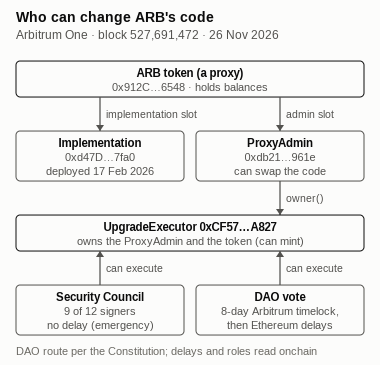
The takeaway for a holder: ARB's documented minting limit is enforced by code that the DAO, or in an emergency 9 of 12 council members, can replace. That is consistent with the documentation, which describes these powers, but it means a reading like the nextMint check in What changes when tokens unlock? is a snapshot of the current code, not a permanent guarantee. It does not prove the past either: an earlier implementation could have minted and rewritten the stored value. That lesson settles the history from the token's mint, burn and Upgraded events instead, which works because this proxy's verified source emits an event on every change. For another token, repeat the pattern and source checks before relying on its events.
What could change the conclusion of a contract check?#
A read is a snapshot. Upgradeable code, governance votes and role changes can alter any value after your block. A read also shows only the present. For an upgradeable token, the history of mints and code changes has to come from its event logs, and those logs are complete only if its code emits an event on every change. Check the proxy pattern and the verified source first, as in the ARB example; an empty event history alone does not prove that a contract was never upgraded. Date every finding and repeat checks before relying on them.
Verified is not the same as safe. An exact source match tells you what the code says, not whether it is free of bugs or whether its permissions are reasonable. Audits and the project's own security disclosures are separate evidence.
Control can sit outside the chain. A multisig's threshold is visible onchain, but who its signers are, and whether they act independently, usually is not. A role held by an externally owned address means one private key can act alone.
Proxies come in several patterns. EIP-1967 is the most common, but older or custom proxies store addresses elsewhere, and some tokens use beacon proxies or modules. A beacon proxy's code is set in its beacon, so its upgrade history sits with the beacon, not in the proxy's own Upgraded events. Read the verified source when the slots are empty or unexpected.
Bridged tokens are separate contracts. UNI and USDC exist on many chains, and each bridged version has its own contract and its own controls, often including the bridge.
Your endpoint could be wrong. A faulty or malicious endpoint can return false data. Repeat important reads on a second, independent endpoint, as the UNI example did.
Documentation is not one document. Launch posts, documentation pages and governance proposals can disagree with each other. Note which source and date each claim comes from, as in the UNI table.
Check your understanding: does the contract back the documentation?#
Question. Token Q's website says: "Fixed supply of 100 million. No one can mint new tokens. The contract is immutable." At a recorded block you find:
totalSupply()returns 100,000,000.- The source is verified and contains
mint(address,uint256), callable only byowner(), with no cap. owner()returns a multisig whosegetThreshold()is 2 and which has 3 signers.- The verified transparent-proxy source exposes an upgrade function restricted to its admin. Its EIP-1967 implementation slot holds a non-zero address, and its admin is a ProxyAdmin owned by the same multisig.
- Which of the three claims does the contract support?
- Who could add supply, and how much?
- If the code instead capped each mint at 2% of total supply, at most once every 365 days, what is the most supply could reach after three mints?
- What would you record?
Show the answers
Answer.
- Only the current supply figure is supported: 100 million exist at that block. "No one can mint" is contradicted by the owner-only
mintfunction. "Immutable" is contradicted by the proxy: the implementation can be replaced. - Any 2 of the 3 multisig signers can mint any amount at any time, or replace the code entirely. The documentation's promises depend on those signers' behavior, not on code.
- 100,000,000 × 1.02³ = 106,120,800 tokens, a 6.12% increase, because each cap applies to the supply after the previous mint.
- The chain, the token, ProxyAdmin and multisig addresses, each function or slot read, the raw results, the block number and time, and the endpoint, plus which website page and date each claim came from.
Related lessons#
- Before this lesson: What changes when tokens unlock? and What does a token holder actually own?
- See also: What determines how many tokens exist?, for issuance, burns and caps, and What is the difference between market cap and fully diluted valuation?, for why the supply definition changes valuations.