What changes when tokens unlock?
Short answerAn unlock lets the holders of existing tokens transfer them. No tokens are created, so total supply stays the same, and so does your share of it if you neither buy nor sell. Circulating supply rises only by unlocked tokens the data source counts as circulating, usually those reaching holders who can trade them; tokens kept in a treasury are often left out. Example: 100 tokens exist, you hold 10, and 20 unlocked tokens go to others who can trade them, lifting circulating supply from 20 to 40. You still own 10% of the total, but 25% of the circulating tokens instead of 50%. Minting is different: new tokens raise total supply and cut your share of it unless you receive your proportional part.
Nothing about the project changes on the unlock date, but the recipients, often team members and early investors who got their tokens on very different terms from today's buyers, can now sell. Whether the price falls depends on how large the unlock is compared with normal trading, who receives it, what those recipients do, and how much the market already expected.
Scope note: Valmy v1 trades on Binance Spot and USDⓈ-M futures, and its launch market list is still an open decision. This lesson uses Arbitrum's ARB token because its issuer publishes the schedule. It does not mean ARB is available in Valmy.
How token supply, vesting and unlocks work#
An unlock moves existing tokens from locked, where a vesting contract or lockup stops their holder from transferring them, to unlocked. It does not change the total supply, so at an unchanged price it does not change the fully diluted valuation (FDV) either; if the price moves, FDV moves with it. It raises the circulating supply, and the market capitalization at an unchanged price, only by the unlocked tokens counted as circulating, usually those that reach holders who can trade them. Whether unlocked tokens kept in a treasury count depends on who publishes the figure. Locked tokens usually belong to the team, early investors or a treasury, and a vesting schedule sets when they unlock. These definitions match the other token-supply lessons:
- Total supply is every token that exists now: tokens minted (also called issued) minus tokens burned, whether locked, unlocked, treasury-held or trading. Some tokens also have a maximum supply. Others, like ARB, allow new tokens to be minted under set rules.
- Treasury-held tokens belong to a DAO treasury, a foundation or a similar body. They can be locked or unlocked. Whether unlocked treasury tokens count as circulating depends on the publisher: the Arbitrum Foundation counts DAO treasury ARB only once governance has deployed it, and the data site CoinGecko typically leaves foundation and treasury holdings out even when they are unlocked.
- Circulating supply is the unlocked tokens available to trade now. It leaves out locked tokens and, usually, unlocked tokens held back in a treasury. It is an estimate, not a value any contract reports.
- A vesting schedule releases a recipient's tokens over time. A cliff is a waiting period after which a large block unlocks at once. After a cliff, tokens often unlock in equal monthly or continuous amounts, called linear vesting.
- An unlock is the moment locked tokens become transferable.
- Market capitalization = price × circulating supply. This lesson uses total-supply FDV = price × total supply. At an unchanged price, an unlock counted as circulating raises market capitalization and leaves that FDV the same, while minting raises it. Some sources instead use maximum-supply FDV = price × maximum supply: at a fixed price and fixed maximum, minting already allowed within the cap leaves that FDV unchanged. Check which convention a figure uses. If the price moves, both valuations move with it.
Who receives the tokens matters. Team members often receive tokens as pay and may sell some to cover living costs. Early investors who bought in private rounds at lower prices may want to take profits or return money to their own funds. Tokens reserved for a treasury or ecosystem fund are spent over time on grants, rewards or market liquidity, and they reach the market through those programs instead of all at once.
What a holder actually owns depends on the token. An ARB holder can vote on Arbitrum DAO governance proposals, including upgrades and how the DAO treasury is spent. Votes are weighted by the number of tokens, and holders can delegate their votes to someone else. ARB does not pay holders a share of network fees. On Arbitrum One, the part of each transaction fee that covers posting data to Ethereum goes to the Arbitrum Foundation, which runs the sequencer, and the rest goes to the DAO treasury. Holders influence how that treasury is used only through governance (as of 26 November 2026). The normal process for new ARB is a core DAO proposal and vote. Under the current implementation, minting is limited to 2% of supply at most once per 365 days; the technical authority and separate emergency route are explained below.
Unlocks versus minting: what happens to your share#
If you neither buy nor sell, an unlock never changes your share of total supply, and minting cuts it unless you receive your proportional part of the new tokens. Take 100 tokens, 20 of them circulating, with 10 of those 20 yours (synthetic data). If 20 locked tokens unlock and go to others who can trade them, circulating supply doubles to 40: you still own 10% of all tokens, but 25% of the circulating ones instead of 50%. If the same 20 unlocked into a treasury that kept them, and the data source left them out of circulating supply, you would still own 50% of the circulating tokens. If instead 25 new tokens were minted for someone else, total supply would become 125 and your share of it would fall to 8%; had you received your proportional 2.5 of them, your 12.5 of 125 would still be 10%. If the 25 new tokens stayed locked, circulating supply would stay at 20, and total supply would rise from 5 to 6.25 times the circulating supply, widening the gap between FDV and market cap. What is the difference between market cap and fully diluted valuation? works through both cases.
Worked example: Arbitrum's first large unlock in March 2024#
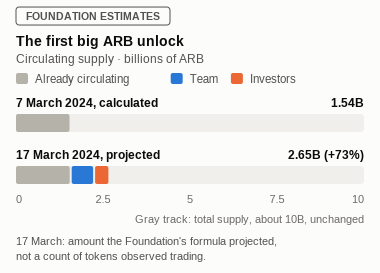
ARB's first large unlock, on 16 March 2024, was expected to raise circulating supply by 72.6%, from 1.54 billion to 2.65 billion ARB, according to the Arbitrum Foundation's published estimates. The first figure is the Foundation's calculation as of 7 March. The second is the amount its release formula projected for 17 March, not a count of tokens observed trading. Total supply stayed at about 10 billion. The Foundation publishes ARB's initial distribution of 10 billion tokens:
| Group | Tokens | Share of total |
|---|---|---|
| Arbitrum DAO treasury | 3.528 billion | 35.28% |
| Team and contributors | 2.694 billion | 26.94% |
| Investors | 1.753 billion | 17.53% |
| Users (airdrop) | 1.162 billion | 11.62% |
| Arbitrum Foundation | 0.750 billion | 7.50% |
| DAOs building on Arbitrum (airdrop) | 0.113 billion | 1.13% |
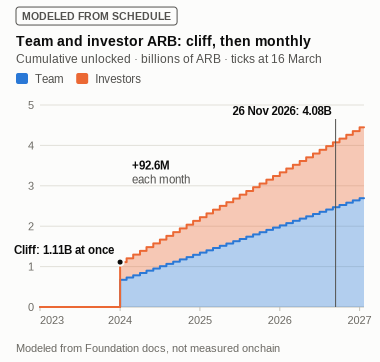
The rule. Team, contributor and investor tokens vest over four years starting 16 March 2023. Nothing unlocked in the first year. On 16 March 2024 one year's worth, a quarter of each allocation, unlocked at once. That was the cliff. The rest unlocks monthly for the following three years.
The numbers. The Foundation published two estimates of circulating supply around the cliff. Both apply its formula to the initial distribution and the unlock schedule. The 7 March column is calculated as of that date; the 17 March column is what the formula was expected to give after the cliff. The Foundation notes that its estimates may differ from the actual circulating supply.
| Group | Estimated, 7 March 2024 | Projected, 17 March 2024 |
|---|---|---|
| Arbitrum DAO treasury | 126,131,267 | 126,131,267 |
| Team and contributors | 0 | 673,500,000 |
| Investors | 0 | 438,250,000 |
| Users (airdrop) | 1,092,551,615 | 1,092,551,615 |
| Arbitrum Foundation | 205,715,264 | 210,506,502 |
| DAOs (airdrop) | 113,000,000 | 113,000,000 |
| Total | 1,537,398,145 | 2,653,939,384 |
Working it through:
- Circulating supply. On the Foundation's figures, 2,653,939,384 − 1,537,398,145 = 1,116,541,239 more tokens, a projected increase of 72.6%. Team and contributors added 673.5 million, investors added 438.25 million, and the Foundation's own continuous vesting added 4.79 million.
- A holder's share. Someone who held 10,000 ARB throughout, neither buying nor selling, owned about 0.00065% of the estimated circulating supply on 7 March and about 0.00038% of the projected figure for 17 March. On those estimates, their share of circulating tokens fell by 42.1% without them doing anything, while their share of the total supply stayed at 0.0001%.
- Market cap and FDV. Suppose the price had stayed at a round, hypothetical $1.00 (not ARB's actual price at the time). On the Foundation's figures, market capitalization would have risen from about $1.54 billion to about $2.65 billion, and FDV would have stayed at $10 billion. Any change in the price would move both. A rise in market capitalization can come from newly tradable supply, not new demand.
- Treasury tokens. The DAO treasury row counts only treasury ARB that governance proposals had deployed: 126.1 million of the treasury's 3.528 billion allocation. The Foundation used its 7 March figure for both dates. In the Foundation's estimate, the rest of that allocation counted in total supply but not in circulating supply. The line is a convention: airdrop tokens nobody claimed were sent to the treasury, yet the Foundation still shows them as circulating in the users row.
What the schedule projects (modeled, not observed). After the cliff, the published rule releases about 92.65 million team and investor tokens each month: roughly 56.1 million for the team and contributors and 36.5 million for investors. That was about 3.5% of the Foundation's projected circulating supply for 17 March 2024. Applying the rule, about 4.08 billion of the 4.447 billion team and investor tokens should have unlocked by 26 November 2026, with about 370.6 million left in four more monthly releases. The last is due around 16 March 2027. These are projections from the rule, not counts of tokens observed leaving vesting contracts.
What the onchain record shows: one mint, at launch#
ARB's onchain history shows one mint: the 10 billion ARB created when the token was set up on 16 March 2023 (real data). The schedule above is a projection, but minting is a matter of record. The ERC-20 token standard asks tokens to log each mint as a transfer from the zero address, and ARB's code does so, logging each burn as a transfer to that address too. A search of every Arbitrum One block up to 527,724,751 (26 November 2026) found exactly one mint. It also found 28 transfers to the zero address, the record ARB's code leaves for a burn. Ten of them burned zero ARB; the other 18 burned 1,022.39 ARB between them, which accounts exactly for the gap between 10 billion and the total supply of 9,999,998,977.61 ARB read at block 527,683,352. This record shows how many ARB exist, not how many circulate: no contract reports circulating supply.
The contract's own counter agrees. ARB's code lets its owner mint (create) new tokens at most once every 365 days, up to 2% of supply each time, and stores the earliest time of the next allowed mint in a public value called nextMint. Setup set it to 365 days after launch, and every mint pushes it forward. Read on 26 November 2026, it was still 15 March 2024 at 12:08 UTC.
That read alone would not prove the history. The token is an upgradeable proxy, so an earlier version of its code could in principle have minted and rewritten nextMint. The proxy's own verified source logs every change of code with an Upgraded event, and those events show only two versions, the original and one installed on 30 March 2026. Both versions are published, verified source with the same minting rules, and both log every mint and burn as a transfer. Relying on the events works here because this proxy's source was checked; How do I check a token's documentation against its contracts? explains why other proxies need the same check.
Two cautions remain. The history was read from one public endpoint, the only one found that would serve it, so it is the record through 26 November 2026 as that node reported it. And minting has been allowed since March 2024, so the normal DAO process could still authorize new ARB; the separate technical authority is described below. Check the event log, nextMint and totalSupply() again before relying on these figures.
What could change the conclusion about an unlock?#
Unlocked does not mean sold. Recipients may hold, stake, use tokens to vote, or sell slowly through private deals with large buyers, known as over-the-counter or OTC trades. Tokens moving from recipient wallets to exchange deposit addresses are a closer signal of selling than the unlock date itself.
A known schedule can be priced in early. Unlock dates are usually public, so traders can act before them, and recipients can lock in a price ahead of time by hedging, for example by selling futures. Keyrock, a crypto market maker, studied more than 16,000 unlock events and tracked prices for 30 days before and after each one, measured against ETH (published December 2024). It reported that most unlocks came with downward price pressure that often began about 30 days before the unlock date. Team unlocks were followed by the largest declines on average, and ecosystem-development unlocks by a small average gain of 1.18%. Treat these findings with care. The study is industry research, not peer-reviewed. Its author is a market maker whose business includes managing large token sales for clients. Averages across thousands of events hide wide differences between tokens. And choices such as measuring against ETH and using 30-day windows shape the results.
Size compared with trading matters more than size compared with supply. An unlock equal to a few hours of normal trading volume is easier for the market to absorb than one equal to weeks of volume, even if both are the same share of supply.
Unlocked is not always circulating. Unlocked tokens held by a treasury or foundation may stay out of circulating supply until they are spent, and data sites draw this line differently, so the same unlock can raise one site's figure and leave another's unchanged. The Foundation itself notes that its estimate may differ from the actual circulating supply, for example because of distributions from the DAO treasury, and its 17 March figure was a projection made before that date. Always check the source and date of the number you use.
Unlocks are not the only new supply. Distributing existing treasury tokens through grants, rewards or liquidity programs can add to circulating supply without changing total supply. Only newly issued staking rewards or other minting increases total supply, diluting holders who receive less than their proportional part. Rewards paid from existing tokens or transaction fees transfer tokens instead. A vesting chart does not capture these flows. For ARB, a core DAO proposal and vote is the normal issuance process, but the token enforces an owner check, not a tokenholder vote itself. The owner is the UpgradeExecutor, with a separate emergency Security Council route under the Constitution. How do I check a token's documentation against its contracts? traces these authorities and the 9-of-12 emergency route without the normal delay. The current code's 2% mint cap and 365-day interval still apply unless upgraded.
The wider market can dominate. A large market-wide move can swamp the effect of any single unlock, in either direction.
Check your understanding: sizing a new unlock#
Question. Token X has a total supply of 1,000 million tokens and 200 million in circulation. In two weeks, 50 million investor tokens reach their cliff and unlock at once, and the investors can trade them. The token trades about 8 million tokens a day and costs $2.00. You hold 1,000 tokens.
- By what percentage will circulating supply rise?
- What happens to market capitalization and FDV if the price doesn't change?
- What happens to your share of the circulating supply?
- How large is the unlock compared with daily trading, and what else would you check before drawing a conclusion?
- Suppose instead that governance minted 50 million new tokens and kept them locked in its treasury. What would change?
Show the answers
Answer.
- 50 ÷ 200 = 25%. Circulating supply rises from 200 million to 250 million.
- At the unchanged $2.00, market capitalization rises from $400 million (200 million × $2) to $500 million (250 million × $2). FDV stays at $2,000 million (1,000 million × $2) because neither the price nor total supply changed.
- If you keep your 1,000 tokens and buy no more, your share falls from 0.0005% (1,000 ÷ 200 million) to 0.0004% (1,000 ÷ 250 million), a 20% drop, even though your share of the total supply stays at 0.0001%.
- 50 million ÷ 8 million ≈ 6.25 days of average volume. That is large enough to matter if a big part were sold quickly. Before concluding that the price will fall, check who the investors are and roughly what they paid, whether the schedule has been public long enough to be priced in, whether futures exist that recipients could use to hedge in advance, how the token's price behaved around its earlier unlocks, and whether tokens start moving to exchange deposit addresses after the unlock.
- Total supply would rise to 1,050 million, so FDV at $2.00 would rise to $2,100 million. Circulating supply and market capitalization would stay at 200 million tokens and $400 million. Still holding 1,000 tokens, your share of total supply would fall from 0.0001% to about 0.0000952% (1,000 ÷ 1,050 million), and total supply would rise from 5 to 5.25 times the circulating supply. Unlike the unlock, this dilutes you even though no new tokens reach the market.
Related lessons#
- Before this lesson: What determines how many tokens exist? and What is the difference between market cap and fully diluted valuation?
- Next: Who gets paid when people use a protocol? and What does a token holder actually own?
- See also: How do I check a token's documentation against its contracts?, which shows how to make reads like the
nextMintcheck yourself, and What is a perpetual future, and what does funding do?, for how recipients can hedge.