Who gets paid when people use a protocol?
Short answerWhen people use a crypto protocol, they pay fees, but most of that money usually goes to whoever supplies the resource being used: liquidity providers on an exchange, lenders in a lending market, or validators on a blockchain. Only part of the fees, often none, stays with the protocol as revenue. A still smaller part may reach token holders, through a burn, a buyback or a governance-controlled "fee switch", and usually indirectly rather than as a payment. Fees, revenue and what holders receive are three different numbers.
Separating the three shows how much of a protocol's fee income could ever reach a token holder, before you compare tokens by their fees. For example, Uniswap pools keep 75% to 83% of their swap fees for liquidity providers, and the rest goes to a contract that releases it only to whoever burns UNI. Before treating a protocol's fees as value for its token, trace where each dollar goes and what the token holder actually receives.
Scope note: Valmy v1 trades on Binance Spot and USDⓈ-M futures, and its launch market list is still an open decision. This lesson uses Ethereum, Uniswap and Aave because their fee rules can be read in public code and onchain. Naming a token does not mean it is available in Valmy. Fee settings are as of 26 November 2026 and can change by governance vote.
Fees, revenue and holder income: three different numbers#
Fees are everything users pay to use a protocol. Revenue is the part the protocol keeps after paying the people who supply the capital or service. Holder income is the part that reaches token holders. The terms below follow the definitions DefiLlama publishes for its fee and revenue dashboards (checked 26 November 2026). Other data providers use similar but not identical terms.
- Fees: all value collected from users and other sources.
- Supply-side revenue: the part of fees paid to liquidity providers, lenders, stakers or others who supply capital or resources.
- Revenue: fees minus supply-side revenue, the part kept by the protocol itself.
- Holders revenue: value flowing to governance token holders, including buybacks, burns and distributions.
A protocol can have large fees and no revenue at all, if every dollar goes to its liquidity providers. It can also have revenue and give holders nothing, if the revenue stays in a treasury. The rest of this lesson follows the money in three real protocols and one synthetic one.
Ethereum: the base fee is burned, the priority fee goes to the block's fee recipient#
On Ethereum, users pay for gas, the unit of computing work a transaction uses. EIP-1559 splits the price per unit of gas into two parts. The base fee is set by the protocol for each block and is burned, meaning destroyed. The priority fee, or tip, goes to the block's fee recipient, an address written into the block when it is built. Since EIP-4844, fees for "blob" data are burned too. Ether holders receive no payment. They benefit only indirectly, because burning reduces the supply of ether.
Validators also receive newly issued ether for securing the network, but that is issuance, not a fee paid by users. Validators can also receive payments outside the protocol's fee rules, which this lesson doesn't trace.
What one block shows: who received the fees in block 26,498,435#
Block 26,498,435 was produced on 26 November 2026 at 09:20 UTC. Its header and the receipts of all 116 of its transactions give an exact split (real data, read onchain):
- Gas used: 4,927,239. The sum of the 116 receipts matches the header exactly.
- Base fee: 0.0537 gwei per unit of gas (a gwei is one billionth of an ether).
- Total paid by users: 0.003199 ETH.
- Burned (base fee × gas used): 0.000265 ETH, or 8.3%.
- Priority fees to the fee recipient: 0.002935 ETH, or 91.7%.
Burned plus priority fees equals the total paid, to the last wei. In this quiet block, the fee recipient got most of the money. The block was only 8.2% full, so the base fee was very low, and one transaction alone paid 40% of all the tips. When blocks are full, the base fee rises by up to 12.5% per block and the burned share grows. One block is a snapshot, and a different block would give a different split.
Uniswap: swap fees go to liquidity providers, and governance turned on a protocol share#
On Uniswap, traders swap tokens against pools that liquidity providers (LPs) fund. Each swap pays a fee set by the pool's fee tier, for example 0.05% or 0.30% of the amount traded. For years all of it went to the LPs. Uniswap's contracts have always included a fee switch that governance could turn on to send a share to the protocol. In December 2025, UNI holders approved a proposal called "UNIfication" (125,342,017 votes for and 742 against) that turned it on.
The proposal sends protocol fees to a contract called the TokenJar. Fees collect there and can be withdrawn only by someone who burns UNI through a second contract, the Firepit. UNI holders receive no payment. Value reaches them only indirectly, as UNI is removed from circulation.
What was verified onchain: Uniswap's fee switch as of 26 November 2026#
These settings were read on Ethereum at block 26,498,435 (real data). Each pool was confirmed to belong to the Uniswap v3 factory, with the fee tier and tokens shown:
| What was read | Result |
|---|---|
Uniswap v2 factory, feeTo() |
the TokenJar, so the v2 protocol fee is on for all v2 pools |
Uniswap v2 factory, feeToSetter() |
the governance Timelock, which carries out approved proposals |
Uniswap v3 factory, owner() |
the V3OpenFeeAdapter, the contract that sets v3 protocol fees by tier |
USDC/WETH 0.05% pool, feeProtocol |
4: the protocol takes 1/4 of swap fees |
USDC/USDT 0.01% pool, feeProtocol |
4: 1/4 of swap fees |
USDC/WETH 0.30% pool, feeProtocol |
6: 1/6 of swap fees |
WBTC/WETH 0.30% pool, feeProtocol |
6: 1/6 of swap fees |
TokenJar, releaser() |
the Firepit |
Firepit, threshold() |
4,000 UNI per release, sent to the burn address 0x000…dEaD |
Firepit, nonce() |
1,613 releases completed so far |
These readings match Uniswap's protocol-fee documentation: 1/4 of swap fees in the 0.01% and 0.05% tiers, 1/6 in the 0.30% and 1% tiers, and 0.05% of the 0.30% fee in v2. The 1% tier was not read onchain. Neither were other pools, Uniswap v4 or other blockchains, which have their own settings. The release count does not say how much value has been released, because the threshold can change and each release can claim different assets.
Calculating who gets paid on a $10,000 swap#
Take a $10,000 swap on Uniswap v3, under the settings read above:
- 0.05% pool: the swap pays $5.00 in fees. The protocol takes 1/4, or $1.25, which goes toward the TokenJar. The LPs keep $3.75.
- 0.30% pool: the swap pays $30.00. The protocol takes 1/6, or $5.00. The LPs keep $25.00.
- Uniswap v2 (all pools, 0.30%): the same $30.00 split. The LPs keep 0.25% of the trade ($25.00), and 0.05% ($5.00) is collected for the protocol. In v2, the protocol's share is collected as newly created LP shares, issued when liquidity is added or removed.
On top of the pool fee, the trader pays Ethereum gas, which is split between the burn and the block's fee recipient as in the previous section.
How Uniswap's fees reach UNI holders#
UNI holders do not receive any of the fees. The TokenJar releases its contents only when someone sends the Firepit's threshold of UNI, 4,000 UNI at the time of reading, to the burn address. A release makes sense for the caller only when the fees waiting in the jar are worth more than 4,000 UNI plus transaction costs. Each release removes UNI from circulation, which can benefit holders by shrinking the supply, but no holder is paid. The UNI contract has no burn function, so the burned UNI still counts in its reported total supply. What determines how many tokens exist? explains why that matters.
Aave: borrowers pay interest, suppliers get most of it, and the reserve factor goes to the treasury#
In a lending protocol, borrowers pay interest and the people who supply the assets earn most of it. Aave keeps a share called the reserve factor, which Aave's glossary describes as the percentage of borrowers' interest allocated to the Aave treasury. Governance sets a reserve factor for each asset in each market.
Read on Aave v3's main Ethereum market at block 26,498,435 (real data):
- Reserve factor: 10% for USDC, 10% for USDT and 15% for WETH.
- The USDC market's interest-bearing token sends its reserve income to the Aave Collector, the DAO's treasury contract.
So of every $100 of interest that USDC borrowers pay, $90 goes to suppliers and $10 to the treasury.
Checking the split against Aave's USDC rates#
Aave's rate formula shows the split directly: supply rate = borrow rate × utilization × (1 − reserve factor). Utilization is the share of supplied funds that is borrowed. A snapshot of the USDC market at block 26,498,435 (real data) shows:
- Supplied: about 4,154.6 million USDC. Borrowed: about 3,314.0 million. Utilization: 79.8%.
- Borrow rate: 4.24% a year. Supply rate: 3.05% a year.
- Check: 4.2432% × 0.79766 × (1 − 0.10) = 3.0462%, which matches the contract's supply rate to four decimal places.
If those rates and balances held for a year (a modeled assumption, since both change constantly), borrowers would pay about $140.6 million of interest. About $126.6 million would go to suppliers and $14.1 million to the treasury.
What reaches AAVE holders#
AAVE holders receive no direct share of Aave's interest. The reserve factor sends part of it to the DAO's treasury, and the DAO decides what to do with that income. It has at times used revenue to buy back AAVE. A governance post by the contributor TokenLogic says those buybacks were paused from 19 April 2026 after an incident involving a bridged asset. This lesson did not confirm whether they had resumed by 26 November 2026. Any benefit to holders therefore depends on governance choices that can change.
Worked example: following $1 million of fees through a synthetic protocol#
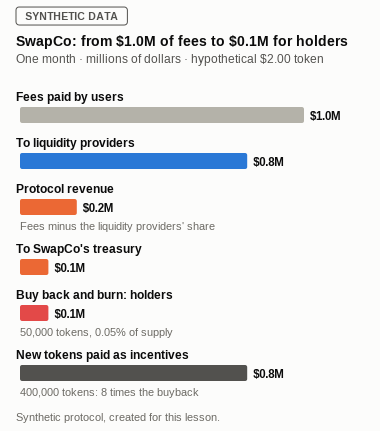
SwapCo is a synthetic exchange built for this lesson. Its token trades at a hypothetical $2.00, and 100 million tokens exist. In one month (synthetic data):
- Users pay $1,000,000 in trading fees.
- 80%, $800,000, goes to liquidity providers. That is supply-side revenue.
- $200,000 is protocol revenue. SwapCo's rules send half, $100,000, to its treasury.
- The other $100,000 buys SwapCo tokens in the market and burns them: 50,000 tokens, or 0.05% of the supply. That is the holders' income.
The pieces add up: $800,000 + $100,000 + $100,000 = $1,000,000.
There is a catch. To attract liquidity, SwapCo also pays its liquidity providers 400,000 newly created tokens a month, worth $800,000 at $2.00. Net of the buyback, supply grows by 350,000 tokens a month, or 0.35%. The protocol hands out eight times as much value in new tokens as it returns to holders through the buyback.
Calculating what the token is priced at relative to each number#
At $2.00 and 100 million tokens, SwapCo's fully diluted valuation (FDV) is $200 million. Over a year, at the same monthly rates, fees would be $12 million, revenue $2.4 million and holder income $1.2 million. The same FDV is:
- 16.7 times annual fees,
- 83.3 times annual revenue,
- 166.7 times annual holder income.
A summary that quotes the first number makes the token look ten times cheaper than the last. Before comparing a token with others, a reader would check which figure the multiple uses, and would set the $9.6 million a year of new-token incentives, four times the revenue, against all three.
Comparing the splits: where each dollar of fees goes#
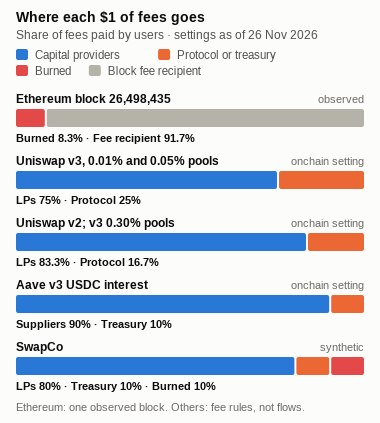
Across all four examples, most of each fee dollar goes to whoever supplies capital or block space, and token holders get the smallest share, if any. In the observed Ethereum block, 8.3% of fees were burned and 91.7% went to the fee recipient. Uniswap's protocol takes 1/4 of swap fees in its lowest fee tiers and 1/6 in the 0.30% tier, and holders benefit only when someone burns UNI to release it. Aave's treasury keeps 10% of USDC borrowers' interest. Synthetic SwapCo burns tokens with 10% of its fees but issues more in incentives.
What could change the conclusion about who gets paid?#
Governance can change the split. Uniswap's protocol fee and Aave's reserve factors are parameters that votes can change. The readings in this lesson are as of 26 November 2026. Re-read them, or check recent proposals, before relying on them.
Settings are not flows. A 1/4 protocol share means nothing if a pool has little volume. The fee settings here describe rules, not amounts collected. Only the Ethereum block was measured as an actual flow.
Fee figures can be inflated. Trading between one's own wallets, known as wash trading, or activity paid for with incentives can create fees that would disappear without the subsidy. See What do onchain activity metrics measure, and how can they be inflated?
Revenue is not profit. A protocol's treasury pays developers, audits and incentives. A protocol can have revenue and still spend more than it earns.
Holder income is not a legal claim. Burns and buybacks depend on contracts and votes that can change. A governance token is not a share with a right to dividends. See What does a token holder actually own?
Definitions differ. Data providers do not all draw the line between revenue and holder income in the same place. For example, some count the value of a burn as holder income, while others count only direct distributions. Check the definition before comparing two protocols.
Check your understanding: following a lending protocol's interest#
Question. A lending protocol has $50 million borrowed at an average borrow rate of 6% a year. Its reserve factor is 15%, and governance sends half of the reserve income to buy back its token at a hypothetical $1.25 and burn it. 200 million tokens exist, and the protocol creates 2 million new tokens a year as rewards.
- How much interest do borrowers pay in a year, and how is it split?
- How many tokens does the buyback remove, as a share of supply?
- What is the net change in supply over the year?
- What would you check before calling this token "backed by revenue"?
Show the answers
Answer.
- $50 million × 6% = $3.0 million. The treasury gets 15%, or $450,000. Suppliers get $2.55 million.
- Half of $450,000 is $225,000. At $1.25 that buys 180,000 tokens, or 0.09% of the supply.
- 2,000,000 new tokens − 180,000 burned = 1,820,000 more tokens, a 0.91% increase. Holders are diluted despite the buyback.
- Whether the reserve factor and buyback policy can be changed by a vote, and how easily. Whether the borrowing is real demand or driven by incentives. How the treasury's other spending compares with its income. And whether any of this gives holders a legal claim, which it usually does not.
Related lessons#
- Before this lesson: What determines how many tokens exist?
- Next: What do staking rewards and token emissions cost existing holders?, What do onchain activity metrics measure, and how can they be inflated? and What does a token holder actually own?
- See also: What is the difference between market cap and fully diluted valuation? and How do I check a token's documentation against its contracts?