What determines how many tokens exist?
Short answerThe number of tokens that exist is set by three things: who is allowed to create new tokens, the limits written into the rules, and how tokens are destroyed. In Bitcoin, the code fixes the schedule: new coins per block halve every 210,000 blocks and stop just under 21 million. For UNI, token-holder governance may create up to 2% more once a year. For USDC, a company creates and redeems tokens. Burns remove tokens, but a "burned" token may still appear in the count you read.
Knowing who can create tokens tells you whether a promised cap can be changed, and by whom. Newly minted tokens shrink the share of total supply held by everyone who does not receive them, while tokens that only unlock leave it unchanged. Data sites also show different counts (total, circulating or maximum, with or without burned tokens), so check which one a figure uses before comparing one token's total with another's circulating figure. Before trusting a supply figure, find out who holds the power to create tokens and what the code actually allows.
Scope note: Valmy v1 trades on Binance Spot and USDⓈ-M futures, and its launch market list is still an open decision. This lesson uses Bitcoin, Ether, UNI and USDC because their rules can be checked in public code and onchain. Naming a token does not mean it is available in Valmy.
Three ways a token's supply gets set#
A token's supply is the result of its issuance rules (who can create new units, how many and when) minus its burns (units destroyed, or sent to an address from which they can never move again). The power to create new units is called mint authority. Where that authority sits tells you how firm any promised limit really is: a cap enforced by every node is harder to change than one that a vote or a company can change.
| Who controls issuance | Example | The rule today | How it could change |
|---|---|---|---|
| Protocol code checked by every node | Bitcoin | A fixed subsidy per block that halves every 210,000 blocks | Only if the network's users adopt different software |
| Protocol code with no fixed cap | Ether | Validator rewards depend on how much ether is staked; part of every fee is burned | Through protocol upgrades |
| Token-holder governance | UNI | Governance may mint up to 2% of supply, at most once every 365 days | By governance vote; the minting role can be handed to another address |
| A company | USDC | Addresses authorized by Circle create and burn tokens | By the company, within the roles its contract defines |
A beginner can read the table as a ladder of trust. The higher a token sits, the fewer people can change its supply rules. Lower down, supply depends more on decisions people make later.
Total, circulating and maximum supply: three different counts#
Three supply numbers answer three different questions, and data sites do not all define them the same way. Before comparing two tokens, check which count each figure uses. The counts nest: circulating supply is at most the total supply, which is at most the maximum supply where one exists.
- Total supply is the number of tokens that exist now: every token minted (also called issued) minus every token the contract has burned, whether the tokens are locked, held in a treasury or trading. For a token on Ethereum, the contract's
totalSupply()function reports it. - Circulating supply is the part available to trade now. It leaves out locked tokens, which a vesting contract or lockup stops their holder from transferring, and usually treasury-held tokens that a foundation or DAO treasury keeps off the market, even after they are unlocked. It is an estimate, not a value any contract reports.
- Maximum supply is the most that can ever exist under the current rules, if there is such a limit. Bitcoin has one, just under 21 million. Ether has none. UNI has no fixed maximum, because governance can keep minting.
Minting raises total supply. An unlock does not: it only changes which existing tokens can be transferred, and it raises circulating supply only when the unlocked tokens reach holders who can trade them. What changes when tokens unlock? follows that difference through a real unlock.
Data sites make different choices. CoinMarketCap defines total supply as the coins that exist minus any that have been verifiably burned. CoinGecko says it gets circulating figures from token teams, verifies them, and for smart-contract tokens deducts locked tokens from total supply. As a result, the same token can show different totals on different sites. UNI, later in this lesson, shows how large the difference can be.
Bitcoin: a supply schedule fixed in code#
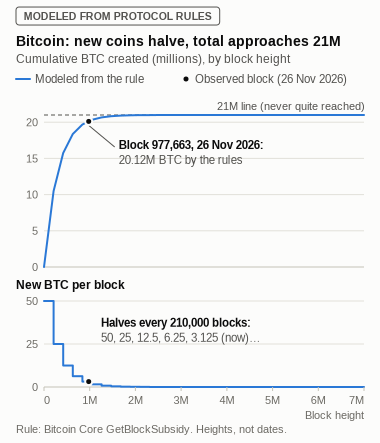
Bitcoin has no issuer. Each new block may pay its miner a block subsidy of newly created bitcoin plus the fees of the transactions it includes. Bitcoin Core's GetBlockSubsidy function sets the subsidy: 50 BTC for each of the first 210,000 blocks, then half as much for each later run of 210,000 blocks. The network targets one block every 10 minutes, so a halving comes about every four years. Every node checks this rule. A block whose miner claims more than the subsidy plus fees is rejected as invalid, so no single party can print extra coins.
Calculating Bitcoin's maximum supply from the subsidy rule#
Adding up every era of the subsidy rule gives a final total of 20,999,999.9769 BTC, which is 0.0231 BTC short of 21 million. The shortfall exists because Bitcoin counts in satoshis (1 BTC is 100,000,000 satoshis), amounts are whole numbers of satoshis, and each halving drops any fraction left over. Applying the rule era by era gives this schedule (modeled from the rule):
| Era | Blocks | New BTC per block | BTC created in the era | Running total |
|---|---|---|---|---|
| 1 | 0 to 209,999 | 50 | 10,500,000 | 10,500,000 |
| 2 | 210,000 to 419,999 | 25 | 5,250,000 | 15,750,000 |
| 3 | 420,000 to 629,999 | 12.5 | 2,625,000 | 18,375,000 |
| 4 | 630,000 to 839,999 | 6.25 | 1,312,500 | 19,687,500 |
| 5 | 840,000 to 1,049,999 | 3.125 | 656,250 | 20,343,750 |
| 6 to 33 | 1,050,000 to 6,929,999 | 1.5625 down to 0.00000001 | 656,249.9769 | 20,999,999.9769 |
If the subsidy kept halving forever and kept every fraction, the total would be exactly 21,000,000 BTC: 10.5 million in the first era, and the same amount again across all later eras. Two details keep it lower:
- From era 11, which starts at block 2,100,000, halving leaves a fraction of a satoshi, and the code drops it.
- After 33 eras the subsidy reaches zero. The last block that creates new bitcoin is block 6,929,999.
The shortfall is 2,310,000 satoshis. Bitcoin Core does contain a 21 million constant, MAX_MONEY, but its code comment explains that it is a sanity limit on amounts, not the money supply, and that the real total is less than 21 million "for various reasons". One reason is that the genesis block's 50 BTC can never be spent. Bitcoin Core also tracks coins sent to scripts that can never be spent.
What the chain shows: the 2024 halving and a block from today#
Through block 977,663, mined on 26 November 2026, the rules allow at most 20,117,700 BTC to have been created, about 95.8% of the final total. The schedule is a model, but block records show the rule at work. In each block below, the coinbase transaction, which pays the miner, paid out exactly the rule's subsidy plus the block's fees (real data, read from the Bitcoin network):
| Block | Date (UTC) | Coinbase paid out | Fees in the block | Subsidy (paid out − fees) |
|---|---|---|---|---|
| 839,999 | 20 April 2024 | 7.29455386 BTC | 1.04455386 BTC | 6.25 BTC |
| 840,000 | 20 April 2024 | 40.75061499 BTC | 37.62561499 BTC | 3.125 BTC |
| 977,663 | 26 November 2026, 09:30 | 3.13446429 BTC | 0.00946429 BTC | 3.125 BTC |
Block 840,000 began era 5, and the subsidy halved from 6.25 to 3.125 BTC. Its unusually large fees show that fees and new issuance are separate: fees move existing coins from users to the miner, while only the subsidy creates new ones.
About 882,300 BTC remain to be created after block 977,663. The real amount in existence is somewhat lower than the rule's maximum, because, for example, the genesis block's 50 BTC can never be spent. The next halving is due at block 1,050,000, which is 72,337 blocks later. At an average of 10 minutes per block that would be around April 2028, and the last new bitcoin would come around 2140. Both dates are modeled: blocks often arrive a little faster or slower than the target.
Ether: no cap, new issuance for validators and a burn on fees#
Ether has no maximum supply. New ether is created as rewards for validators, who stake ether to secure the network, and ether is destroyed by a burn on transaction fees defined in EIP-1559. Whether the supply grows or shrinks over a period depends on which flow is larger. That changes with how much ether is staked and how busy the network is.
Issuance. Ethereum's consensus specification sets each validator's base reward per unit of stake as a constant divided by the square root of all the ether that is actively staked. Each validator earns less per ether as more ether is staked, but total new issuance still grows with the square root of total stake. At full participation, four times as much staked ether means about twice as much new ether. There is no ceiling on the total.
The burn. Every block has a base fee per unit of gas, the measure of computing work a transaction uses. EIP-1559 burns the base fee times the gas used. Any extra tip, called the priority fee, goes to the block's fee recipient. Since EIP-4844, fees for "blob" data are burned as well. The base fee moves with demand. If a block uses more gas than its target, half of the block's gas limit, the next base fee rises, by at most 12.5% per block. If it uses less, the base fee falls. EIP-1559's authors noted that burning fees gives up any fixed supply: ether shrinks when more is burned than issued, and grows otherwise.
Calculating the burn in one Ethereum block#
Fees on Ethereum are quoted in gwei (one billionth of an ether) and wei (10^-18 ether). Block 26,498,435, produced on 26 November 2026 at 09:20 UTC, gives a real example (real data, read onchain):
- Base fee: 53,708,662 wei per unit of gas, about 0.0537 gwei.
- Gas used: 4,927,239 of the 60,000,000 limit, or 8.2%. The target was 30,000,000.
- Burned: 53,708,662 × 4,927,239 = 264,635,414,044,218 wei, about 0.000265 ETH.
The block was far below its target, so the base fee had to fall. The EIP-1559 formula predicts a 10.4% drop to 48,097,727 wei, about 0.0481 gwei, and that is exactly the base fee recorded in the next block. A quiet block like this burns very little, while busy periods burn much more.
This lesson does not quote ether's total supply. No single contract reports it, because balances are split between ordinary accounts and validator stakes.
Governance-controlled minting: UNI#
Some tokens let a governance process create more. Uniswap's UNI launched with 1 billion tokens. Its contract gives one address, the minter, the right to create more: at most 2% of the current supply per mint, and at most one mint every 365 days. The minter is Uniswap's governance Timelock, the contract that carries out proposals UNI holders approve, so any new UNI would need a successful governance vote. Minting has been allowed since 1 January 2024, and as of 26 November 2026 none has happened.
These values were read from the UNI contract on Ethereum at block 26,498,435 (26 November 2026, real data):
| Contract value | Reading |
|---|---|
totalSupply() |
exactly 1,000,000,000 UNI |
minter() |
the Uniswap governance Timelock |
mintingAllowedAfter() |
1 January 2024, 00:00 UTC |
mintCap() |
2 (percent of supply per mint) |
minimumTimeBetweenMints() |
365 days |
Reading the record. The readings show that no UNI has been minted since the initial 1 billion. A mint would have raised totalSupply() above 1 billion and moved mintingAllowedAfter() to 365 days after the mint. The contract has no burn function and cannot be upgraded, so the total could not have gone up and then back down.
Calculating the most UNI governance could add#
The largest possible next mint is 2% × 1,000,000,000 = 20,000,000 UNI. Each later mint is 2% of the larger supply. If governance minted the maximum every 365 days for ten years, supply would reach 1.02^10 × 1 billion, about 1.219 billion UNI. That is an upper bound computed from the contract rules, not a forecast. So far, no mint has happened.
Burned but still counted: the UNI at the burn address#
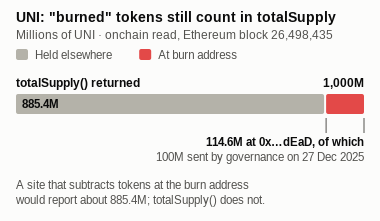
In December 2025, UNI governance passed a proposal called "UNIfication". Among other changes, it moved 100 million UNI from the governance treasury to the address 0x000…dEaD, which nobody is known to control. That transfer is in block 24,106,378 (27 December 2025, 20:33 UTC). Because UNI has no burn function, "burning" here means sending tokens to an address from which they cannot be expected to move again.
On 26 November 2026, that address held 114.64 million UNI: the 100 million from governance plus about 14.6 million from other transfers. Yet totalSupply() still reports 1 billion. A site that subtracts tokens at the burn address would report about 885.4 million. A site that copies totalSupply() would report 1 billion. Both describe the same token.
A company that mints and redeems: USDC#
For a stablecoin backed by dollars, a company sets the supply in response to its customers. Circle says each USDC is always redeemable one for one for US dollars, and it publishes its reserve holdings each week along with mint and burn flows. The USDC contract gives a master minter role the power to authorize minters, each with an allowance. Those minters create new tokens and burn redeemed ones. Supply follows customer demand rather than a schedule.
On 26 November 2026, the USDC contract on Ethereum reported a total supply of about 44.65 billion USDC (real data, block 26,498,435). USDC is also issued on other blockchains, so that figure covers Ethereum only. For a token like this, the supply number says little about value. What matters is whether the reserves and the company stand behind redemption. That is a different kind of trust from a code-enforced cap.
What could change the conclusion about a token's supply?#
Code can change. Some token contracts can be upgraded, so the rules you read today describe the code in force today. Bitcoin's schedule could only change if the network's users adopted different software. A token whose contract an administrator can upgrade offers a much weaker promise.
Mint authority can move. UNI's minter can hand its role to another address, and company-run tokens can add or remove minters. Re-check the minter and any recent mints before relying on an earlier reading.
A "cap" may only be a description. A maximum in a white paper means little unless the contract enforces it. How do I check a token's documentation against its contracts? shows how to compare the two.
"Burned" can mean different things. Some contracts reduce total supply when tokens are burned. Others, like UNI, only move tokens to an address nobody is known to control. Data sites treat these cases differently.
The same token can live on several chains. Tokens bridged to other networks can be counted twice if you add chain totals together, and a single chain's total can be only part of the whole.
Lost coins never disappear from the count. Coins whose keys are lost still count in every supply figure, even though they will never move.
Supply is not price. New tokens always shrink the share of total supply held by everyone who does not receive them. Whether the price falls depends on demand: a schedule that adds 2% a year matters less if usage grows faster, and more if it doesn't.
Check your understanding: a governance mint cap#
Question. Token Y's contract reports a total supply of 500 million. Governance may mint up to 2% of the current supply, at most once every 365 days, and minting is allowed now. 25 million Token Y have been sent to a burn address, and the contract has no burn function. You hold 50,000 tokens.
- What is the most governance could mint in the next allowed mint?
- What is the largest the total supply could be after three maximum mints, one every 365 days?
- What total would a site that subtracts tokens at the burn address show today?
- What happens to your share of the contract's total supply after three maximum mints, if you don't buy more?
Show the answers
Answer.
- 2% × 500 million = 10 million tokens.
- Each mint is 2% of the supply at that time: 500 million × 1.02 × 1.02 × 1.02 = 530.604 million tokens. This is an upper bound, not a forecast.
- 500 million − 25 million = 475 million. The contract itself would still report 500 million, because sending tokens to a burn address does not change its count.
- Your share falls from 0.01% (50,000 ÷ 500 million) to about 0.009423% (50,000 ÷ 530.604 million), a drop of about 5.8%. Whether that hurts depends on whether demand for the token grows at least as fast as its supply.
Related lessons#
- Before this lesson: no earlier lesson is required. For background on holding tokens through an exchange, see What do I own when I hold crypto on an exchange?
- Next: What is the difference between market cap and fully diluted valuation? and What changes when tokens unlock?
- See also: What do staking rewards and token emissions cost existing holders?, How do I check a token's documentation against its contracts? and, for the stock-market parallel, How does dilution happen, and how do I spot it in a filing?