Where do I find a company's numbers?
Short answerFor a company whose shares trade in the United States, the official numbers are in the reports it files with the US Securities and Exchange Commission (SEC), free to read on the SEC's EDGAR website. The audited annual financial statements are in the annual report on Form 10-K, in Part II, Item 8. Quarterly statements, reviewed by an auditor but not audited, are in Form 10-Q, Part I, Item 1. The earnings press release usually arrives first, attached to a Form 8-K under Item 2.02. Companies based outside the US may file Forms 20-F and 6-K instead, or publish only on their home country's system.
Before a number from an app, data site or news story shapes a decision, check it in the filing. Those sources often round, relabel or adjust what the company reported. The filing shows exactly what was reported, for which period and under which accounting rules, and it carries the notes, where much of the useful detail lives.
Scope note: Valmy v1 trades crypto on Binance Spot and USDⓈ-M futures and does not offer company shares. This lesson shows where a company's filed numbers are, so you can check any figure at its source.
The main SEC filings and what each one contains#
A US public company reports through a small set of forms. Two of them hold the financial statements: the 10-K, filed once a year with audited statements, and the 10-Q, filed after each of the first three fiscal quarters with unaudited statements. There is no 10-Q for the fourth quarter, because the 10-K covers the full year. The other common forms are the 8-K for specific events such as an earnings release, the proxy statement (DEF 14A) for the shareholder meeting, Forms 3, 4 and 5 for insiders' holdings, the S-1 for a public offering, and Forms 20-F and 6-K for many companies based abroad.
| Form | What it is | Financial statements? |
|---|---|---|
| 10-K | Annual report | Full year, audited, with notes |
| 10-Q | Quarterly report for quarters 1 to 3 | Latest quarter and year to date, unaudited but reviewed |
| 8-K | Current report on specific events, generally within four business days | The earnings release, if any, is an exhibit. Not audited |
| DEF 14A | Definitive proxy statement for the shareholder meeting: directors, executive pay, proposals | No |
| 3, 4 and 5 | Holdings and trades of officers, directors and owners of more than 10% | No |
| S-1 | Registration statement for a public offering, often an initial public offering (IPO) | Yes, in the prospectus |
| 20-F | Annual report of a foreign private issuer | Yes, audited |
| 6-K | Report furnishing what a foreign private issuer publishes at home or sends to its shareholders | Sometimes |
A few terms help when you read these forms:
- An 8-K item is a numbered event type. Item 2.02, Results of Operations and Financial Condition, is triggered when a company publicly announces results for a completed quarter or year. The company must attach the text of the release as an exhibit, usually Exhibit 99.1. Item 5.07 reports shareholder vote results. Item 5.02 covers directors and certain officers leaving or joining, and their pay arrangements.
- Furnished versus filed. The Form 8-K instructions say an earnings release under Item 2.02 is not treated as "filed" for the liability provisions of Section 18 of the Securities Exchange Act, unless the company says otherwise. The 10-Q and 10-K that follow are filed documents.
- The glossy annual report that many companies send to shareholders is a separate document. Microsoft, for example, also posts it on EDGAR as an "ARS" filing. The 10-K is the report that follows the SEC's required layout.
Where the financial statements sit inside a 10-K and a 10-Q#
In a 10-K, the audited financial statements and their notes are in Part II, Item 8, "Financial Statements and Supplementary Data." In a 10-Q they are in Part I, Item 1, "Financial Statements," labeled unaudited. Management's Discussion and Analysis (MD&A), management's explanation of what changed and why, is Item 7 of a 10-K and Item 2 of a 10-Q. Find each part by its item number or the table of contents, not by its position. In the order the forms set, a 10-Q puts MD&A after the statements, and a 10-K puts Item 7A, on market risk, between MD&A and Item 8. Read the statements for the numbers and MD&A for the reasons, then check one against the other.
The form lists a 10-K's items in the order below, and Microsoft's 10-K follows it. A company that combines its 10-K with its glossy annual report may arrange the material differently and add a cross-reference sheet that maps each item to its pages.
- Part I. Item 1 Business (what the company sells and where). Item 1A Risk Factors. Item 1C Cybersecurity. Item 2 Properties. Item 3 Legal Proceedings.
- Part II. Item 5 the market for the company's shares, including buybacks. Item 7 MD&A. Item 7A market risk. Item 8 the financial statements, notes and auditor's report. Item 9A controls and procedures.
- Part III. Items 10 to 14: directors, executive pay, ownership and accountant fees. A company may leave these out of the 10-K and incorporate them from its proxy statement, if that statement is filed within 120 days after the fiscal year ends.
- Part IV. Item 15 exhibits, such as the list of subsidiaries and the chief executive's and chief financial officer's certifications.
A 10-Q is shorter. Part I holds the financial statements (Item 1), MD&A (Item 2), market risk (Item 3) and controls (Item 4). Part II covers legal proceedings, updated risk factors, share buybacks and exhibits. Under Regulation S-X, a 10-Q's income statement shows the latest quarter, the fiscal year to date and the same periods a year earlier. The cash flow statement shows only the year to date.
Audited versus reviewed statements#
An audit is an independent accounting firm's examination that ends in an opinion on whether the statements are presented fairly under the accounting rules. A review is narrower. Rule 10-01(d) of Regulation S-X requires the statements in every 10-Q to be reviewed by an independent public accountant before filing, but not audited. That is why each statement in Microsoft's 10-Q carries the label "(Unaudited)". In practice, the annual 10-K is the strongest version of the numbers, and later 10-Ks may still revise earlier years.
How quickly companies must file: deadlines by filer status#
Deadlines depend on a company's filer status, which mainly reflects its public float: the market value of shares held by investors other than its officers, directors and other affiliates. A large accelerated filer has a public float of $700 million or more, measured on the last business day of its second fiscal quarter, plus conditions such as at least a year of reporting history. It must file its 10-K within 60 days after the fiscal year ends and each 10-Q within 40 days after the quarter ends. Smaller companies get more time.
| Filer status | 10-K due after year end | 10-Q due after quarter end |
|---|---|---|
| Large accelerated filer | 60 days | 40 days |
| Accelerated filer | 75 days | 40 days |
| All other registrants | 90 days | 45 days |
Other timing rules (as of 26 November 2026):
- A Form 8-K is generally due within four business days after the event. Many companies furnish the earnings 8-K on the same day as the release.
- If a deadline falls on a Saturday, Sunday or federal holiday, the filing may be made on the next business day (Exchange Act Rule 0-3).
- A company that cannot file on time can file a Form 12b-25 notice (shown on EDGAR as "NT 10-K" or "NT 10-Q"). If it meets the rule's conditions, it gets up to 15 more calendar days for a 10-K or 5 for a 10-Q.
- A foreign private issuer files its 20-F within four months after its fiscal year ends.
Counting the days for Microsoft's fiscal 2026 reports#
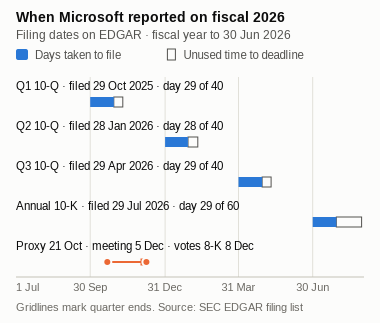
Microsoft is a large accelerated filer, and its fiscal year ends on 30 June. Its first fiscal 2026 quarter ended on 30 September 2025. Day 40 was Sunday 9 November, so the 10-Q was due on Monday 10 November 2025. Microsoft filed it on 29 October, day 29. The second quarter ended on 31 December 2025, with day 40 on 9 February 2026. It filed on 28 January, day 28. The third quarter ended on 31 March 2026. Day 40 was Sunday 10 May, so the report was due on Monday 11 May. It filed on 29 April, day 29. The fiscal year ended on 30 June 2026. Day 60 was Saturday 29 August, so the 10-K was due on Monday 31 August. Microsoft filed it on 29 July, day 29.
Worked example: finding Microsoft's latest 10-K and 10-Q on EDGAR (real data)#
As of 26 November 2026, Microsoft's latest annual report is its Form 10-K for the fiscal year ended 30 June 2026, filed on 29 July 2026 under accession number 0001193125-26-323660. Its latest quarterly report is the Form 10-Q for the quarter ended 30 September 2026, filed on 28 October 2026 under accession number 0001193125-26-436133. An accession number is the unique ID EDGAR gives each submission, and it is the safest way to cite one. Here is how to find both reports.
- Search. On the SEC's EDGAR search page, type the company name or ticker (MSFT). The company's page shows its CIK (Central Index Key), the permanent ID EDGAR uses for a filer. Microsoft's is 0000789019. The page also shows its fiscal year end as "0630", meaning 30 June, and lists filings newest first, labeled by form type.
- Filter to 10-K. The newest 10-K was filed on 29 July 2026. The one before it, filed on 30 July 2025, covers fiscal 2025.
- Open the filing index. It lists the period of report (2026-06-30), the time EDGAR accepted the filing (16:08:01 New York time), the main document, exhibits such as the subsidiaries list and the officers' certifications, and an Interactive Data link.
- Go to Part II, Item 8. The income statement shows revenue of $331,839 million and net income of $133,749 million for the year, that is, $331.8 billion and $133.7 billion. The header says "In millions, except per share amounts". Check the units before you copy a number.
- Or use Interactive Data. This view shows each statement and note as a separate table: income statements, balance sheets, cash flow statements, then one table per note, such as "Segment Information and Geographic Data".
- Repeat for the 10-Q. The quarter's income statement is labeled "(Unaudited)". Revenue was $92,279 million, up 18.8% from $77,673 million a year earlier, and net income was $36,629 million.
- Find the earnings 8-K. On the same afternoon, Microsoft furnished an 8-K under Items 2.02 and 9.01 (accession 0001193125-26-436122), with the press release as Exhibit 99.1. EDGAR accepted it at 4:04 pm New York time, 2 minutes and 55 seconds before the 10-Q. Microsoft's earnings releases also present measures that are not in the financial statements, such as growth in constant currency and net income adjusted for its investments in OpenAI.
A year of filings: Microsoft's fiscal 2026 reporting calendar (real data)#
Over one fiscal year a large company files on a steady rhythm. It files a 10-Q about four weeks after each of the first three quarters and a 10-K about four weeks after the year ends, each on the same afternoon as an earnings 8-K, plus a proxy statement before the annual meeting. Between 1 July 2025 and 31 July 2026, EDGAR lists 188 filings under Microsoft's name. Most are not about results: 129 are Form 4 reports of insiders' share transactions. Ten are 8-Ks, five of them earnings releases.
| Filed | Form | What it covered | Accession |
|---|---|---|---|
| 21 Oct 2025 | DEF 14A | Proxy statement for the 5 December 2025 annual meeting | 0001193125-25-245150 |
| 29 Oct 2025 | 8-K (2.02) and 10-Q | First quarter, to 30 September 2025 | 0001193125-25-256310 and 0001193125-25-256321 |
| 8 Dec 2025 | 8-K (5.02, 5.07) | Shareholder vote results | 0001193125-25-311196 |
| 28 Jan 2026 | 8-K (2.02) and 10-Q | Second quarter, to 31 December 2025 | 0001193125-26-027198 and 0001193125-26-027207 |
| 29 Apr 2026 | 8-K (2.02) and 10-Q | Third quarter, to 31 March 2026 | 0001193125-26-191457 and 0001193125-26-191507 |
| 29 Jul 2026 | 8-K (2.02) and 10-K | Full fiscal year, to 30 June 2026 | 0001193125-26-323632 and 0001193125-26-323660 |
The 8-K for the first quarter also lists Item 7.01, which covers disclosures made under Regulation FD, the SEC's fair-disclosure rule. Some entries under a company's name come from other people, such as a Schedule 13G filed by an investor that owns more than 5% of the shares. The shareholder meeting itself also creates paperwork. At the 5 December 2025 meeting, shareholders elected 12 directors, approved a new employee stock plan, and rejected six shareholder proposals.
XBRL: the same numbers in a form computers can read#
The financial statements and cover page of every 10-K and 10-Q are tagged in Inline XBRL, a format that makes one document both readable by people and readable by machines. The SEC adopted the requirement in 2018 and phased it in. Each tagged number carries a concept name, a period and a unit. The tags power the Interactive Data tables on EDGAR and the SEC's free data feeds, so you can pull a company's history without retyping a single number.
- Inline XBRL viewer. Built into EDGAR, it lets you click a tagged number in the document to see its concept, period and definition.
- data.sec.gov. The SEC's application programming interfaces (APIs) return each company's filing history and every XBRL fact it has reported, as JSON. They need no account or key. The SEC says updates usually appear within a minute of a filing being published (as of 26 November 2026). In Microsoft's "company facts" file, fiscal 2026 revenue of $331,839 million appears under the concept
RevenueFromContractWithCustomerExcludingAssessedTax, tagged with the 10-K's accession number.
Use structured data with three cautions. First, one value often appears in several filings, because each report repeats prior periods for comparison. Record the accession number and the period, not just the number. Second, the company-facts file leaves out amounts that are broken down by segment, product or region. Those are tagged with extra dimensions, so read the note itself. Third, tags can be generic or company-specific, so compare the label in the document with the tag before you combine data from different companies.
Investor-relations websites, data sites and EDGAR#
A company's investor-relations (IR) website is convenient. It usually hosts the press release, slides, the earnings call webcast and sometimes a transcript. But the documents on EDGAR are the record the company submitted to the regulator, with a time stamp, an accession number and the required layout. A practical routine is to find material quickly on the IR site, then confirm the numbers in the filing.
Some material exists only on the IR site. Under Item 2.02(b) of Form 8-K, a company does not have to furnish a separate 8-K for its earnings call if four conditions are met. The call must take place within 48 hours after a written release that was furnished on Form 8-K, and it must be broadly accessible, for example by webcast. The financial information discussed must be posted on the company's website, and the call must have been announced in a widely distributed press release. So the slides and the call may not appear on EDGAR at all.
Data sites and apps add another layer. They may sum the last four quarters into a "trailing twelve months" figure, use the company's adjusted numbers instead of the audited ones, round, or keep an old figure after the company has revised it. When a number matters to you, check the period, the units and the source filing.
Companies outside the United States#
A company based abroad whose shares or depositary receipts are registered in the US usually files on EDGAR as a foreign private issuer. It files an annual report on Form 20-F within four months after its fiscal year ends, and Form 6-K for information it publishes at home, files with its home exchange or sends to shareholders. The 20-F cover page asks which accounting basis the statements use: US GAAP, International Financial Reporting Standards (IFRS) as issued by the International Accounting Standards Board, or another basis. Interim figures from these companies often reach EDGAR only on Form 6-K, so their timing and format depend on home-country rules.
Companies that are not registered with the SEC file only with their home regulator. Two examples, as of 26 November 2026:
- Canada: SEDAR+, run by the Canadian Securities Administrators. The BC Securities Commission describes it as a secure web-based system to file, disclose and search for issuer information.
- Japan: EDINET, run by the Financial Services Agency. Annual securities reports are filed in Japanese. The Financial Services Agency notes that English translations are voluntary and keeps a list of companies that publish them.
What could change the number you found?#
A number copied correctly from the right filing can still mislead if you miss its context. These are the usual traps.
- Fiscal years are not calendar years. Microsoft's fiscal 2026 ran from 1 July 2025 to 30 June 2026. Another company's "fiscal 2026" can end in January 2026 or December 2026. Compare periods, not labels.
- Later filings can change earlier numbers. Each 10-K repeats prior years, and those columns can differ from what was first reported. In its fiscal 2025 10-K, Microsoft said it had "recast certain prior period amounts" in its segment note to match how it now manages the business. Restatements and amended filings (10-K/A, 10-Q/A) also happen. Cite the filing and line you used.
- Quarter versus year to date. A third-quarter 10-Q shows the third quarter and the first nine months side by side. A cash flow statement in a 10-Q shows only the year to date.
- Units and signs. Most statements are in millions or thousands, while per-share amounts are in dollars. Parentheses mean a negative number.
- Release versus report. The earnings release is furnished first and often features adjusted, non-GAAP measures. The audited or reviewed statements are in the 10-K or 10-Q.
- Late or missing reports. An "NT 10-K" or "NT 10-Q" on the filing list means the company has said it cannot file on time. That is worth reading before relying on older numbers.
Check your understanding: filing deadlines#
Question. A company's fiscal year ends on Wednesday 31 December 2025.
- If it is a large accelerated filer, when is its 10-K due? What if it is an accelerated filer, or neither?
- Its first quarter ends on 31 March 2026. When is that 10-Q due if it is a large accelerated filer, and if it is neither large accelerated nor accelerated?
- It announces full-year results in a press release on 4 February 2026. Where will the release appear on EDGAR, and are its numbers audited?
Show the answers
Answer.
- Large accelerated: day 60 is Sunday 1 March 2026, so the 10-K is due on Monday 2 March 2026. Accelerated: day 75 is Monday 16 March 2026. Neither: day 90 is Tuesday 31 March 2026.
- Large accelerated: day 40 is Sunday 10 May 2026, so the 10-Q is due on Monday 11 May. Neither: day 45 is Friday 15 May 2026.
- On a Form 8-K under Item 2.02, with the release attached as an exhibit, generally within four business days of the announcement. The release itself is not audited. The audited statements arrive with the 10-K, which also carries the auditor's report. If the two documents differ, rely on the 10-K and look for an explanation.
Related lessons#
- Before this lesson: no earlier lesson is needed. This lesson starts the path on reading company filings.
- Next: How does this company make money?, which reads Microsoft's segment note.
- See also: How do I read an income statement? and What does a balance sheet tell me?
- See also: How can a profitable company run short of cash?
- See also: What do I own when I buy a share through a broker?