What does a balance sheet tell me?
Short answerA balance sheet is a snapshot, on one date, of what a company owns (its assets), what it owes (its liabilities), and what is left for shareholders (its equity). The two sides always match: assets = liabilities + equity. Read it to see whether the company can pay what falls due within a year, how its cash compares with its debt, and how much of its equity rests on intangible items such as goodwill. It records most assets at historical cost, so it says little about what the business is worth. Microsoft's assets of $758.4 billion on 30 June 2026 equaled $316.0 billion of liabilities plus $442.4 billion of equity.
Reading the balance sheet lets you judge whether a profitable company could survive a bad year. One with little cash and heavy short-term debt can be fragile, while one with net cash can ride it out. It also shows why a stock's market value can be many times its accounting value.
Scope note: Valmy v1 trades crypto on Binance Spot and USDⓈ-M futures and does not offer company shares. This lesson shows how to read a balance sheet in a filing to judge liquidity, debt and book value.
Assets, liabilities and equity: the equation that always balances#
Every balance sheet obeys one identity: assets = liabilities + equity. Assets are resources the company controls that are expected to bring future benefits, such as cash, money customers owe, buildings and equipment. Liabilities are obligations to others, such as suppliers, lenders, tax authorities, and customers who paid in advance. Equity (shareholders' equity or book value) is what remains for shareholders after all liabilities, so it is the balancing figure, not a separate pile of cash.
Equity grows mainly in two ways. Shareholders put money in by buying newly issued shares, and the company keeps profits instead of paying them out, recorded as retained earnings. It shrinks when the company makes losses, pays dividends or buys back its own shares. Because every transaction touches at least two lines, the two sides stay equal. Borrowing $10 adds $10 of cash and $10 of debt. Paying a $10 dividend removes $10 of cash and $10 of retained earnings.
In a 10-K, the balance sheet is in Part II, Item 8, next to the income statement. It shows two dates, the latest year end and the one before, so you can see what changed.
Current and non-current: what comes due within a year#
Both sides are split by timing. Current assets are cash and items expected to turn into cash within a year (or one operating cycle), such as short-term investments, receivables and inventory. Current liabilities are obligations due within a year, such as supplier bills, wages, taxes, the part of long-term debt due in the next twelve months, and unearned revenue, which is money customers paid in advance. Everything else is non-current (long-term).
Two measures compare the current lines:
- Working capital = current assets − current liabilities. Positive working capital means near-term resources exceed near-term obligations.
- Current ratio = current assets ÷ current liabilities. A ratio above 1 means the same thing in proportional form.
Neither has a universal "safe" level. A retailer that sells inventory for cash every day can run with a low ratio. A company whose current assets are mostly slow-moving inventory may need a high one. Look at what the current items actually are.
Worked example: Microsoft's balance sheet on 30 June 2026 (real data)#
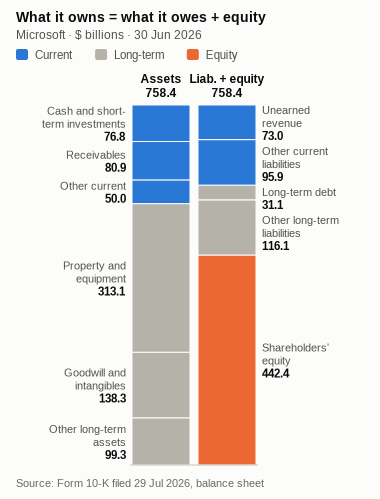
Microsoft's balance sheet at the end of fiscal 2026, from its Form 10-K filed on 29 July 2026 (accession 0001193125-26-323660), balances at $758.4 billion. Equity is the largest claim, at 58% of the total. Property and equipment is the largest asset, at 41.3%, after growing 52.7% in one year as the company built data centers. Amounts are in US dollars, condensed from the statement.
| Line | 30 June 2026 | 30 June 2025 |
|---|---|---|
| Cash, cash equivalents and short-term investments | $76.8 billion | $94.6 billion |
| Accounts receivable | $80.9 billion | $69.9 billion |
| Inventories and other current assets | $50.0 billion | $26.7 billion |
| Total current assets | $207.7 billion | $191.1 billion |
| Property and equipment, net | $313.1 billion | $205.0 billion |
| Goodwill | $119.7 billion | $119.5 billion |
| Intangible assets, net | $18.6 billion | $22.6 billion |
| Other long-term assets (leases, investments, other) | $99.3 billion | $80.8 billion |
| Total assets | $758.4 billion | $619.0 billion |
| Short-term unearned revenue | $73.0 billion | $64.6 billion |
| Other current liabilities (payables, current debt, pay, taxes, other) | $95.9 billion | $76.7 billion |
| Total current liabilities | $168.8 billion | $141.2 billion |
| Long-term debt | $31.1 billion | $40.2 billion |
| Other long-term liabilities (taxes, leases, other) | $116.1 billion | $94.2 billion |
| Total liabilities | $316.0 billion | $275.5 billion |
| Shareholders' equity | $442.4 billion | $343.5 billion |
Checking that Microsoft's balance sheet balances#
Always re-add the totals before using them, in millions of dollars. Total liabilities of $315,989 plus equity of $442,387 equals $758,376, exactly the reported total assets. The year before, $275,524 + $343,479 = $619,003. The subtotals tie too. Current assets of $76,843 (cash and short-term investments) + $80,876 + $1,397 + $48,594 = $207,710. Current liabilities of $42,416 + $9,227 + $14,945 + $2,534 + $72,965 + $26,738 = $168,825.
Working capital and the current ratio#
Microsoft's working capital was $207,710 million − $168,825 million = $38.9 billion, down from $49.9 billion. Its current ratio was 207,710 ÷ 168,825 = 1.23, down from 1.35. Taken alone, that looks like a weaker position.
Read the lines, though. Short-term unearned revenue of $73.0 billion is 43.2% of current liabilities. It is mostly subscriptions that customers have already paid for. Microsoft settles it by delivering software and cloud services, not by paying out cash. Excluding it, current assets cover the remaining current liabilities 2.17 times. Neither ratio is "the" answer. The first is the standard measure, and the second shows why a subscription business can run a lower current ratio than a manufacturer.
Cash, debt and net cash#
Microsoft held $76.8 billion of cash, cash equivalents and short-term investments, against $40.3 billion of debt: $9.2 billion due within a year and $31.1 billion later. Net cash = cash and short-term investments − debt = $76,843 million − $40,294 million = $36.5 billion, down from $51.4 billion a year earlier. A company with net cash could repay all its borrowings from its cash and liquid investments.
A competing reading counts leases as debt. Adding Microsoft's $66.6 billion of finance lease liabilities, mainly for data centers, turns its net cash into net debt of about $30.0 billion. These liabilities sit inside "other" current and long-term liabilities. Leases are contracts to use an asset for years in exchange for fixed payments, and many analysts treat them like borrowing. Operating leases would add a further $21.9 billion. The company is not short of cash either way, but the label "net cash" depends on a choice you should state.
Book value versus market value, and why they differ#
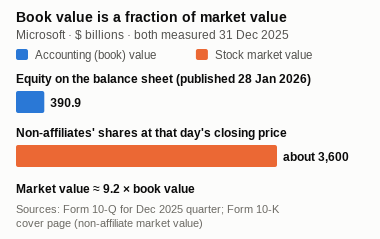
Book value is shareholders' equity on the balance sheet. Market value (market capitalization) is the share price times the number of shares. They usually differ, sometimes enormously, because the balance sheet records most assets at what they cost, less depreciation, and leaves out much of what makes a business valuable. Market value reflects investors' expectations of future cash flows, while book value reflects past transactions. Measured on the same date, 31 December 2025, the market value of Microsoft's shares held by outside investors was about 9.2 times its book value, using a balance sheet that Microsoft published four weeks later.
Microsoft's 10-K cover page allows this same-date comparison. At the Nasdaq closing price on 31 December 2025, the market value of its shares held by non-affiliates (investors other than directors, officers and other insiders) was about $3.6 trillion. Its balance sheet at that date, published in the 10-Q filed on 28 January 2026 (accession 0001193125-26-027207), shows equity of $390.9 billion. Market value was about 9.2 times book value, and the true multiple is slightly higher, because the cover figure leaves out insiders' shares.
The comparison uses hindsight. On 31 December 2025, investors could not yet see that balance sheet. The latest one published by then, at 30 September 2025 in the 10-Q filed on 29 October 2025, showed equity of $363.1 billion, against which the same market value was about 9.9 times book value. When you compute a price-to-book ratio, record both dates: the day of the price and the day the balance sheet was published.
Three things open the gap at Microsoft:
- Internally built assets are mostly missing. Microsoft charged $35.6 billion of research and development to expense in fiscal 2026. Its accounting policy keeps software development costs in R&D expense until technological feasibility is reached, generally shortly before release. The software, cloud platform and brand that this spending built are not recorded as assets at anything near their value.
- Long-lived assets sit at depreciated cost. Property and equipment of $313.1 billion is what Microsoft paid, less depreciation, not what the data centers would fetch or earn.
- Profits leave through dividends and buybacks. These return cash to shareholders and reduce equity, as the next calculation shows.
Tracing the change in equity over fiscal 2026#
Equity rose by $98.9 billion, from $343,479 million to $442,387 million. Net income added $133,749 million. Stock-based pay added $12,405 million, because shares granted to employees are recorded in paid-in capital. Shares issued added $2,009 million, other comprehensive income $63 million and other items $2 million. Dividends removed $27,034 million and share buybacks $22,286 million. The result ties exactly: 343,479 + 133,749 + 12,405 + 2,009 + 63 + 2 − 27,034 − 22,286 = 442,387. Dividends and buybacks together returned $49.3 billion, 36.9% of the year's net income, and every dollar of it reduced book value. Book value per share was $442,387 million ÷ 7,427 million shares = $59.56.
Goodwill and other intangible assets#
When a company buys another business for more than the fair value of its identifiable net assets, the excess is recorded as goodwill. It stands for things the buyer paid for but cannot separately identify, such as a workforce, expected synergies or market position. Identifiable items such as customer relationships, technology and trade names are recorded separately as intangible assets, and most are amortized over their useful lives. Under US accounting rules goodwill is not amortized. Instead it is tested for impairment at least once a year, and a write-down hits profit and equity at once.
Microsoft's goodwill was $119.7 billion on 30 June 2026, 15.8% of total assets and 27.0% of equity. More than half, $62.3 billion, belongs to More Personal Computing, the segment that includes Xbox. When Microsoft completed its acquisition of Activision Blizzard on 13 October 2023, for a total purchase price of $75.4 billion, it recorded $51.0 billion of goodwill in that segment. Microsoft tests goodwill each year on 1 May. The tests in 2024, 2025 and 2026 found no impairment, and accumulated impairments from earlier years total $11.3 billion. Net intangible assets were $18.6 billion after $4.7 billion of amortization in fiscal 2026.
Calculating tangible book value#
Tangible book value removes goodwill and intangible assets from equity, leaving the part backed by assets that could, in principle, be sold separately. For Microsoft: $442,387 million − $119,651 million − $18,609 million = $304.1 billion. Goodwill and intangibles make up 31.3% of book value. A company whose tangible book value is small or negative relies heavily on the success of past acquisitions.
What the balance sheet cannot show#
A balance sheet records what past transactions have produced and leaves out much of what matters for the future. Before drawing conclusions, look in the notes for these gaps.
- Commitments not yet on the balance sheet. At 30 June 2026, Microsoft had signed leases, mainly for data centers, that had not yet started, worth $329.1 billion. They commence between fiscal 2027 and fiscal 2033, with terms of 1 to 20 years. That is 3.7 times the $88.5 billion of lease liabilities already recorded, and equal to 74.4% of equity. Each lease will join the balance sheet as an asset and a liability when it starts.
- The value of brands, software and people. As shown above, most internally created value is not recorded.
- Contracted future revenue. Microsoft's $684 billion of signed contracts not yet recognized as revenue is disclosed in the notes, but it is not an asset on the balance sheet.
- Legal and tax uncertainties. Contingencies appear in the notes, and only some are accrued as liabilities.
- Anything after the balance-sheet date. The snapshot is one day. Cash, debt and receivables can look different a week later.
What could change the conclusion about a balance sheet?#
- Definitions of debt and cash. Including or excluding leases turned Microsoft's $36.5 billion of net cash into $30.0 billion of net debt. Some analysts also exclude cash held abroad or in restricted accounts.
- Impairments. If an acquired business underperforms, a goodwill write-down can cut equity sharply without any cash leaving the company.
- Investment values. Microsoft's equity and other investments rose from $15.4 billion to $36.3 billion in fiscal 2026, and its notes report $4.4 billion of unrealized gains on equity investments it still held. Changes in investment values can move both profit and equity without any change in the operating business.
- Debt coming due. The current portion of Microsoft's debt rose from $3.0 billion to $9.2 billion, because more long-term debt now falls due within a year. Debt maturities are covered in When does debt become dangerous?
- The pace of buybacks. Heavy buybacks can push equity toward zero or below even at very profitable companies. Low or negative book value then says more about capital returns than about financial weakness.
Check your understanding: balance, liquidity and tangible book value#
Question. Example Retail, a fictional company, reports in millions of dollars: cash $30, short-term investments $20, receivables $40, inventory $30, property and equipment $100 and goodwill $90. It owes suppliers $50, holds $40 of customer prepayments (unearned revenue), and has $10 of debt due within a year and $60 due later.
- What are total assets, total liabilities and equity?
- What are the current ratio and working capital?
- What are net debt and tangible book value?
- If the company writes off $50 of goodwill, what happens to total assets, equity, tangible book value and cash?
Show the answers
Answer.
- Current assets = 30 + 20 + 40 + 30 = $120. Total assets = 120 + 100 + 90 = $310. Current liabilities = 50 + 40 + 10 = $100. Total liabilities = 100 + 60 = $160. Equity = 310 − 160 = $150, so 310 = 160 + 150 balances.
- Current ratio = 120 ÷ 100 = 1.2. Working capital = 120 − 100 = $20. Of the current liabilities, $40 is customer prepayments, settled by delivering goods rather than paying cash.
- Net debt = (10 + 60) − (30 + 20) = $20. Tangible book value = 150 − 90 = $60.
- Total assets fall to $260 and equity to $100. Tangible book value stays at $60, and cash does not change, because the write-off is an accounting charge. The impairment records that a past acquisition was worth less than was paid for it.
Related lessons#
- Before this lesson: How do I read an income statement?
- Next: How can a profitable company run short of cash?, which connects the balance sheet to cash flow.
- Next: How does dilution happen, and how do I spot it in a filing?
- See also: When does debt become dangerous? and Is this stock cheap? What each valuation multiple assumes
- See also: Where do I find a company's numbers? and How does this company make money?