When does debt become dangerous?
Short answerDebt becomes dangerous when the cash a business produces cannot cover its interest and the repayments coming due, and the company cannot count on lenders to refinance. Four things decide it: how many times earnings cover the interest bill, how large the debt is next to earnings, when the principal must be repaid, and what the loan terms let lenders do if things go wrong. At 30 June 2026, Hain Celestial had $558.0 million of debt due on 22 December 2026, against $78.3 million of operating cash flow for its fiscal year, and reported substantial doubt about continuing as a going concern.
Checking these four things in the filings lets you see the risk before lenders act. Shareholders are paid last: in a restructuring, lenders can take the assets pledged to them, and the shares can lose most or all of their value. The same debt can be harmless for a company with steady cash flow and distant maturities, and fatal for one whose loan comes due in a bad year.
Scope note: Valmy v1 trades crypto on Binance Spot and USDⓈ-M futures and does not offer company shares. This lesson shows how to judge a company's debt from its filings.
The four questions that decide whether debt is dangerous#
Whether debt is dangerous depends on four questions, and a company can look fine on three of them and still fail on the fourth. Ask them in this order:
- Can earnings pay the interest? Compare operating earnings with the interest bill (interest cover).
- How big is the debt compared with earnings? Compare debt, minus cash, with yearly earnings before depreciation (net debt to EBITDA).
- When does the principal come due? Read the maturity schedule. Principal is the amount borrowed, as opposed to the interest charged on it. The maturity is the date it must be repaid.
- What do the terms allow? Check whether the rate is fixed or floating, what conditions (covenants) the company has promised to meet, and whether lenders hold claims on specific assets (security).
The first two questions are about size, the last two about timing and control. A maturity must be paid in cash on a fixed date: from cash on hand, operating cash flow, asset sales, new money from shareholders, or new borrowing, which is called refinancing. When none is available in time, the company defaults.
This lesson builds on How can a profitable company run short of cash?, which explains operating cash flow and the going-concern assessment.
Interest cover: can earnings pay the interest?#
Interest cover (also called interest coverage) divides operating earnings by interest expense. It says how many times over the year's earnings could pay the year's interest. A cover of 4 means earnings were four times the interest bill. A cover below 1 means earnings did not even cover interest, so the company paid it from cash, asset sales or new borrowing. The ratio is only as good as the earnings measure you put on top, so always say which one you used.
Calculating interest cover from the income statement#
Two versions are common:
- EBIT ÷ interest expense. EBIT is earnings before interest and taxes, usually the "operating income" line of the income statement. It is the stricter version because it subtracts depreciation, the yearly cost of wearing out equipment and buildings.
- EBITDA ÷ interest expense. EBITDA adds depreciation and amortization back to EBIT. Depreciation uses no cash in the year, so EBITDA is closer to operating cash, but the equipment still has to be replaced eventually.
For the interest figure, use interest expense from the income statement, or interest paid from the cash flow statement or the debt note if you want a cash view. Watch for one-off charges. A large impairment, which writes down the value of an asset without any cash leaving, can push EBIT below zero in a year when the business still produced cash. Calculate the ratio with and without such items, and say which version you are quoting.
There is no universal safe level. A useful benchmark is the one in the company's own loan agreement: many credit agreements require a minimum interest cover, so the filing tells you how close the company is to the line its lenders drew.
Net debt to EBITDA: how many years of earnings the debt represents#
Net debt to EBITDA divides debt minus cash by a year's EBITDA. It roughly answers: if all of this year's earnings before interest, taxes and depreciation went to repaying debt, how many years would it take? A ratio of 2 means about two years' worth. A ratio of 7 means the debt is large next to what the business earns, so any fall in earnings or rise in rates hits hard.
Calculating net debt to EBITDA#
- Total debt is borrowed money due within a year plus borrowed money due later. Both are on the balance sheet, and the debt note itemizes them.
- Net debt is total debt minus cash and cash equivalents. Subtracting cash assumes the cash could be used to repay debt. If the cash is already earmarked for something else, net debt understates the burden.
- Divide by EBITDA for the same year.
The ratio flatters a company that needs heavy capital spending, because EBITDA ignores the money spent on new equipment, and it ignores taxes and interest too. Lenders often write their own definition of EBITDA into the loan agreement, with add-backs for items such as restructuring costs or expected savings, so the "leverage ratio" in a covenant can be lower than the one you calculate from the reported statements.
Maturities: when the principal comes due#
A maturity schedule lists how much principal falls due in each of the next five years and after. It sits in the debt note of the annual report on Form 10-K, usually as a small table near the end of the note, and the balance sheet shows the part due within twelve months as "current portion of long-term debt" or "current debt." Many companies also discuss upcoming maturities under "Liquidity and Capital Resources" in Item 7, Management's Discussion and Analysis.
Line the schedule up against the cash that could repay it:
- cash on hand today,
- operating cash flow for a typical year, from the cash flow statement,
- unused borrowing capacity, such as an undrawn revolving credit facility (a credit line the company can draw, repay and draw again), and
- assets the company could sell.
A maturity wall is a year when a large amount falls due at once. It is dangerous when it is bigger than cash plus a year or two of operating cash flow, because the company then depends on refinancing. Check whether the credit line matures on the same date as the loans it is supposed to back up. A revolver that expires with the term loan cannot repay it.
Floating rates, covenants and security: the terms that change the risk#
The loan terms decide how fast a problem turns into a crisis. Three terms matter most.
Fixed or floating rate. A fixed-rate bond pays the same coupon until it matures. A floating-rate loan pays a benchmark rate plus a fixed margin, so the interest bill rises and falls with the benchmark. In the United States the usual benchmark is SOFR, the Secured Overnight Financing Rate. An interest rate swap, a contract to exchange floating-rate payments for fixed-rate payments on a set amount, protects against rises but gives up the benefit of falls. A fixed-rate bond still resets when it matures, because the company must refinance at whatever rate lenders then demand.
Covenants. Covenants are promises in a loan agreement. Researchers at the Federal Reserve Bank of Dallas describe two kinds:
- Maintenance covenants must be met at every test date, usually each quarter end, for example a maximum leverage ratio or a minimum interest cover. If the company fails one, lenders gain control rights.
- Incurrence covenants are tested only when the company takes a restricted action, such as paying a dividend or borrowing more. Loans with only incurrence covenants are nicknamed "covenant-lite."
Breaking a covenant is usually an event of default. The agreement then typically lets lenders demand immediate repayment of everything owed, which is called acceleration. In practice lenders often grant a waiver or an amendment instead, in exchange for fees, a higher margin, tighter limits or a shorter leash. Each amendment is a sign of strain worth reading.
Security and seniority. Secured debt is backed by specific assets, called collateral, that lenders can claim if the loan is not repaid. Unsecured debt has only a general claim. Secured lenders are paid first from their collateral, then unsecured creditors, and shareholders get only what is left.
Finally, check the going-concern assessment. Under US accounting rules, management must evaluate whether there is substantial doubt that the company can meet its obligations for one year after the financial statements are issued. When a loan is due within that year and has not been refinanced, the answer is often yes.
Worked example: Hain Celestial's credit agreement comes due (real data)#
The Hain Celestial Group, Inc. (ticker HAIN), which sells teas, yogurt, baby food and other packaged foods under brands such as Celestial Seasonings and Earth's Best, reported in its annual report for the fiscal year ended 30 June 2026 that almost all of its debt, $558.0 million, was due on 22 December 2026. Its operations produced $78.3 million of cash that year. Management concluded that there is substantial doubt about the company's ability to continue as a going concern. The 10-K was filed with the SEC on 14 September 2026. Figures below come from that filing and are in US dollars, as of 30 June 2026 unless stated.
How to find the numbers:
- On SEC EDGAR, open Hain's filing list and choose the 10-K for the fiscal year ended 30 June 2026.
- In Item 8, open Note 11, Debt and Borrowings. It lists $411.0 million drawn on the revolver and $146.95 million of term loans under one credit agreement, the interest terms, the covenants, and a maturity table.
- Read Note 1 for the going-concern conclusion and management's plans, and Item 1A, Risk Factors, for what a default could mean.
- Read Item 7, Liquidity and Capital Resources, and the statements of operations and cash flows for earnings, interest and cash flow.
Hain's interest cover in fiscal 2026#
Hain reported an operating loss of $203.5 million, after $220.6 million of impairment charges (goodwill and other long-lived assets written down). Its income statement shows "interest and other financing expense, net" of $57.0 million. Cash interest paid, from the debt note, was $49.9 million.
| Earnings measure, fiscal 2026 | $ millions | Cover (÷ 57.0 interest) |
|---|---|---|
| Operating loss (EBIT) | −203.5 | −3.57× |
| Operating income before impairments | 17.1 | 0.30× |
| EBITDA before impairments (adds 52.6 of depreciation and amortization) | 69.7 | 1.22× |
| Adjusted EBITDA as the company defines it (non-GAAP) | 89.0 | 1.56× |
Every version is weak. Even the company's own adjusted EBITDA, which removes more items than GAAP (US generally accepted accounting principles) does, covers the income-statement interest line 1.56 times and cash interest paid 1.79 times. The credit agreement requires a minimum interest coverage of 2.00 times on its own definitions. Hain reported compliance on 30 June 2026, so those definitions must produce a higher ratio than any figure above, which is how a covenant test can pass while reported numbers look strained.
Hain's net debt to EBITDA#
The maturity table totals $558.3 million of principal: $557.95 million under the credit agreement plus $0.4 million of finance leases. Subtracting $58.1 million of cash gives net debt of $500.2 million.
- Net debt ÷ EBITDA before impairments: 500.2 ÷ 69.7 = 7.2 times.
- Net debt ÷ company-defined adjusted EBITDA: 500.2 ÷ 89.0 = 5.6 times.
Either way, the debt equals many years of earnings. For comparison, the agreement caps consolidated leverage at 6.00 times and secured leverage at 5.50 times, again on its own definitions.
Hain's maturity ladder against its cash flow#
The maturity table shows how concentrated the debt is: $558.0 million due in fiscal 2027, the year ending 30 June 2027, and about $0.1 million in each of the three following years. The revolver and the term loans both mature on 22 December 2026.
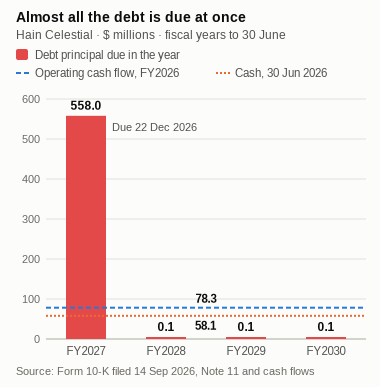
The debt due in December 2026 equals 7.1 years of fiscal 2026 operating cash flow. Operating cash flow for the five fiscal years 2022 to 2026 was $80.2 million, $66.8 million, $116.4 million, $22.1 million and $78.3 million, which adds up to $363.8 million, still less than the amount due in one day. The $185.9 million of unused revolver capacity does not help, because it expires on the same date. Hain cannot repay from its own resources. It needs lenders to extend or refinance, a buyer for assets, or new capital. The company says so directly in its risk factors: without an extension or refinancing it does not currently expect to be able to repay the credit agreement in full at maturity.
Floating rates, swaps, security and covenants at Hain#
- Floating rate. The loans pay Term SOFR plus 4.00%. The margin was 2.5% after a 2023 amendment, rose to 3.00% in May 2025 and to 4.00% in September 2025, each time as part of amendments that loosened covenants. Higher margins were part of the price of relief.
- Hedging. Interest rate swaps with a notional amount of $400.0 million fix the rate on about 72% of the credit-agreement principal. The weighted average rate on borrowings was 7.92% before hedges and 7.38% including them. On the $157.95 million not covered by swaps, each 1 percentage point rise in SOFR adds about $1.58 million of yearly interest.
- Security. The loans are secured by liens on assets of the company and its material US subsidiaries, including the shares of their subsidiaries and intellectual property. Lenders have a senior claim on those assets.
- Maintenance covenants. After the September 2025 amendment the agreement requires a maximum consolidated secured leverage ratio of 5.50 times, a maximum consolidated leverage ratio of 6.00 times and a minimum consolidated interest coverage ratio of 2.00 times. The risk factors state that a breach could let lenders declare all outstanding debt due immediately.
- Going concern. Note 1 ties the substantial doubt to the uncertainty about refinancing or repaying the debt due on 22 December 2026. Shareholders' equity was only $154.8 million on 30 June 2026.
What happened next, as of 26 November 2026#
The quarterly report on Form 10-Q for the quarter ended 30 September 2026, filed on 9 November 2026, shows the position getting tighter. Debt under the credit agreement rose to $586.1 million, cash was $63.0 million, and operations used $18.9 million of cash in the quarter. In September 2026 Hain agreed to sell its International business. The sale required an amendment extending the loan maturity by at least nine months by 12 October 2026, and a Form 8-K filed on 15 October 2026 says that condition was not met. The 10-Q still reports substantial doubt and puts expected net sale proceeds at $301.6 million to $306.5 million, which would leave $279.6 million to $284.5 million of credit-agreement debt even if all of it went to repayment. As of 26 November 2026, Hain's filings did not report an extension or refinancing. Check the latest 8-Ks before relying on this example, because the outcome may already be known.
Worked example: how a rate reset changes interest cover (synthetic data)#
A rate reset can push a company from comfortable to in breach without its business changing at all. This invented example, Example Foods, was designed to show that. Amounts are in millions of dollars.
- EBITDA is 100 and depreciation is 30, so EBIT is 70.
- Debt is a 300 term loan at SOFR plus 3.00% and 200 of fixed-rate notes at 5.00%. Cash is 50, so net debt is 450.
- The loan agreement requires EBITDA of at least 2.0 times interest and net debt of at most 5.0 times EBITDA.
| Scenario | Interest | EBIT ÷ interest | EBITDA ÷ interest | Net debt ÷ EBITDA |
|---|---|---|---|---|
| A. Base: SOFR 1%, so the loan costs 4% (12.0), notes 10.0 | 22.0 | 3.18× | 4.55× | 4.5× |
| B. SOFR rises to 5%, so the loan costs 8% (24.0) | 34.0 | 2.06× | 2.94× | 4.5× |
| C. As B, and the notes mature and are refinanced at 9% (18.0) | 42.0 | 1.67× | 2.38× | 4.5× |
| D. As C, and EBITDA falls 20% to 80 | 42.0 | 1.19× | 1.90× | 5.6× |
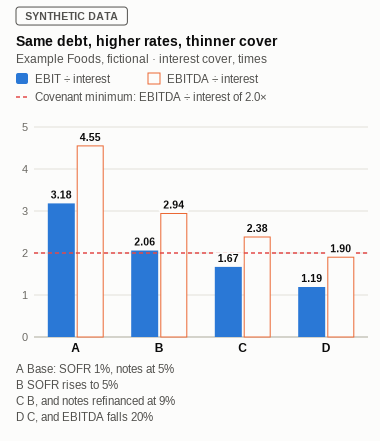
Reading it. Between A and C the business is unchanged and the debt is the same size, but interest rises from 22 to 42 and EBITDA cover falls from 4.55 to 2.38. The company still passes its covenants, with little room. In D an ordinary bad year cuts EBITDA to 80: cover falls to 1.90, below the 2.0 minimum, and net debt rises to 5.6 times EBITDA, above the 5.0 maximum. Lenders could now demand repayment or charge for a waiver. Notice that net debt to EBITDA did not move until earnings fell, so a leverage ratio alone would have missed the rising interest burden in B and C.
What could change the conclusion about debt risk?#
Lenders often extend rather than enforce. Many companies near a maturity wall agree an amend-and-extend deal: a later maturity in exchange for fees, a higher margin, partial repayment or more collateral. The risk does not vanish, but it moves to a later date at a higher cost. The three amendments Hain's 10-K describes, from August 2023, May 2025 and September 2025, loosened covenants and raised the margin but left the December 2026 maturity unchanged, which is why the maturity itself became the problem.
Asset sales and new money can close the gap, at a price. Selling a division turns assets into cash for lenders. New shares or convertible securities can also repay debt, but they dilute existing shareholders, which is the subject of How does dilution happen, and how do I spot it in a filing?. In a court-supervised restructuring, lenders may end up owning the company, and existing shares may be cancelled.
Reported ratios and covenant ratios differ. Covenant definitions can add back restructuring costs, expected savings or other items, so a company can pass its covenants while reported numbers look alarming, as Hain did. Read the amendments, usually filed as exhibits to 8-Ks or 10-Qs.
Low ratios can hide a near maturity, and high ratios can be manageable. A company with modest leverage can still default if a large bond comes due when credit markets are closed, while a heavily indebted one with fixed rates, long maturities and stable cash flow may carry its debt for years.
Debt is not the only fixed obligation. Leases, pension promises and purchase commitments also take cash on fixed dates. Some analysts add lease liabilities to debt. Say which convention you use.
Check your understanding: a bond refinancing at a higher rate#
Question. A company has EBITDA of $150 million and depreciation of $50 million. It owes $400 million on a floating-rate loan currently costing 7% (SOFR of 4% plus a 3% margin) and $300 million of bonds paying 4%, which mature in eight months. It holds $100 million of cash. Its loan agreement requires EBITDA of at least 3.0 times interest and net debt of at most 4.5 times EBITDA.
- What are its interest cover (EBITDA and EBIT versions) and net debt to EBITDA today?
- If it refinances all the bonds at 9%, does it still meet the interest-cover covenant?
- Suppose it instead uses all $100 million of cash to repay part of the bonds and refinances the remaining $200 million at 9%. What happens to each covenant?
Show the answers
Answer.
- Interest is 400 × 7% + 300 × 4% = 28 + 12 = $40 million. EBITDA cover is 150 ÷ 40 = 3.75 times. EBIT is 150 − 50 = 100, so EBIT cover is 2.5 times. Net debt is 700 − 100 = 600, which is 600 ÷ 150 = 4.0 times EBITDA. Both covenants pass.
- The bonds would cost 300 × 9% = 27 instead of 12, so interest rises to 28 + 27 = $55 million. EBITDA cover falls to 150 ÷ 55 = 2.73 times, below the 3.0 minimum. The business has not changed, yet refinancing at today's rates would put the company in breach.
- Interest becomes 28 + 200 × 9% = 28 + 18 = $46 million, and EBITDA cover is 150 ÷ 46 = 3.26 times, which passes. Net debt stays at 600 (debt of 600, no cash), so leverage is still 4.0 times. The trade-off: the company now has no cash cushion, and a fall in EBITDA of about 8% would breach the cover test again (3.0 × 46 = 138). A reader would check the maturity schedule, the credit agreement's own definition of EBITDA, and whether any undrawn credit line outlives the bonds.
Related lessons#
- Before this lesson: How can a profitable company run short of cash?
- Next: How does dilution happen, and how do I spot it in a filing?, which covers the new shares that companies often issue to repair their balance sheets.
- See also: Is this stock cheap? What each valuation multiple assumes, which shows how debt enters enterprise value, and What does a balance sheet tell me?
- See also: Where do I find a company's numbers?