What is a tokenized stock, and what does the holder actually own?
Short answerA tokenized stock is a blockchain token whose price tracks a company's share. Usually the holder does not own the share: what you own depends on who issued the token and how. As of 26 November 2026, three structures cover the main products:
- A certificate backed by shares: a debt claim on an issuer that holds the shares, such as Backed's xStocks.
- A broker's derivative: a contract with a broker, such as Robinhood's Classic Stock Tokens in the EU.
- The share recorded onchain: the share itself, recorded by the company's transfer agent, such as Galaxy Digital's Class A stock.
Only the last carries a shareholder vote. The first two give price exposure, handle dividends their own way, cannot be swapped for the share and are not offered to US persons.
Before buying one, read its legal description to see whose promise you would hold and whether a vote, dividends or the share itself come with it.
Scope note: Valmy v1 trades crypto on Binance Spot and USDⓈ-M futures and offers no shares, tokenized stocks or stock derivatives. This lesson describes products offered by others, as of 26 November 2026, so you can tell what each one's holder owns. It does not recommend any of them.
Three structures behind tokenized stocks#
The useful question about any tokenized stock is: against whom do I have a claim, and for what? The US SEC staff published a statement on tokenized securities on 28 January 2026. It sorts them into two groups. The first is securities tokenized by their own issuer. The second is securities tokenized by unaffiliated third parties, either as custodial tokens, which represent an indirect interest in a share someone holds, or as synthetic tokens. A synthetic token is a security or swap that the third party issues itself, and the staff says such a security "confers no rights or benefits" from the company it references. The statement is a staff view, not a rule, but its categories line up with the products below:
| Structure | Example (as of 26 November 2026) | What the holder owns legally |
|---|---|---|
| Certificate backed by shares | Backed xStocks; Robinhood Stock Tokens (Jersey issuer) | A debt claim on the token's issuer for a cash amount tied to the share |
| Broker derivative | Robinhood Classic Stock Tokens (EU) | A derivative contract with the broker |
| Share recorded onchain | Galaxy Digital Class A common stock | The company's share, in token form |
Products change quickly, and their terms differ by country. Each section below states the documents and dates it relies on.
Certificates backed by shares: Backed's xStocks#
An xStocks token is a tracker certificate: a debt security of Backed Assets (JE) Limited, a company incorporated in Jersey, that tracks one share or fund. The issuer buys the underlying shares and holds them as collateral. The holder has a claim on the issuer for a cash redemption amount linked to the share price, not a claim on the shares. These terms come from Backed's base prospectus dated 8 May 2026, which the Liechtenstein Financial Market Authority approved under the EU Prospectus Regulation and notified to other European Economic Area (EEA) countries. The prospectus says the following:
- No shareholder rights. Holders have no dividend, voting or pre-emption rights in the underlying company. They cannot demand delivery of the shares: redemptions are paid in cash or crypto.
- Dividends are reinvested. Dividends the issuer receives are used to buy more of the underlying. Kraken, which sells xStocks, explains this as a multiplier: each token comes to represent slightly more than one share. Its FAQ (updated 11 November 2026) says US dividends are reinvested after 30% withholding tax.
- Custody and collateral. The prospectus names InCore Bank AG in Switzerland and Alpaca Crypto LLC in the United States as custodians for different products. A security agent acts for investors over the collateral.
- Redemption goes through the issuer. An investor must pass the issuer's identity and anti-money-laundering checks (known as KYC and AML), and the issuer may reject a request. Payment can take until the fifth business day. The prospectus allows a surcharge of up to 5% on issuance or redemption. It also allows a management fee of up to 5% a year. The figures for a specific product are in its final terms.
- Where it is sold. Not to US persons. Kraken's FAQ also excludes Canada, the UK and Australia.
On 2 December 2025, Kraken announced it would acquire Backed Finance AG, the issuer's parent. The prospectus says the purchase by Kraken's group (Payward) closed around 5 January 2026. The issuer is unchanged, but it now relies on Payward for technical and operational services under an agreement, and the prospectus flags the resulting conflict of interest.
Robinhood's Stock Tokens outside the EU app follow the same pattern. Robinhood announced them on 1 July 2026. Its documentation describes them as debt securities of Robinhood Assets (Jersey) Limited, issued as tokens and held in the Robinhood Wallet. They give no legal or beneficial rights in the shares, reinvest dividends through a multiplier and can be redeemed with the issuer after KYC. They are not available in the United States, Canada, the UK or Switzerland.
A broker's derivative: Robinhood's Classic Stock Tokens in the EU#
Each of Robinhood's Classic Stock Tokens is a derivative contract you hold with Robinhood, offered in the EU and EEA under MiFID II, the EU's main investment-services law. The holder does not own the shares. These details come from Robinhood Europe's help pages, checked 26 November 2026:
- Who you face. The counterparty is Robinhood Europe, UAB, which is authorized by the Bank of Lithuania. The underlying assets are held by a US-licensed institution that the pages do not name.
- No vote. The FAQ says holders do not own the stock and do not have shareholder rights such as voting.
- Dividends in cash. Eligible dividends are paid automatically as a cash distribution in euros, and tax withholding may apply. Stock splits change the number of tokens.
- No way out except selling. Tokens cannot be sent to other wallets or platforms. Holders can buy, sell or hold them in the app.
- Hours. Trading runs from Monday 02:00 to Saturday 02:00 Central European Time and closes on listed US market holidays. That is 24 hours a day, five days a week. A 0.10% currency-conversion fee applies to each order.
Robinhood launched the product on 30 June 2025, and said the tokens were issued on Arbitrum, a blockchain network. The current help pages do not name a chain. Because the token cannot leave the app, the blockchain record matters less to the holder than the contract with Robinhood.
The share recorded onchain: Galaxy Digital's Class A stock#
Here the token is not a claim on anyone else: it is the share. On 3 September 2025, Galaxy Digital announced that its Class A common stock could be held as tokens on the Solana blockchain. The official record of who owns those shares is kept onchain by Superstate, a transfer agent registered with the SEC, so when a token moves from one approved wallet to another, the register changes with it. Galaxy's release, which it filed with the SEC, says the tokens are "not derivatives or representations": each one is a Class A share, carrying the full rights of one.
The limits are practical, not legal:
- Only approved holders. Only investors who pass Superstate's identity checks can hold the token. Galaxy's own explainer says their wallets must be on an approved list, called an allowlist.
- Limited trading. Galaxy's explainer says the tokenized shares can move only between allowlisted wallets, not through decentralized exchanges. The listed shares keep trading on Nasdaq.
- Converting back. A holder can move shares between the token form and a brokerage account through the transfer agents, much like the direct registration described in What do I own when I buy a share through a broker?.
Galaxy's 10-Q for the quarter to 30 September 2026 still lists the tokenized shares among its risk factors. One more development is often confused with this structure. DTC's tokenization service, live since 28 October 2026, lets DTC participants hold tokenized records of street-name positions. It is not open to retail investors directly.
How the three structures compare#
The three structures differ most on votes, dividends, getting the share itself and moving the token. The figure summarizes the documents above. Filled circles mean yes, hollow circles no and half-filled partly.
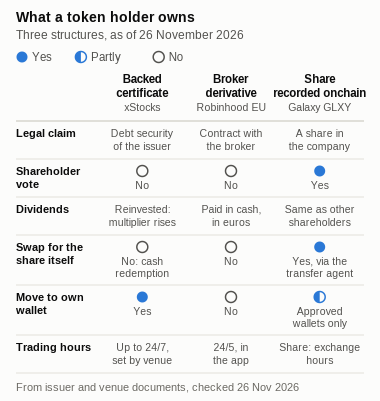
| Question | Backed certificate (xStocks) | Broker derivative (Robinhood EU Classic) | Share onchain (Galaxy) |
|---|---|---|---|
| What you own | Debt security of the issuer | Contract with the broker | The share |
| Shareholder vote | No | No | Yes |
| Dividends | Reinvested via a multiplier | Paid in cash, in euros | As for other shareholders |
| Swap for the share | No, cash redemption via the issuer, with KYC | No | Yes, via the transfer agent |
| Move to your own wallet | Yes | No | Approved wallets only |
| Trading hours | Up to 24/7, set by each venue | 24/5 in the app | Share: exchange hours |
The risks a token adds to the share's own risk#
A token holder carries the share's price risk plus the risks of whatever stands between them and the share. Which extra risks apply depends on the structure:
- Issuer, custodian and counterparty risk. A backed certificate is a promise from its issuer, secured by shares that a custodian holds, so a failure at either can cost holders money (the next subsection walks through it). A broker derivative rests on the broker instead: Robinhood warns that its insolvency could cost investors everything they put in.
- Smart-contract and key risk. Tokens that move onchain depend on the token contract and the issuer's private keys. Backed's prospectus lists hacking and theft, and bugs in smart contracts, among its risk factors.
- Liquidity and price gaps. A token's market can be much thinner than the share's, and it can trade when the share cannot. The issuer's ability to issue and redeem, which normally keeps the price in line, depends on buying and selling the shares in exchange hours. Backed's prospectus rates this "limited trading hours" risk as high. It also lets the issuer handle all issuance and redemption in a single daily round, priced at the market close rather than when each request arrives.
- Access risk. Rules on who may hold or redeem differ by country and can change. A holder who moves country may lose access.
What a certificate holder faces if the custodian or issuer fails#
If a firm behind a backed certificate such as an xStocks token fails, the holder does not end up with shares. They become a creditor, waiting on someone else's insolvency process for money. Backed's base prospectus (8 May 2026) describes three cases:
- The custodian fails. Getting at the shares it holds as collateral could take a long time or prove impossible, and holders could lose part or all of what they paid.
- The issuer fails. A security agent acting for holders sells the collateral set aside for that product. The agent, the custodian and the payments firm are paid their claims and the sale costs first, and holders share what is left in proportion to their holdings. Collateral backing other products is out of reach, and the holder has no further claim on the issuer's other assets.
- Another firm in the chain fails. The issuer depends on other companies, including the bank or securities firm that handles its payments and Kraken's group, which runs its token technology. Trouble at one of them can reach holders through the issuer.
Kraken's group owns the issuer, but the prospectus says it has not guaranteed the issuer's obligations. A holder of a share in street name faces a different chain: the protections in What do I own when I buy a share through a broker?, such as SIPC, apply to a US broker's customers, not to a token issuer's creditors.
Worked example: a token that trades through a US market holiday (synthetic data)#
This invented example shows why a token's price can drift away from the share's last price while the stock market is shut, and why the gap is not free money. The assumptions are kept simple:
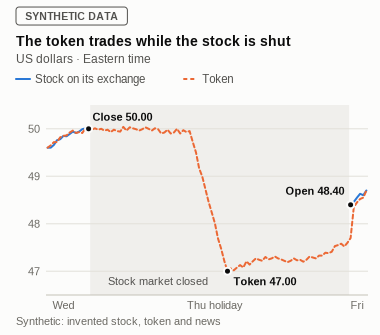
- An invented stock closes on Wednesday at $50.00. Thursday is a US market holiday, so no US venue trades it.
- A backed certificate on the stock, with a multiplier of 1.0000 (one token per share), trades 24/7 on a crypto venue.
- On Thursday morning, invented company news appears. The token falls to $47.00 by Thursday 14:00 and is at $47.60 just before Friday's open.
- The stock opens on Friday at $48.40. Ignore fees and the spread.
Measuring the gap against the last close#
At its low, the token was 47.00 ÷ 50.00 − 1 = −6.0% below the stock's last close. Just before Friday's open it was 47.60 ÷ 50.00 − 1 = −4.8%. The stock then opened at 48.40 ÷ 50.00 − 1 = −3.2%. While the market is shut, the "last close" is stale: it says what the share was worth before the news, not after.
Who gained and who lost#
- A holder who sold 100 tokens at the low received 100 × $47.00 = $4,700. At Friday's open the same tokens were worth 100 × $48.40 = $4,840, so selling early cost $140 compared with waiting.
- The buyer at the low gained $1.40 a token by the open, 1.40 ÷ 47.00 = 2.98%.
- A shareholder could not trade at all on Thursday. They took the −3.2% at the open.
- A holder who sold just before the open at $47.60 got $0.80 a token less than the opening price.
Had the stock opened at $46.00 instead, the seller at the low would have been the winner. The token price was a forecast made by whoever traded on the venue that day, not a guaranteed value.
Why arbitrage did not close the gap. Normally, if a backed token trades below the share, a firm can buy tokens and redeem them with the issuer for the share's value. On a holiday that does not work. The issuer can sell the collateral shares only when the market reopens, at whatever price prevails then. A redemption may take up to five business days, and the redeeming party must have passed the issuer's checks. A firm buying at $47.00 on Thursday was taking the same risk as any other buyer.
How a reinvested dividend changes the multiplier#
Suppose the company pays a dividend of $0.50 a share. The issuer receives it after 30% US withholding tax, which leaves 0.50 × (1 − 0.30) = $0.35 a share, and reinvests it at a share price of $50.00. Each token gains 0.35 ÷ 50.00 = 0.0070 shares, so the multiplier rises from 1.0000 to 1.0070. A holder of 100 tokens now has exposure to 100 × 1.0070 = 100.70 shares. At $50.00 that is $5,035, which is $35 more than before, exactly the net dividend on 100 shares. The holder receives no cash, and how the increase is taxed depends on where they live.
What could change the conclusion about a tokenized stock?#
The documents can change. Prospectuses are approved for a year at a time, and supplements can change the terms. Backed's prospectus is valid until 7 May 2027. Robinhood lists a supplement dated 9 November 2026 to its Jersey prospectus, which this lesson did not review. Read the current version before relying on any term here.
The venue matters as much as the token. The same xStocks certificate can trade 24/7 on one venue and only five days a week on another, with different fees and depth. Kraken's FAQ, for example, lists ten xStocks that trade 24/7 on Kraken Pro, while the others trade 24/5.
Where you live decides what you can buy and redeem. US persons are excluded from both certificate programs and from the EU derivative. Redemption rights may be limited to investors the issuer has onboarded.
A token being onchain does not make it a share. Of the three structures, only the issuer-recorded share gives shareholder rights. The SEC staff statement makes the same distinction. Read the legal description, not the name or the ticker.
Onchain shares are new. Few holders use Galaxy's onchain share so far, and trading is limited to approved wallets. More issuers may follow, and rules on who can trade them may change.
Check your understanding: a token over a long weekend#
Question. A stock closes on Friday at $80.00. Its backed certificate, with a multiplier of 1.0150, trades through the weekend. After news on Sunday, the token trades at the equivalent of $76.00 per share it represents. On Monday the stock opens at $77.20.
- How far below the last close was the token on Sunday, and how far below it did the stock open?
- On Sunday you sold tokens representing 50 shares at that price. How much less did you receive than the same exposure was worth at Monday's open?
- Later the company pays $1.20 a share. The issuer receives it after 30% withholding and reinvests it at $80.00. What is the new multiplier?
- Could you have asked the issuer for shares instead of selling?
Show the answers
Answer.
- 76.00 ÷ 80.00 − 1 = −5.0% on Sunday. The stock opened 77.20 ÷ 80.00 − 1 = −3.5% below Friday's close.
- 50 × (77.20 − 76.00) = $60.00 less. The Sunday price reflected the news before the stock market could, and in this case it overshot. Had the stock opened at $75.00, selling on Sunday would have been the better choice.
- Net dividend 1.20 × 0.70 = $0.84 a share. Divided by $80.00 that is 0.0105 shares, so the multiplier rises from 1.0150 to 1.0255.
- No. A backed certificate gives a claim for a cash redemption amount, not for delivery of shares. Redemption also requires passing the issuer's checks and would be priced when the market reopens, not on Sunday.
Related lessons#
- Before this lesson: What do I own when I buy a share through a broker?
- Next: When can I trade, and what happens to prices outside market hours? and What are perpetuals and other derivatives that track stocks?
- See also: What does a token holder actually own?, the same question for crypto tokens, and What makes a market liquid, and why does it matter for my order?