What are perpetuals and other derivatives that track stocks?
Short answerA derivative that tracks a stock lets you gain or lose from its price without owning it. As of 26 November 2026 the main kinds are:
- Listed equity options, which typically cover 100 shares per standard US contract and give the holder a choice about exercising
- Dated single-stock futures, agreements on the value of a share at a specified future date
- Contracts for difference (CFDs) with a broker, restricted for EU retail clients since 2018 and generally not offered to US retail investors
- Perpetual futures on stocks listed by crypto venues
Holding the contract alone gives you neither a share nor a shareholder vote. Shares can change hands later if the contract calls for physical delivery. A contract can also pass along the economic effect of a dividend through a cash adjustment. When the contract’s reference feed has no fresh eligible share price, the venue’s fallback and funding rules matter most.
Stock derivatives are a reference topic in Valmy’s private paper beta. The venue examples describe how contracts work. The beta’s paper strategies use eligible crypto instruments.
What every derivative on a stock has in common#
A derivative on a stock is a contract whose value depends on the share price. You hold the contract, not the share. Your result depends on the contract. A future tracks price changes times the position size. An option also has a strike, a premium and an expiry. The share itself stays with whoever holds it. That has three consequences that apply to every product in this lesson:
- No shareholder rights. You have no vote and no claim on the company. The SEC staff statement on tokenized securities (28 January 2026) says a security-based swap typically gives its holder no equity, voting or information rights in the referenced company. The same is true of options, futures and CFDs.
- Dividends are handled by the contract, if at all. An option holder receives no dividend. A perpetual may adjust for it through a payment between longs and shorts, or not at all. The rules differ by venue and are covered below.
- You face a counterparty. A clearinghouse stands between buyers and sellers of a centrally cleared contract. With a CFD you face the broker. On a crypto venue, check the contract’s rules for who bears a loss if the other side cannot pay. Most of these products also use leverage: you post margin worth a fraction of the position, and losses beyond it can force the position to close. See What does leverage change, and when is a position liquidated?
Listed options on stocks#
An option gives its buyer the right, but not the obligation, to buy (a call) or sell (a put) a stock at a set price, the strike, until or on an expiry date. The buyer pays a price for that right, called the premium. US-listed equity options are issued and cleared by the Options Clearing Corporation (OCC), and its education site says one contract usually represents 100 shares. An option holder owns no shares unless they exercise the option, and receives no dividends before then.
Dated futures on a single stock#
A dated single-stock future sets a contract price and a delivery or cash-settlement date. The buyer and seller post margin. Gains and losses are credited or debited as the contract price moves. For a hypothetical contract covering ten shares, a move from $50 to $52 credits the long $20 before fees and debits the short the same amount.
One historical US example is OneChicago, an exchange for security futures that stopped trading on 18 September 2020. Its contracts had expiration dates. For a perpetual, there is no scheduled expiry, so the link to the share price depends on the venue’s index and funding rules.
Contracts for difference (CFDs)#
A CFD is a contract with a broker that pays the difference between a stock's price when you open the position and when you close it. You never own the stock, and the broker is your counterparty.
In the EU, the European Securities and Markets Authority (ESMA) agreed restrictions on CFDs for retail clients on 27 March 2018. They applied from 1 August 2018:
- Leverage limits when opening a position: 30:1 for major currency pairs; 20:1 for other currency pairs, gold and major indices; 10:1 for other commodities and minor equity indices; 5:1 for individual shares; and 2:1 for cryptocurrencies. At 5:1, a 10,000 euro position in one share needs at least 2,000 euros of margin.
- A margin close-out rule: the broker must close positions when the account's margin falls to 50% of the required minimum.
- Negative balance protection: a retail client cannot lose more than the money in the account.
- A standard risk warning and limits on incentives to trade.
ESMA stopped renewing its own measures on 31 July 2019 because most national regulators had adopted permanent rules at least as strict.
In the United States, the Securities Exchange Act makes it unlawful to enter into a security-based swap, a category that includes a swap on a single stock, with someone who is not an eligible contract participant unless it is traded on a registered national securities exchange. Eligible contract participants are mainly institutions and wealthy individuals. The SEC (in 2018) and the CFTC (in 2019) brought cases against a platform that offered such contracts to US customers, and the SEC acted against another in 2020. In practice, single-stock CFDs are generally not offered to US retail investors.
Perpetual futures on stocks at crypto venues (as of 26 November 2026)#
Several crypto venues list perpetual futures on US stocks, settled in stablecoins and often traded around the clock. A perpetual has no expiry date and uses funding to stay close to an index. These venues exclude US persons, and each sets its own leverage, hours, index and dividend rules. What is a perpetual future, and what does funding do? explains funding for crypto perpetuals. The table summarizes what each venue's own documents said on 26 November 2026:
| Venue | Settlement and leverage | Hours | Index outside the reference market’s hours | Funding and dividends |
|---|---|---|---|---|
| Binance (USDⓈ-M "TradFi" perpetuals) | USDT; up to 20x for contracts listed on 20 November 2026 | 24/7 | An exponentially weighted average (EWMA) of Binance's own order-book mid price, for equities since 16 May 2026. It previously stayed fixed at the last value. | Every 8 hours, capped at ±2.00% for those listings. Dividends are passed on through a special funding payment from shorts to longs. |
| OKX | USDT; up to 5x | 24/7 | Relies more on OKX's own contract price and other venues' stock perpetuals, kept within 10% of the stock price | Every 8 hours, capped at ±1.50% |
| Kraken (xStocks perpetuals) | Up to 20x | 24/7 | Uses the price of the xStocks token, which keeps trading | Not stated on the launch page |
| trade.xyz on Hyperliquid | USDC; for example up to 20x on TSLA | 24/7, with an external price from Sunday 20:05 to Friday 20:00 Eastern | An EMA of trade.xyz's own prices with a 30-minute time constant, starting from the last external price | Hourly. Holders do not receive dividends directly. |
Every row can change, and leverage often differs from one contract to the next on the same venue.
What happens to a stock perpetual when the stock market is closed#
An index follows the price sources named in the contract. When its reference market closes or its feed has no fresh eligible trade, the contract needs a fallback. A share might still trade in an extended session or on another venue. That trade only enters the index if its rules include that source and session. The fallback changes the gap between the contract price and index, which in turn can change funding. Compare two published designs with a hypothetical third case.
- Freeze the index at the last price. This was Binance's "Fixed" mode for equities until 16 May 2026. If news moves the perpetual, its premium to a stale index becomes large, and funding pushes it back toward the old price.
- Let the index follow the venue's own market. Binance's current EWMA mode and trade.xyz's internal EMA work this way. The contract can move on news. An index that also moves toward the venue price can narrow the premium used to calculate funding. An order in a thin book can move both the price and its reference.
- Pause both trading and funding (hypothetical). Suppose a contract closes on Friday and resumes alongside the stock. A holder cannot trade during the break and pays no funding for it. News can still move the price sharply at the reopening.
When the contract’s eligible external price feed resumes, the venue’s rules determine how the index returns to that feed. Binance says the switch completes within a minute. trade.xyz says its oracle reverts to the external price on the next update. The perpetual's own traded price is not reset: funding and traders who arbitrage the gap pull it toward the index, which can take time when the book is thin. A leveraged position that survived the weekend can still be liquidated at the open if the stock opens far from where the perpetual traded. The mark price is the price used to value positions and trigger liquidations. Binance's FAQ sets caps on how far the mark price of its equity perpetuals may deviate: ±5% during US sessions and ±3% at weekends and holidays.
Worked example: funding and a gap on a stock perpetual over a weekend (synthetic data)#
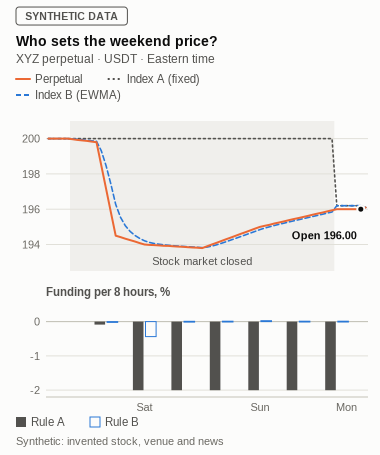
This invented example compares the first two designs on the same weekend. It was designed to show how the index rule changes who pays funding. The assumptions:
- An invented stock, XYZ, closes Friday at $200.00. Assume extended-hours trading that evening stays at $200.00, and that no outside price exists from Friday 20:00 to Monday 04:00 Eastern time.
- A USDT-settled perpetual on XYZ trades 24/7. After invented news early on Saturday, it falls to about 194, bottoms at 193.80 and recovers to 196.00. On Monday, the stock is quoted at $196.20 before the market opens and opens at $196.00.
- A trader opens a short of 10 contracts (one share each) at 200.00 on Friday at 20:00 and closes it at Monday's open, 196.00.
- Funding is settled every 8 hours: seven times over the weekend, from Saturday 04:00 to Monday 04:00. The rate per settlement is the average premium + clamp(0.01% − average premium, −0.05%, +0.05%), then capped at ±2.00%. This is a simplified version of the formula in the perpetual-futures lesson, with hourly premium samples and the cap of Binance's November 2026 stock listings. A negative rate means shorts pay longs. Each payment is the rate times 10 contracts times the perpetual's price at that settlement, which stands in for the mark price.
- Rule A freezes the index at 200.00. Rule B sets the index to an hourly EWMA of the perpetual's own price with a 2-hour time constant, starting at 200.00.
Calculating one funding settlement: Saturday 12:00#
From Saturday 04:00 to 12:00 the perpetual averaged 194.84, and at 12:00 it traded at 194.00, so 10 contracts were worth 10 × 194.00 = 1,940 USDT.
- Rule A. The average premium was 194.84 ÷ 200.00 − 1 = −2.58%. The clamp adds +0.05% (because 0.01% − (−2.58%) is above 0.05%), giving −2.53%. The cap limits that to −2.00%. The short pays 2.00% × 1,940 = 38.80 USDT.
- Rule B. The EWMA index averaged 195.80 over the same hours, because it was still catching up with the fall. The average premium was −0.49%, and the rate −0.44% after the clamp. The short pays 0.437% × 1,940 = 8.48 USDT.
The whole weekend under both rules#
Over the seven weekend settlements, the short pays 235.46 USDT under rule A and 7.59 USDT under rule B. Under rule A, six of the seven rates hit the −2.00% cap.
| Settlement (Eastern) | Average perpetual | Rule A rate | Rule A, short pays (USDT) | Rule B average index | Rule B rate | Rule B, short pays (USDT) |
|---|---|---|---|---|---|---|
| Sat 04:00 | 199.72 | −0.09% | 1.75 | 199.86 | −0.02% | 0.33 |
| Sat 12:00 | 194.84 | −2.00% | 38.80 | 195.80 | −0.44% | 8.48 |
| Sat 20:00 | 193.94 | −2.00% | 38.77 | 194.02 | +0.01% | −0.14 |
| Sun 04:00 | 193.90 | −2.00% | 38.84 | 193.88 | +0.01% | −0.19 |
| Sun 12:00 | 194.55 | −2.00% | 39.00 | 194.40 | +0.03% | −0.49 |
| Sun 20:00 | 195.22 | −2.00% | 39.10 | 195.10 | +0.01% | −0.20 |
| Mon 04:00 | 195.72 | −2.00% | 39.20 | 195.62 | +0.01% | −0.20 |
| Total | −12.09% | 235.46 | 7.59 |
A negative number in a "short pays" column means the short received funding. The Saturday 20:00 row under rule B shows that a discount alone does not reverse funding: the perpetual averaged 0.04% below its index, yet the clamp lifted the rate to +0.0071%, so longs paid and the short received 0.14 USDT. With this formula, shorts pay longs only when the average premium is below −0.05%.
What the short made or lost#
The short was right about the direction: 10 × (200.00 − 196.00) = 40.00 USDT of price gain at Monday's open.
- Under rule A it paid 235.46 USDT of funding, so the weekend lost 40.00 − 235.46 = −195.46 USDT. A frozen index treats every weekend move as a premium to be corrected. In a market with this rule, traders would be paid about 2% every 8 hours to buy the perpetual. That buying would likely have pulled its price back toward 200, so the perpetual's weekend price would have said little about the news.
- Under rule B it paid 7.59 USDT, for a net gain of 40.00 − 7.59 = 32.41 USDT. The perpetual could reflect the news, but its weekend price came only from the traders on that venue.
- Under the hypothetical weekend pause, the short has no funding payments. Its gain at reopening is 10 × (200 − 196) = 40.00 USDT before fees. The holder would have had no opportunity to close the contract on Saturday.
The fictional price path is the same in all three comparisons. The contract’s index, funding and trading-hour rules determine which payments would occur while its regular reference feed is closed.
What could change the conclusion about stock derivatives?#
Venue rules change quickly. Binance changed its weekend index for stocks in May 2026, and listings, leverage and funding caps vary by contract. Every venue fact in this lesson is as of 26 November 2026. Check the contract specification before trading.
Dividends and corporate actions are handled differently. Binance's published method pays a cash dividend through a one-off funding payment, at the rate −D ÷ M, where D is the dividend per share and M the mark price. Shorts pay longs, and the usual funding cap does not apply. For US stocks it runs at 20:00 Eastern on the day before the ex-dividend date. trade.xyz says holders do not receive dividends directly, and it settles positions and reopens the market after a stock split. A position held over an ex-dividend date or a split can behave differently from the share.
Who may trade depends on where you are. The crypto venues above exclude US persons, and some also exclude other countries, such as Canada and the UK. CFDs are restricted for EU retail clients and generally unavailable to US retail investors.
Weekend liquidity can be thin. When the usual reference feed is closed, a venue may rely on a thin weekend order book. A large order can move the price that sets both the index and liquidations. See What makes a market liquid, and why does it matter for my order?
Venue and collateral risk come on top. A perpetual on an offshore crypto venue depends on that venue staying solvent and on the stablecoin used as collateral.
Check your understanding: dividends and a frozen index#
Question.
- A venue uses Binance's published dividend method. A stock perpetual's mark price is 160.00 USDT, and the stock pays a dividend of $0.80 a share. What is the special funding rate, and what does a trader who is short 20 contracts (one share each) pay?
- On another venue the index is frozen at 160.00 over a weekend. During one 8-hour interval the perpetual averages 156.00 and trades at 156.00 at the settlement. Using this lesson's simplified formula, with its ±2.00% cap, what rate applies? What does a long of 20 contracts receive, and what might other traders do?
- In a quieter interval on the same venue, the perpetual averages 159.96 and trades at 159.96 at the settlement, slightly below the frozen index. What rate applies, and does the long of 20 contracts pay or receive?
Show the answers
Answer.
- Rate = −0.80 ÷ 160.00 = −0.50%. The short pays 0.50% × 20 × 160.00 = 16.00 USDT, which equals 20 × $0.80, the dividend on 20 shares. The long receives the same amount. That compensates the long for the drop in the share price when the stock goes ex-dividend, but the long receives no dividend from the company.
- Premium = 156.00 ÷ 160.00 − 1 = −2.50%. The clamp adds 0.05%, giving −2.45%, and the cap limits it to −2.00%. The long receives 2.00% × 20 × 156.00 = 62.40 USDT. At that rate, traders are paid to buy the perpetual and sell it later, which tends to push its price back toward the frozen index. The weekend price then reflects the funding rule more than the news.
- Premium = 159.96 ÷ 160.00 − 1 = −0.025%. The clamp term is 0.01% − (−0.025%) = 0.035%, inside ±0.05%, so the rate is −0.025% + 0.035% = +0.010%. The rate is positive, so the long pays 0.010% × 20 × 159.96 ≈ 0.32 USDT even though the perpetual trades below the index. A small discount leaves the base rate in place; shorts pay longs only below an average premium of −0.05%.
Related lessons#
- Before this lesson: What is a perpetual future, and what does funding do? and What is a tokenized stock, and what does the holder actually own?
- Next: When can I trade, and what happens to prices outside market hours?
- See also: Why does a futures price drift from the spot price? Mark, index and basis and What do I own when I buy a share through a broker?